

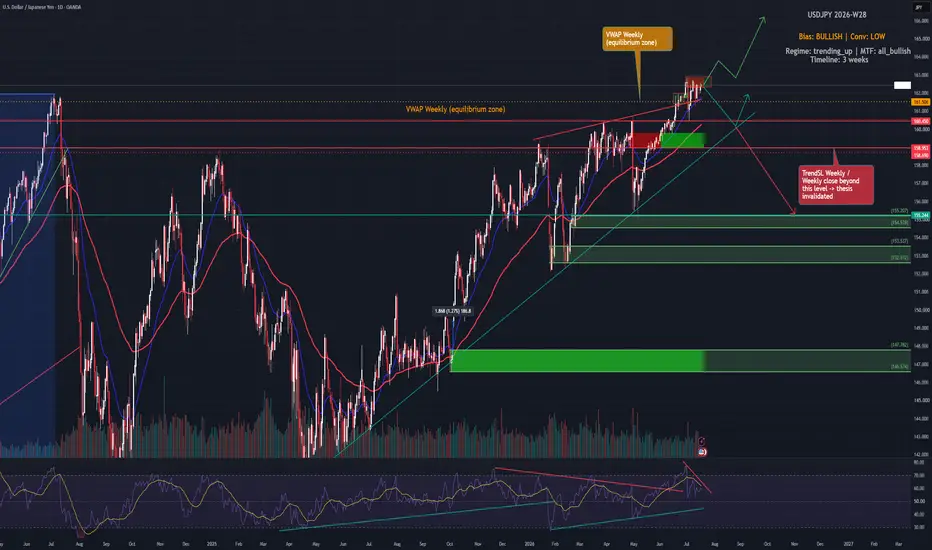
# USDJPY Week W28-2026: Yen Slides Toward 170 as Fed's Waller Reverses Dovish Stance, BOJ-Fed Divergence Keeps Pressure On at 161.51 | 17 July 2026
**Reference data** | week 2026-W28
- Symbol: USDJPY
- Week: 2026-W28
- Bias: bullish
- Conviction: low
- Regime: trending_up
- FX implication: trend_follow
- MTF alignment: all_bullish
- VWAP weekly: 161.505997
- TrendSL weekly: 158.689751
- Close price: 161.505997
- US 10Y yield: 4.56%
- US 2Y yield: 4.21%
- US 10Y real yield: 2.32%
- DXY: bias=bullish, close_price=100.806999
## L0 - Regime Identification
The immediate news backdrop is dominated by two converging catalysts. First, Yen extended its slide toward the 170 level as USDJPY pushed higher, with RSM's Brusuelas flagging Japan's growth bet as the key driver keeping Yen pressured ahead of any BOJ policy pivot. Second, and critically for the USD side of the pair, Fed's Waller reversed his prior dovish stance and signaled openness to further rate hikes if inflation stays hot -- this lifted US rate-hike odds and helped USD hold its gains even after a softer-than-expected June CPI print. Yen is now hovering near 40-year lows against the dollar, extending a multi-decade downtrend as the BOJ-Fed policy divergence remains the dominant macro backdrop.
The regime is classified as trending_up with moderate confidence (0.70). Price closed exactly at VWAP weekly of 161.51, which is a technically neutral-to-constructive read -- the trend structure remains intact above the TrendSL weekly at 158.69, but closing precisely at VWAP suggests the pair is digesting recent gains rather than accelerating. Compared to a trend-following context, this is consistent with a consolidation phase within an established uptrend rather than a clean breakout continuation.
## L1 - Driver Stack
-> **[STRONGEST] Technical momentum (+2.50):** Multi-timeframe alignment is fully bullish. Price holding above both VWAP weekly (161.51) and TrendSL weekly (158.69) keeps the structural bid intact. This is the single highest-weighted factor in the current scoring.
-> **COT positioning (bullish, +0.80):** Commitments of Traders data leans bullish for USD/short-Yen positioning. However, elevated crowding risk is worth flagging here -- when speculative positioning is stretched in one direction, carry unwind events (triggered by a surprise BOJ move or a sharp risk-off shock) can produce violent reversals even within an uptrend.
-> **Macro tailwinds (+0.30):** Fed hawkishness with real yields rising is USD-bullish on the base side. Waller's reversal reinforces this. BOJ hawkish risk is the most surprising potential event -- a genuine policy pivot would be the primary carry unwind trigger across all JPY crosses (note: this dynamic applies differently to crosses like EURJPY where ECB stance must be layered in separately).
-> **Rate differential:** The US 10Y-2Y spread (4.56% minus 4.21% = 35 bps) is positive and the 10Y real yield at 2.32% is meaningfully positive -- both support USD carry demand over a funding currency like JPY that still operates near zero policy rates.
## L2 - Macro Snapshot
The macro picture for USDJPY is anchored in a widening and persistent rate differential. The US 10Y yield sits at 4.56% and the 2Y at 4.21%, with the 10Y real yield (inflation-adjusted) at 2.32% -- the real yield figure is particularly important because it reflects genuine USD attractiveness rather than nominal carry that could be eroded by inflation expectations. When real yields are this elevated, capital flows tend to favor USD assets, maintaining the structural bid under USDJPY.
On the JPY side, the BOJ has been the most watched central bank for any policy surprise. A genuine hawkish pivot -- rate hike or meaningful adjustment to yield curve control -- would compress the rate differential rapidly and trigger a carry unwind that could unwind months of USDJPY appreciation in days. That risk is not reflected in the current bias but it is the single biggest tail risk in the near term. Waller's hawkish reversal at the Fed, meanwhile, pushes that rate differential wider still, reinforcing the carry trade logic for holding USDJPY longs.
Softer-than-expected June CPI was not enough to flip the narrative -- USD held its gains, which itself is a bullish signal about the resilience of USD demand at current levels.
## L3 - Technical Structure
Close price at 161.51 coincides exactly with VWAP weekly at 161.51. In weekly VWAP terms, this is a neutral anchor point -- price is neither extended above VWAP (which would suggest overextension and potential mean reversion) nor below it (which would flag momentum deterioration). The structure is best read as consolidation at equilibrium within the uptrend.
The TrendSL weekly at 158.69 defines the line in the sand for the bullish structure. There is approximately 280 pips of buffer between current price and that invalidation level. MTF alignment is listed as all_bullish, meaning lower timeframes (daily, 4H) are directionally consistent with the weekly trend -- no divergence is flagged in the data.
With price sitting at VWAP and all timeframes aligned bullish, the technically preferred scenario is a continuation bid on any pullback toward VWAP support, as long as the TrendSL holds on a weekly close basis.
## L4 - Intermarket Cross-Check
DXY (US Dollar Index) carries a bullish bias for W28-2026 with medium conviction, closing at 100.81. This is directly supportive of the USDJPY bullish thesis -- when DXY is biased upward across the board, JPY (as a high-beta funding currency) tends to face the most persistent selling pressure among majors, precisely because the carry trade logic is strongest against low-yield currencies.
The alignment between DXY bullish (medium conviction) and USDJPY bullish (low conviction) is internally consistent but worth noting: DXY carries higher conviction than the individual pair. This could reflect pair-specific uncertainty around BOJ risk that does not apply to DXY as a basket. Traders should treat DXY as a confirming tailwind rather than a sufficient standalone reason to add USDJPY exposure.
## L5 - Event Risk
Key events and scenarios to monitor:
-> BOJ policy meeting / yield curve control adjustment announcement
-> Fed speakers following Waller's hawkish reversal (watch for confirmation or pushback)
-> US CPI and inflation data prints (June CPI already softer, but follow-through data matters)
-> Any significant risk-off event (geopolitical, credit) that could trigger carry unwind across JPY crosses
| Scenario | Probability |
|---|---|
| BOJ delivers surprise hawkish pivot / rate hike | Low |
| Fed confirms Waller's hawkish tilt, rate-hike odds rise further | Moderate |
| US inflation softens materially, reducing rate-hike probability | Low-Moderate |
| Carry unwind triggered by risk-off shock | Low but non-trivial tail risk |
## L6 - Conviction Scorecard
Overall bias is bullish with LOW conviction. This is an important qualifier. The regime is trending_up and the technical structure is intact, but the combination of (a) price sitting exactly at VWAP weekly with no clear directional impulse, (b) COT crowding risk from stretched speculative positioning, and (c) the asymmetric tail risk of a BOJ surprise all argue for caution about sizing. Low conviction does not mean bearish -- it means the risk-reward for aggressive positioning is unfavorable relative to the uncertainty. Trend-following is the indicated approach, not momentum loading.
No explicit prior-week conviction level is available in the data for a direct comparison, but the current narrative of Yen near 40-year lows suggests this uptrend has been in place for an extended period, which itself increases crowding risk even as the structural bias remains upward.
## L7 - Time Horizon
**Near-term (1 week):** Price digesting at VWAP weekly 161.51. Expect range-bound behavior or a mild test of VWAP support. Directional commitment should wait for a clear weekly close above or below this level.
**Timeline / Core window (3 weeks):** The stated timeline for this thesis is 3 weeks. Over this window, the base case is a continuation of the uptrend toward the 170 area flagged by recent commentary, conditional on no BOJ surprise and continued Fed hawkishness. The rate differential and COT positioning support this trajectory, but low conviction caps the expected position size.
**Medium-term (beyond 3 weeks):** The multi-decade downtrend in JPY is a structural backdrop, but at 40-year lows the pair is increasingly exposed to policy normalization risk from the BOJ as political and economic pressure mounts. Medium-term outlook is conditionally bullish but subject to regime change if BOJ credibly pivots.
## L8 - Invalidation Conditions
-> If Weekly close below TrendSL weekly (158.6898): Bullish structure invalidated -- exit longs, reassess
-> If Price sustained below VWAP weekly (161.5060): Short-term momentum against thesis -- reduce size
---
*This analysis is for informational and educational purposes only and does not constitute financial advice.*
#USDJPY #ForexTrading #FX #Yen #JapaneseYen #USD #DollarYen #BOJ #FederalReserve #RateDifferential #CarryTrade #CarryUnwind #MacroFX #TrendFollowing #ForexAnalysis
**Reference data** | week 2026-W28
- Symbol: USDJPY
- Week: 2026-W28
- Bias: bullish
- Conviction: low
- Regime: trending_up
- FX implication: trend_follow
- MTF alignment: all_bullish
- VWAP weekly: 161.505997
- TrendSL weekly: 158.689751
- Close price: 161.505997
- US 10Y yield: 4.56%
- US 2Y yield: 4.21%
- US 10Y real yield: 2.32%
- DXY: bias=bullish, close_price=100.806999
## L0 - Regime Identification
The immediate news backdrop is dominated by two converging catalysts. First, Yen extended its slide toward the 170 level as USDJPY pushed higher, with RSM's Brusuelas flagging Japan's growth bet as the key driver keeping Yen pressured ahead of any BOJ policy pivot. Second, and critically for the USD side of the pair, Fed's Waller reversed his prior dovish stance and signaled openness to further rate hikes if inflation stays hot -- this lifted US rate-hike odds and helped USD hold its gains even after a softer-than-expected June CPI print. Yen is now hovering near 40-year lows against the dollar, extending a multi-decade downtrend as the BOJ-Fed policy divergence remains the dominant macro backdrop.
The regime is classified as trending_up with moderate confidence (0.70). Price closed exactly at VWAP weekly of 161.51, which is a technically neutral-to-constructive read -- the trend structure remains intact above the TrendSL weekly at 158.69, but closing precisely at VWAP suggests the pair is digesting recent gains rather than accelerating. Compared to a trend-following context, this is consistent with a consolidation phase within an established uptrend rather than a clean breakout continuation.
## L1 - Driver Stack
-> **[STRONGEST] Technical momentum (+2.50):** Multi-timeframe alignment is fully bullish. Price holding above both VWAP weekly (161.51) and TrendSL weekly (158.69) keeps the structural bid intact. This is the single highest-weighted factor in the current scoring.
-> **COT positioning (bullish, +0.80):** Commitments of Traders data leans bullish for USD/short-Yen positioning. However, elevated crowding risk is worth flagging here -- when speculative positioning is stretched in one direction, carry unwind events (triggered by a surprise BOJ move or a sharp risk-off shock) can produce violent reversals even within an uptrend.
-> **Macro tailwinds (+0.30):** Fed hawkishness with real yields rising is USD-bullish on the base side. Waller's reversal reinforces this. BOJ hawkish risk is the most surprising potential event -- a genuine policy pivot would be the primary carry unwind trigger across all JPY crosses (note: this dynamic applies differently to crosses like EURJPY where ECB stance must be layered in separately).
-> **Rate differential:** The US 10Y-2Y spread (4.56% minus 4.21% = 35 bps) is positive and the 10Y real yield at 2.32% is meaningfully positive -- both support USD carry demand over a funding currency like JPY that still operates near zero policy rates.
## L2 - Macro Snapshot
The macro picture for USDJPY is anchored in a widening and persistent rate differential. The US 10Y yield sits at 4.56% and the 2Y at 4.21%, with the 10Y real yield (inflation-adjusted) at 2.32% -- the real yield figure is particularly important because it reflects genuine USD attractiveness rather than nominal carry that could be eroded by inflation expectations. When real yields are this elevated, capital flows tend to favor USD assets, maintaining the structural bid under USDJPY.
On the JPY side, the BOJ has been the most watched central bank for any policy surprise. A genuine hawkish pivot -- rate hike or meaningful adjustment to yield curve control -- would compress the rate differential rapidly and trigger a carry unwind that could unwind months of USDJPY appreciation in days. That risk is not reflected in the current bias but it is the single biggest tail risk in the near term. Waller's hawkish reversal at the Fed, meanwhile, pushes that rate differential wider still, reinforcing the carry trade logic for holding USDJPY longs.
Softer-than-expected June CPI was not enough to flip the narrative -- USD held its gains, which itself is a bullish signal about the resilience of USD demand at current levels.
## L3 - Technical Structure
Close price at 161.51 coincides exactly with VWAP weekly at 161.51. In weekly VWAP terms, this is a neutral anchor point -- price is neither extended above VWAP (which would suggest overextension and potential mean reversion) nor below it (which would flag momentum deterioration). The structure is best read as consolidation at equilibrium within the uptrend.
The TrendSL weekly at 158.69 defines the line in the sand for the bullish structure. There is approximately 280 pips of buffer between current price and that invalidation level. MTF alignment is listed as all_bullish, meaning lower timeframes (daily, 4H) are directionally consistent with the weekly trend -- no divergence is flagged in the data.
With price sitting at VWAP and all timeframes aligned bullish, the technically preferred scenario is a continuation bid on any pullback toward VWAP support, as long as the TrendSL holds on a weekly close basis.
## L4 - Intermarket Cross-Check
DXY (US Dollar Index) carries a bullish bias for W28-2026 with medium conviction, closing at 100.81. This is directly supportive of the USDJPY bullish thesis -- when DXY is biased upward across the board, JPY (as a high-beta funding currency) tends to face the most persistent selling pressure among majors, precisely because the carry trade logic is strongest against low-yield currencies.
The alignment between DXY bullish (medium conviction) and USDJPY bullish (low conviction) is internally consistent but worth noting: DXY carries higher conviction than the individual pair. This could reflect pair-specific uncertainty around BOJ risk that does not apply to DXY as a basket. Traders should treat DXY as a confirming tailwind rather than a sufficient standalone reason to add USDJPY exposure.
## L5 - Event Risk
Key events and scenarios to monitor:
-> BOJ policy meeting / yield curve control adjustment announcement
-> Fed speakers following Waller's hawkish reversal (watch for confirmation or pushback)
-> US CPI and inflation data prints (June CPI already softer, but follow-through data matters)
-> Any significant risk-off event (geopolitical, credit) that could trigger carry unwind across JPY crosses
| Scenario | Probability |
|---|---|
| BOJ delivers surprise hawkish pivot / rate hike | Low |
| Fed confirms Waller's hawkish tilt, rate-hike odds rise further | Moderate |
| US inflation softens materially, reducing rate-hike probability | Low-Moderate |
| Carry unwind triggered by risk-off shock | Low but non-trivial tail risk |
## L6 - Conviction Scorecard
Overall bias is bullish with LOW conviction. This is an important qualifier. The regime is trending_up and the technical structure is intact, but the combination of (a) price sitting exactly at VWAP weekly with no clear directional impulse, (b) COT crowding risk from stretched speculative positioning, and (c) the asymmetric tail risk of a BOJ surprise all argue for caution about sizing. Low conviction does not mean bearish -- it means the risk-reward for aggressive positioning is unfavorable relative to the uncertainty. Trend-following is the indicated approach, not momentum loading.
No explicit prior-week conviction level is available in the data for a direct comparison, but the current narrative of Yen near 40-year lows suggests this uptrend has been in place for an extended period, which itself increases crowding risk even as the structural bias remains upward.
## L7 - Time Horizon
**Near-term (1 week):** Price digesting at VWAP weekly 161.51. Expect range-bound behavior or a mild test of VWAP support. Directional commitment should wait for a clear weekly close above or below this level.
**Timeline / Core window (3 weeks):** The stated timeline for this thesis is 3 weeks. Over this window, the base case is a continuation of the uptrend toward the 170 area flagged by recent commentary, conditional on no BOJ surprise and continued Fed hawkishness. The rate differential and COT positioning support this trajectory, but low conviction caps the expected position size.
**Medium-term (beyond 3 weeks):** The multi-decade downtrend in JPY is a structural backdrop, but at 40-year lows the pair is increasingly exposed to policy normalization risk from the BOJ as political and economic pressure mounts. Medium-term outlook is conditionally bullish but subject to regime change if BOJ credibly pivots.
## L8 - Invalidation Conditions
-> If Weekly close below TrendSL weekly (158.6898): Bullish structure invalidated -- exit longs, reassess
-> If Price sustained below VWAP weekly (161.5060): Short-term momentum against thesis -- reduce size
---
*This analysis is for informational and educational purposes only and does not constitute financial advice.*
#USDJPY #ForexTrading #FX #Yen #JapaneseYen #USD #DollarYen #BOJ #FederalReserve #RateDifferential #CarryTrade #CarryUnwind #MacroFX #TrendFollowing #ForexAnalysis

Intermarket Edge — Institutional Macro & Cross-Market Research
Live automated FX strategies with independently tracked performance:
intermarketedge.com/signals
Live automated FX strategies with independently tracked performance:
intermarketedge.com/signals
Publications connexes
Clause de non-responsabilité
Les informations et publications ne sont pas destinées à être, et ne constituent pas, des conseils ou recommandations financiers, d'investissement, de trading ou autres fournis ou approuvés par TradingView. Pour en savoir plus, consultez les Conditions d'utilisation.
Intermarket Edge — Institutional Macro & Cross-Market Research
Live automated FX strategies with independently tracked performance:
intermarketedge.com/signals
Live automated FX strategies with independently tracked performance:
intermarketedge.com/signals
Publications connexes
Clause de non-responsabilité
Les informations et publications ne sont pas destinées à être, et ne constituent pas, des conseils ou recommandations financiers, d'investissement, de trading ou autres fournis ou approuvés par TradingView. Pour en savoir plus, consultez les Conditions d'utilisation.