
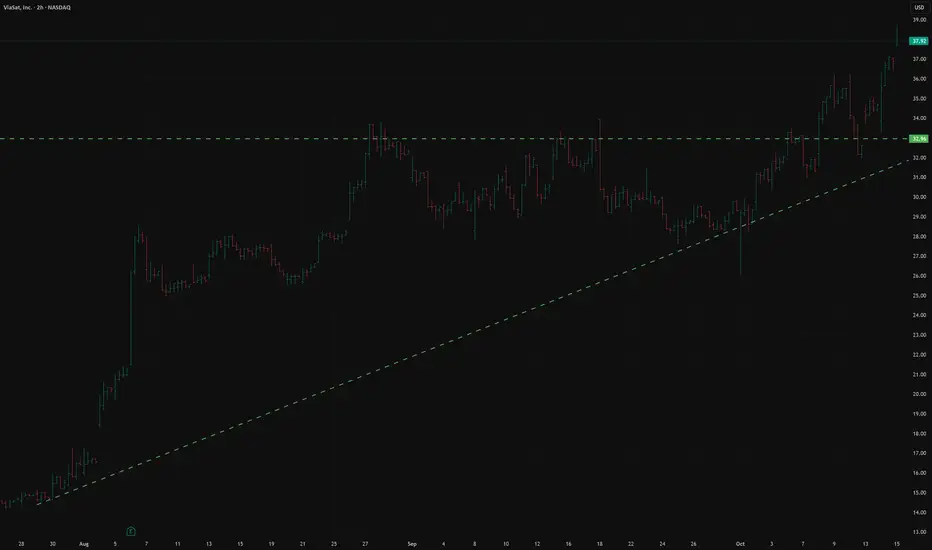
🌎Viasat is a key player in the global satellite communications market. Its business focuses on providing broadband internet access, in-flight connectivity solutions, and high-tech services for the government and defense sectors.
The company uses VSAT (Very Small Aperture Terminal) technology. This is a small satellite earth station that provides satellite communications via small-diameter antennas. This technology enables the transmission of data, voice, and video, providing internet access and creating corporate networks in remote and hard-to-reach regions where terrestrial or cellular networks are unreliable or unavailable.
Key business segments:
Satellite services: Broadband access for private and corporate clients, connectivity for ships and aircraft.
Government and defense solutions: Creation of secure satellite networks, tactical communications systems, information security solutions.
Equipment Sales: Manufacture and sales of satellite terminal equipment and modems
The compound annual growth rate (CAGR) for revenue over the past three years was 23.6%, and 14.6% over the past five years.
A significant jump in revenue in 2024 is due to the consolidation of Inmarsat's results, which were acquired by Viasat.
Net income remains negative, but the operating cash flow (OCF) is 1B TTM.
FCF has moved into positive territory, reaching 88M TTM.
Capital expenditures decreased by 37% to $229 million, indicating a transition from the active phase of satellite construction to the phase of their commercial operation and monetization.
The defense, aviation, and government services segments are showing steady growth. These segments are less susceptible to price competition and generate stable cash flow.
On the downside, debt is 6.4 billion and cash is 1.17 billion.
The company refinanced by issuing $1.98 billion in secured notes and repurchasing notes maturing in 2025. This improved the debt structure and delayed peak payments.
The company confirmed that the expected launch dates of the ViaSat-3 F2 and F3 satellites remain unchanged. These satellites will significantly increase the capacity and coverage of Viasat's network. Once technical issues with the antenna on ViaSat-3 F1 are resolved, the company will have access to a significant amount of unused capacity that it can monetize, particularly in promising regional markets such as Asia.
Management confirmed that it is actively exploring strategic alternatives for its assets, including partnerships or spinoffs. In particular, there is growing interest in the company's mobile satellite spectrum (L-band).
The global VSAT market is projected to continue to grow, reaching $13.7 billion by 2025.
The company uses VSAT (Very Small Aperture Terminal) technology. This is a small satellite earth station that provides satellite communications via small-diameter antennas. This technology enables the transmission of data, voice, and video, providing internet access and creating corporate networks in remote and hard-to-reach regions where terrestrial or cellular networks are unreliable or unavailable.
Key business segments:
Satellite services: Broadband access for private and corporate clients, connectivity for ships and aircraft.
Government and defense solutions: Creation of secure satellite networks, tactical communications systems, information security solutions.
Equipment Sales: Manufacture and sales of satellite terminal equipment and modems
The compound annual growth rate (CAGR) for revenue over the past three years was 23.6%, and 14.6% over the past five years.
A significant jump in revenue in 2024 is due to the consolidation of Inmarsat's results, which were acquired by Viasat.
Net income remains negative, but the operating cash flow (OCF) is 1B TTM.
FCF has moved into positive territory, reaching 88M TTM.
Capital expenditures decreased by 37% to $229 million, indicating a transition from the active phase of satellite construction to the phase of their commercial operation and monetization.
The defense, aviation, and government services segments are showing steady growth. These segments are less susceptible to price competition and generate stable cash flow.
On the downside, debt is 6.4 billion and cash is 1.17 billion.
The company refinanced by issuing $1.98 billion in secured notes and repurchasing notes maturing in 2025. This improved the debt structure and delayed peak payments.
The company confirmed that the expected launch dates of the ViaSat-3 F2 and F3 satellites remain unchanged. These satellites will significantly increase the capacity and coverage of Viasat's network. Once technical issues with the antenna on ViaSat-3 F1 are resolved, the company will have access to a significant amount of unused capacity that it can monetize, particularly in promising regional markets such as Asia.
Management confirmed that it is actively exploring strategic alternatives for its assets, including partnerships or spinoffs. In particular, there is growing interest in the company's mobile satellite spectrum (L-band).
The global VSAT market is projected to continue to grow, reaching $13.7 billion by 2025.

Clause de non-responsabilité
Les informations et publications ne sont pas destinées à être, et ne constituent pas, des conseils ou recommandations financiers, d'investissement, de trading ou autres fournis ou approuvés par TradingView. Pour en savoir plus, consultez les Conditions d'utilisation.
Clause de non-responsabilité
Les informations et publications ne sont pas destinées à être, et ne constituent pas, des conseils ou recommandations financiers, d'investissement, de trading ou autres fournis ou approuvés par TradingView. Pour en savoir plus, consultez les Conditions d'utilisation.