
NOTE – This is a post on Mindset and emotion. It is NOT a Trade idea or strategy designed to make you money. If anything, I’m taking the time here to post as an effort to help you preserve your capital, energy and will so that you are able to execute your own trading system as best you can from a place of calm, patience and confidence.
This 5-part series on the Psychology of Exits is inspired by TradingView’s recent post “The Stop-Loss Dilemma.” Link to the original post at the end of this article.
Here’s another scenario:
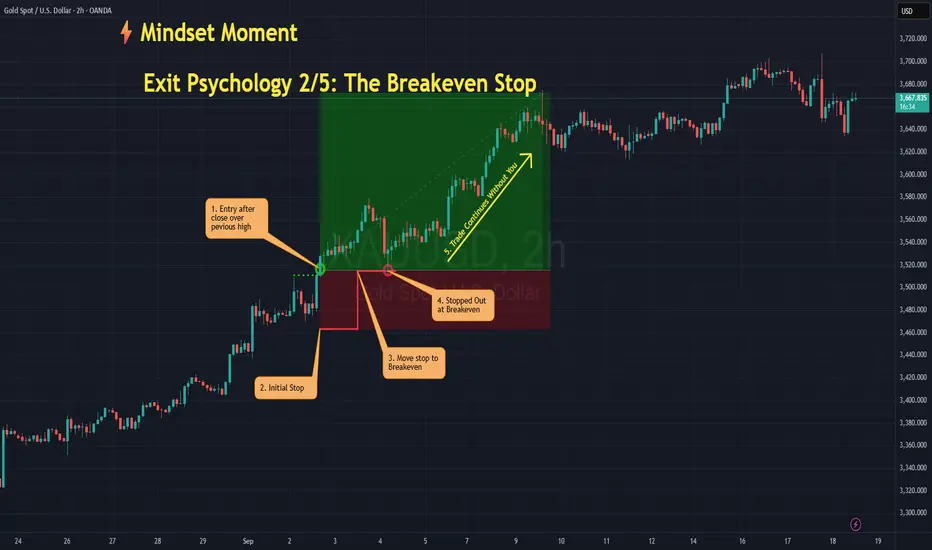
Your trade starts working in your favour. You feel relief. Within minutes, you move the stop to break-even. “Now I can’t lose.”
But the market breathes back, tags your new level by a whisker and then runs in your original direction. You’re flat, frustrated and watching from the sidelines.
How behaviour shows up with break-even stops:
For many traders, the urge to move to break-even comes quickly. It’s a way of taking risk off the table but often at the cost of cutting trades short. Typical behaviours include:
Why traders choose this approach:
There are rational reasons for going break-even:
These can all make sense in context. But the challenge is that moving too soon to break-even can turn a promising trade into repeated small scratches leaving you exhausted, under-confident and questioning your method. And … you’re still taking full losses for those trades that go immediately against you.
The psychology underneath:
At break-even, traders aren’t usually optimising expectancy; they're seeking emotional relief. The pull comes from:
Practical tips … the How:
Reframe:
A break-even stop isn’t wrong. It can be useful in the right context. But when used as a reflex, it’s more about managing feelings than managing risk.
Closing thought:
Break-even can feel like safety. But safety and growth don’t always align. The real edge comes from knowing when you’re protecting wisely and when you’re just buying short-term comfort at the expense of long-term results.
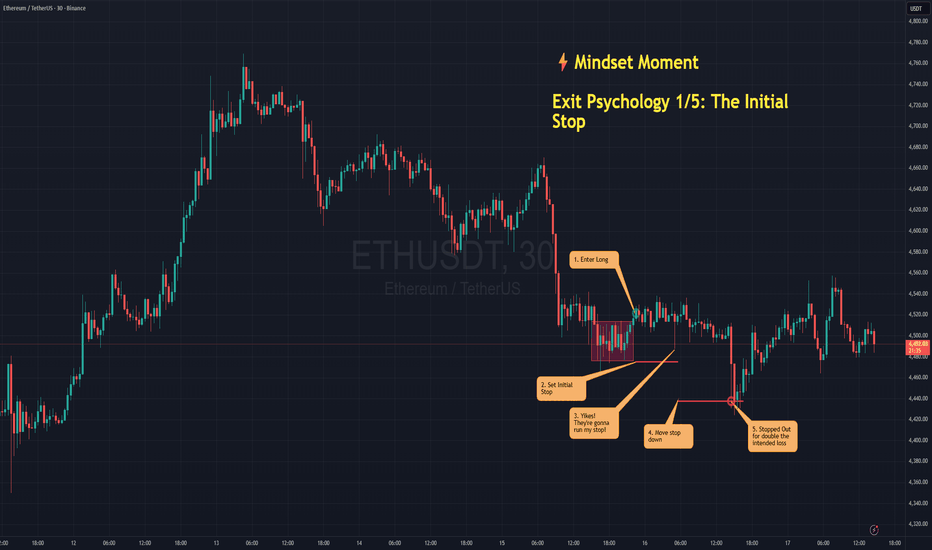
A link to Exit Psychology 1/5 : The Initial Stop
A link to the original article as promised:

This is Part 2 of the Psychology of Exits series.
👉 Follow and stay tuned for Part 3: The Trailing Stop - Patience vs. Protection out next week.
This 5-part series on the Psychology of Exits is inspired by TradingView’s recent post “The Stop-Loss Dilemma.” Link to the original post at the end of this article.
Here’s another scenario:
Your trade starts working in your favour. You feel relief. Within minutes, you move the stop to break-even. “Now I can’t lose.”
But the market breathes back, tags your new level by a whisker and then runs in your original direction. You’re flat, frustrated and watching from the sidelines.
How behaviour shows up with break-even stops:
For many traders, the urge to move to break-even comes quickly. It’s a way of taking risk off the table but often at the cost of cutting trades short. Typical behaviours include:
- Locking in break-even as soon as price moves a little in your favour.
- Using break-even as a substitute for taking partial profits.
- Feeling “safe” after the adjustment and disengaging from trade management.
Why traders choose this approach:
There are rational reasons for going break-even:
- Protecting capital in volatile conditions.
- Reducing stress when multiple trades are open.
- Creating a sense of progress after a string of losses.
These can all make sense in context. But the challenge is that moving too soon to break-even can turn a promising trade into repeated small scratches leaving you exhausted, under-confident and questioning your method. And … you’re still taking full losses for those trades that go immediately against you.
The psychology underneath:
At break-even, traders aren’t usually optimising expectancy; they're seeking emotional relief. The pull comes from:
- Fear of loss: Wanting to avoid the pain of turning a winner back into a loser.
- Need for certainty: A break-even stop feels like control in an uncertain environment.
- Regret avoidance: Scratches hurt less than watching profit evaporate into loss.
- Anchoring bias: Once price moves your way, the mind treats that unrealised gain as already yours. Giving it back feels like losing more than it is.
- Identity narrative: Moving to break-even can reinforce the self-image of being disciplined or “safe” even if it’s cutting potential edge.
- Control vs. trust: The break-even adjustment is often less about the market and more about soothing the discomfort of waiting. It’s easier to do something than to trust the original plan.
- Short-term comfort over long-term edge: The relief of “no risk” overrides the patience needed to let the trade develop.
- Physiology: Heart rate settles, shoulders relax, the nervous system rewards the move with immediate calm, even if expectancy drops.
Practical tips … the How:
- If you use break-even stops, the work is about applying them intentionally rather than reflexively. A few ways to manage the psychological side:
- Define in advance: When will you move to break-even? After it moves a pre-defined amount in your favour ( X ATRs)? After a structure shift? Make it rule-based.
- Consider scaling out partial size instead of rushing to break-even. Bank some, let the rest breathe.
- Journal whether break-even stops are improving or reducing expectancy across 50–100 trades.
- Train your nervous system: stay with mild discomfort instead of rushing to neutralise it. For instance: notice the physical tension that arises (tight chest, shallow breath, clenched jaw) when your trade pulls back. Instead of reacting on the chart, take one slow, deliberate breath and simply observe that feeling before deciding.
Reframe:
A break-even stop isn’t wrong. It can be useful in the right context. But when used as a reflex, it’s more about managing feelings than managing risk.
Closing thought:
Break-even can feel like safety. But safety and growth don’t always align. The real edge comes from knowing when you’re protecting wisely and when you’re just buying short-term comfort at the expense of long-term results.
A link to Exit Psychology 1/5 : The Initial Stop
A link to the original article as promised:
This is Part 2 of the Psychology of Exits series.
👉 Follow and stay tuned for Part 3: The Trailing Stop - Patience vs. Protection out next week.

Helping serious traders stay calm, clear & in control
🧠 Free Mindset Reset + 📈 TradingView Tools + ✉️ Trader Newsletter
➝ rfactory.io/tradingview
Follow for Mindset Insights
🧠 Free Mindset Reset + 📈 TradingView Tools + ✉️ Trader Newsletter
➝ rfactory.io/tradingview
Follow for Mindset Insights
Publications connexes
Clause de non-responsabilité
Les informations et publications ne sont pas destinées à être, et ne constituent pas, des conseils ou recommandations financiers, d'investissement, de trading ou autres fournis ou approuvés par TradingView. Pour en savoir plus, consultez les Conditions d'utilisation.
Helping serious traders stay calm, clear & in control
🧠 Free Mindset Reset + 📈 TradingView Tools + ✉️ Trader Newsletter
➝ rfactory.io/tradingview
Follow for Mindset Insights
🧠 Free Mindset Reset + 📈 TradingView Tools + ✉️ Trader Newsletter
➝ rfactory.io/tradingview
Follow for Mindset Insights
Publications connexes
Clause de non-responsabilité
Les informations et publications ne sont pas destinées à être, et ne constituent pas, des conseils ou recommandations financiers, d'investissement, de trading ou autres fournis ou approuvés par TradingView. Pour en savoir plus, consultez les Conditions d'utilisation.