OPEN-SOURCE SCRIPT
Ichimoku Cloud Calibrated & Multi-Timeframe
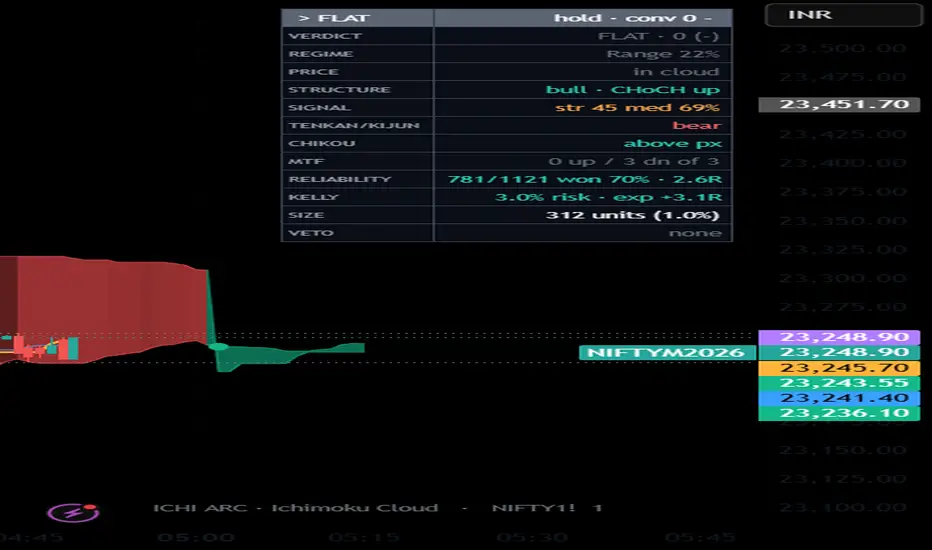
# Ichimoku Cloud — Strength-Graded, Calibrated & Multi-Timeframe (ICHI ARC)
## What it is
The classic Ichimoku Kinko Hyo five-line system — Tenkan, Kijun, the Senkou A/B cloud (Kumo) and the Chikou span — drawn faithfully, but with the *reading* of it done by a modern engine instead of the eye.
A plain Ichimoku throws six signals at once with no synthesis, uses fixed periods designed for one market in the 1930s, and tells you nothing about whether its signals actually work.
ICHI ARC keeps the cloud exactly as the core, then fuses the whole signal cluster into **one 0–100 strength score per signal**, confirms it with market structure and volume, and **calibrates the score to what actually happened on this symbol**.
It runs on **any symbol, asset class, timeframe and market**. The raw data source and every optional feed are user-selectable; nothing is hard-coded to a market.
---
## Why these components are combined (mashup rationale)
A raw Ichimoku has four well-known weaknesses, and each added layer fixes exactly one of them and feeds the next — none is decorative:
### 1. Adaptive periods (fixes the "one-market settings" problem)
Optionally derive Tenkan/Kijun/Span-B from the measured **dominant cycle** so the cloud fits the instrument and timeframe instead of fixed 9/26/52. Classic mode is the default.
### 2. One strength score (fixes "six signals, no synthesis")
Price-vs-cloud (the master bias), Tenkan/Kijun, Chikou clearance, current cloud colour, the forward Kumo twist, Kijun slope and cloud thickness are weighted into a single 0–100 grade so you read one number, not six lines.
### 3. Market-structure confirmation, BOS / CHoCH (fixes false breakouts)
Swing-pivot structure independently checks whether a cloud breakout is a real structural shift: a same-direction Break of Structure strengthens the signal; a signal against the last Change of Character is vetoed.
This is price geometry, so it is orthogonal to the cloud and to volume.
### 4. Relative-volume confirmation (fixes dead-volume fakeouts)
Real breakouts carry volume; RVOL (volume vs its own average) boosts strong-volume signals and can veto dead-volume ones — a third, independent angle on the same failure mode.
### 5. Regime + multi-timeframe context (keeps it out of chop)
An efficiency-ratio / trend-strength / volatility-cluster classifier and three higher-timeframe clouds gate the signals, since Ichimoku breakouts fail in range-bound tape.
### 6. Conviction, vetoes and Kelly sizing
Everything resolves to one LONG / SHORT / FLAT verdict with hard vetoes, and the calibrated win-rate is turned into a fractional-Kelly position-size suggestion.
Remove any one layer and a specific Ichimoku failure returns (wrong fit, signal overload, false breakout, dead-volume breakout, chop). That is the justification for combining them.
---
## How it is original
ICHI ARC keeps a **self-calibrating quality engine**.
Every cloud-bias signal is checked a fixed window later for whether price actually ran a **favourable target (in ATR)** in the signal's direction — i.e. whether the trade *worked*, not merely whether the cloud held.
From that it reports, live, the **realised win-rate of past signals at each strength tier on this symbol** plus the average favourable move (in ATR), can **auto-learn the strength cutoff** worth acting on, and converts the win-rate into a **Kelly-based sizing suggestion**.
A stock Ichimoku tells you nothing about the quality of its own signals; this one is accountable to its own track record.
---
## What it plots
• The full classic Ichimoku: Tenkan, Kijun, the displaced Senkou A/B **cloud** (with opacity scaled by cloud thickness), the Chikou span, and marked forward **Kumo twists**.
• Strength-graded signal triangles with a score label (`72 S` / `55 M` / `31 w`), and small diamonds marking **Change-of-Character** structure flips.
• A compact **dashboard** featuring:
* Verdict
* Regime
* Price-vs-cloud
* Structure state
* Signal strength and realised win-rate
* Tenkan/Kijun status
* Chikou status
* MTF agreement
* Relative volume
* Calibration statistics
* Kelly / expectancy sizing reference
* Active veto status
---
## How to use it
### 1. Trade with the cloud
Long bias above the Kumo, short bias below, no-trade inside.
### 2. Focus on strength-graded signals
A high-strength signal that also has:
• Same-direction Break of Structure
• Higher-timeframe agreement
• Real volume confirmation
is the A+ setup.
Weak signals during chop regimes are generally the ones to skip.
### 3. Read the VERDICT / VETO rows
WEAK or VETO means stand aside (for example, a signal against structure, in chop, or on dead volume).
### 4. Use the RELIABILITY and KELLY rows
The **RELIABILITY** row shows how this symbol's signals at each strength tier have historically behaved.
The **KELLY** row suggests a risk percentage for journaling and trade review purposes.
The displayed size is a reference only and not an order recommendation.
### 5. Alerts
Alerts cover:
• Bullish cloud signals
• Bearish cloud signals
• Conviction verdict changes
• Kumo twists
---
## Settings (use on any asset / market)
### Raw data source
`close`, `hl2`, `hlc3`, `ohlc4`, or another indicator's plot.
The cloud's highs/lows always use chart high/low.
Works on any instrument.
### Periods
Classic (9/26/52/26) or Adaptive (dominant-cycle).
Displacement remains fixed.
### Structure
Swing pivot length and structure veto controls.
### Volume
RVOL length and minimum thresholds.
Optional low-volume veto.
### Calibration
Judging window and favourable ATR target defining a "good" signal.
Auto-learn cutoff and target win-rate settings.
### Advanced Controls
Regime, MTF, conviction weights, risk controls, Kelly fraction and maximum risk.
### Optional feeds (blank = off)
• Volatility-index symbol (spike veto)
• Cross-asset symbol (confluence)
Both are disabled by default, allowing fully self-contained operation on any market.
---
## Notes
• This is a **study / indicator**, not a strategy, and it places no orders.
• Signals are evaluated on bar close to avoid intrabar repainting.
• Structure uses confirmed pivots and higher-timeframe reads use confirmed values.
• The cloud and Chikou are displaced exactly as in classic Ichimoku.
• Relative-volume features require a symbol that reports volume (such as futures). On volume-less symbols they gracefully revert to neutral behaviour.
---
## Disclaimer
This script is provided for educational and informational purposes only. It is a technical-analysis study, not financial, investment, or trading advice, and not a recommendation or solicitation to buy or sell any instrument.
No indicator can predict markets; past behaviour and any historical statistics shown (including the signal win-rates and any Kelly-based sizing suggestion) do not guarantee future results.
Trading involves substantial risk of loss.
You are solely responsible for your own decisions — do your own research and consider consulting a licensed financial professional before trading.
The author accepts no liability for any loss arising from use of this script.
## What it is
The classic Ichimoku Kinko Hyo five-line system — Tenkan, Kijun, the Senkou A/B cloud (Kumo) and the Chikou span — drawn faithfully, but with the *reading* of it done by a modern engine instead of the eye.
A plain Ichimoku throws six signals at once with no synthesis, uses fixed periods designed for one market in the 1930s, and tells you nothing about whether its signals actually work.
ICHI ARC keeps the cloud exactly as the core, then fuses the whole signal cluster into **one 0–100 strength score per signal**, confirms it with market structure and volume, and **calibrates the score to what actually happened on this symbol**.
It runs on **any symbol, asset class, timeframe and market**. The raw data source and every optional feed are user-selectable; nothing is hard-coded to a market.
---
## Why these components are combined (mashup rationale)
A raw Ichimoku has four well-known weaknesses, and each added layer fixes exactly one of them and feeds the next — none is decorative:
### 1. Adaptive periods (fixes the "one-market settings" problem)
Optionally derive Tenkan/Kijun/Span-B from the measured **dominant cycle** so the cloud fits the instrument and timeframe instead of fixed 9/26/52. Classic mode is the default.
### 2. One strength score (fixes "six signals, no synthesis")
Price-vs-cloud (the master bias), Tenkan/Kijun, Chikou clearance, current cloud colour, the forward Kumo twist, Kijun slope and cloud thickness are weighted into a single 0–100 grade so you read one number, not six lines.
### 3. Market-structure confirmation, BOS / CHoCH (fixes false breakouts)
Swing-pivot structure independently checks whether a cloud breakout is a real structural shift: a same-direction Break of Structure strengthens the signal; a signal against the last Change of Character is vetoed.
This is price geometry, so it is orthogonal to the cloud and to volume.
### 4. Relative-volume confirmation (fixes dead-volume fakeouts)
Real breakouts carry volume; RVOL (volume vs its own average) boosts strong-volume signals and can veto dead-volume ones — a third, independent angle on the same failure mode.
### 5. Regime + multi-timeframe context (keeps it out of chop)
An efficiency-ratio / trend-strength / volatility-cluster classifier and three higher-timeframe clouds gate the signals, since Ichimoku breakouts fail in range-bound tape.
### 6. Conviction, vetoes and Kelly sizing
Everything resolves to one LONG / SHORT / FLAT verdict with hard vetoes, and the calibrated win-rate is turned into a fractional-Kelly position-size suggestion.
Remove any one layer and a specific Ichimoku failure returns (wrong fit, signal overload, false breakout, dead-volume breakout, chop). That is the justification for combining them.
---
## How it is original
ICHI ARC keeps a **self-calibrating quality engine**.
Every cloud-bias signal is checked a fixed window later for whether price actually ran a **favourable target (in ATR)** in the signal's direction — i.e. whether the trade *worked*, not merely whether the cloud held.
From that it reports, live, the **realised win-rate of past signals at each strength tier on this symbol** plus the average favourable move (in ATR), can **auto-learn the strength cutoff** worth acting on, and converts the win-rate into a **Kelly-based sizing suggestion**.
A stock Ichimoku tells you nothing about the quality of its own signals; this one is accountable to its own track record.
---
## What it plots
• The full classic Ichimoku: Tenkan, Kijun, the displaced Senkou A/B **cloud** (with opacity scaled by cloud thickness), the Chikou span, and marked forward **Kumo twists**.
• Strength-graded signal triangles with a score label (`72 S` / `55 M` / `31 w`), and small diamonds marking **Change-of-Character** structure flips.
• A compact **dashboard** featuring:
* Verdict
* Regime
* Price-vs-cloud
* Structure state
* Signal strength and realised win-rate
* Tenkan/Kijun status
* Chikou status
* MTF agreement
* Relative volume
* Calibration statistics
* Kelly / expectancy sizing reference
* Active veto status
---
## How to use it
### 1. Trade with the cloud
Long bias above the Kumo, short bias below, no-trade inside.
### 2. Focus on strength-graded signals
A high-strength signal that also has:
• Same-direction Break of Structure
• Higher-timeframe agreement
• Real volume confirmation
is the A+ setup.
Weak signals during chop regimes are generally the ones to skip.
### 3. Read the VERDICT / VETO rows
WEAK or VETO means stand aside (for example, a signal against structure, in chop, or on dead volume).
### 4. Use the RELIABILITY and KELLY rows
The **RELIABILITY** row shows how this symbol's signals at each strength tier have historically behaved.
The **KELLY** row suggests a risk percentage for journaling and trade review purposes.
The displayed size is a reference only and not an order recommendation.
### 5. Alerts
Alerts cover:
• Bullish cloud signals
• Bearish cloud signals
• Conviction verdict changes
• Kumo twists
---
## Settings (use on any asset / market)
### Raw data source
`close`, `hl2`, `hlc3`, `ohlc4`, or another indicator's plot.
The cloud's highs/lows always use chart high/low.
Works on any instrument.
### Periods
Classic (9/26/52/26) or Adaptive (dominant-cycle).
Displacement remains fixed.
### Structure
Swing pivot length and structure veto controls.
### Volume
RVOL length and minimum thresholds.
Optional low-volume veto.
### Calibration
Judging window and favourable ATR target defining a "good" signal.
Auto-learn cutoff and target win-rate settings.
### Advanced Controls
Regime, MTF, conviction weights, risk controls, Kelly fraction and maximum risk.
### Optional feeds (blank = off)
• Volatility-index symbol (spike veto)
• Cross-asset symbol (confluence)
Both are disabled by default, allowing fully self-contained operation on any market.
---
## Notes
• This is a **study / indicator**, not a strategy, and it places no orders.
• Signals are evaluated on bar close to avoid intrabar repainting.
• Structure uses confirmed pivots and higher-timeframe reads use confirmed values.
• The cloud and Chikou are displaced exactly as in classic Ichimoku.
• Relative-volume features require a symbol that reports volume (such as futures). On volume-less symbols they gracefully revert to neutral behaviour.
---
## Disclaimer
This script is provided for educational and informational purposes only. It is a technical-analysis study, not financial, investment, or trading advice, and not a recommendation or solicitation to buy or sell any instrument.
No indicator can predict markets; past behaviour and any historical statistics shown (including the signal win-rates and any Kelly-based sizing suggestion) do not guarantee future results.
Trading involves substantial risk of loss.
You are solely responsible for your own decisions — do your own research and consider consulting a licensed financial professional before trading.
The author accepts no liability for any loss arising from use of this script.
Script open-source
Dans l'esprit TradingView, le créateur de ce script l'a rendu open source afin que les traders puissent examiner et vérifier ses fonctionnalités. Bravo à l'auteur! Bien que vous puissiez l'utiliser gratuitement, n'oubliez pas que la republication du code est soumise à nos Règles.

Clause de non-responsabilité
Les informations et publications ne sont pas destinées à être, et ne constituent pas, des conseils ou recommandations financiers, d'investissement, de trading ou autres fournis ou approuvés par TradingView. Pour en savoir plus, consultez les Conditions d'utilisation.
Script open-source
Dans l'esprit TradingView, le créateur de ce script l'a rendu open source afin que les traders puissent examiner et vérifier ses fonctionnalités. Bravo à l'auteur! Bien que vous puissiez l'utiliser gratuitement, n'oubliez pas que la republication du code est soumise à nos Règles.
Clause de non-responsabilité
Les informations et publications ne sont pas destinées à être, et ne constituent pas, des conseils ou recommandations financiers, d'investissement, de trading ou autres fournis ou approuvés par TradingView. Pour en savoir plus, consultez les Conditions d'utilisation.