Mis à jour
STA FVG Locator
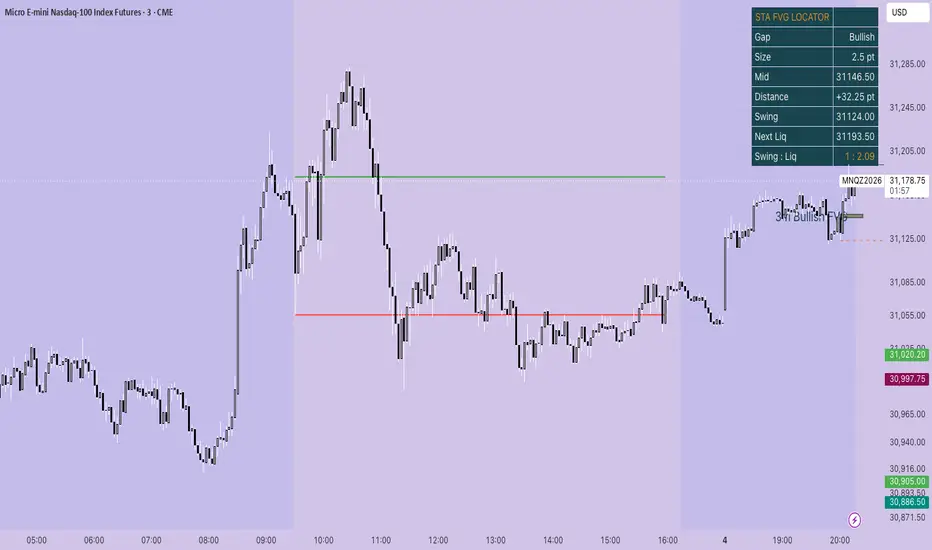
Marks the current unfilled fair value gap and the structural levels around it, so the zone you would work and the level price is drawing toward are both on screen at once.
This is a locator, not a signal tool. It reports measurements. It does not grade setups, score quality, or tell you when to trade.
What it draws
Three things, all belonging to one gap:
The panel
Gap, Size, Mid, Distance, Swing, Next Liq, and Swing : Liq. Hover any row for its definition.
Mid is snapped to the instrument's tick grid so it is a price an order can actually rest at, and Distance and the ratio are computed from that same snapped value.
Swing : Liq is the ratio of two measured distances from the midline: midline to Gap Swing against midline to Next Liquidity. It is arithmetic on two landmarks. It is deliberately not labeled risk to reward, because what counts as risk is the trader's decision and not the indicator's.
Unfilled and untested
A gap stays on the board until price trades through its far edge. A wick into the gap is a partial fill and leaves it live, which matters because that wick is often where you would be working from.
Swing levels are tracked until price trades through them, then dropped. Next Liquidity therefore only ever points at a level that has not been taken.
Settings
Gaps shown per side, unfilled only or all recent, the full color palette, label sizes, label lane spacing, gap box extension, and dashboard position, size and visibility.
Used by members of the Sisterhood Trading Academy
This is a locator, not a signal tool. It reports measurements. It does not grade setups, score quality, or tell you when to trade.
What it draws
Three things, all belonging to one gap:
- The nearest unfilled gap, as a shaded box with a midline. When more than one gap is on screen, the one the panel describes keeps a solid, full strength midline and the others are faded, so there is never doubt which gap the numbers refer to.
- Gap Swing, the swing that preceded the displacement which created the gap. A bullish gap takes the swing low before the move up, a bearish gap the swing high before the move down. Captured when the gap forms and fixed from then on.
- Next Liquidity, the nearest swing level price has not yet traded through, on the side the gap's own type implies. Below for a bearish gap, above for a bullish one. The gap chooses the side, not a directional filter.
The panel
Gap, Size, Mid, Distance, Swing, Next Liq, and Swing : Liq. Hover any row for its definition.
Mid is snapped to the instrument's tick grid so it is a price an order can actually rest at, and Distance and the ratio are computed from that same snapped value.
Swing : Liq is the ratio of two measured distances from the midline: midline to Gap Swing against midline to Next Liquidity. It is arithmetic on two landmarks. It is deliberately not labeled risk to reward, because what counts as risk is the trader's decision and not the indicator's.
Unfilled and untested
A gap stays on the board until price trades through its far edge. A wick into the gap is a partial fill and leaves it live, which matters because that wick is often where you would be working from.
Swing levels are tracked until price trades through them, then dropped. Next Liquidity therefore only ever points at a level that has not been taken.
Settings
Gaps shown per side, unfilled only or all recent, the full color palette, label sizes, label lane spacing, gap box extension, and dashboard position, size and visibility.
Used by members of the Sisterhood Trading Academy
Notes de version
Added Version Number
Clause de non-responsabilité
Les informations et publications ne sont pas destinées à être, et ne constituent pas, des conseils ou recommandations financiers, d'investissement, de trading ou autres fournis ou approuvés par TradingView. Pour en savoir plus, consultez les Conditions d'utilisation.
Clause de non-responsabilité
Les informations et publications ne sont pas destinées à être, et ne constituent pas, des conseils ou recommandations financiers, d'investissement, de trading ou autres fournis ou approuvés par TradingView. Pour en savoir plus, consultez les Conditions d'utilisation.