Strategy Auto-Optimized by Backpulse
Hey TradingView community,
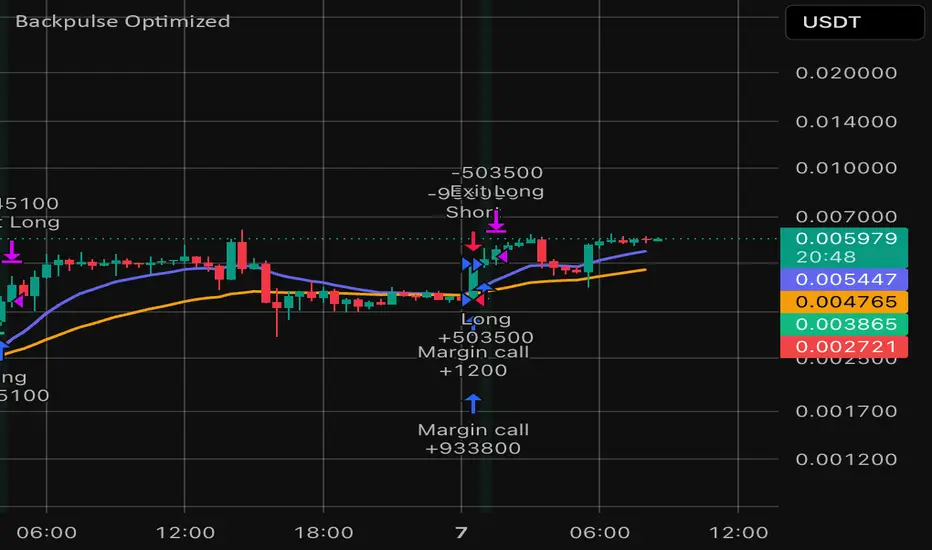
Today, I’d like to break down a critical topic that every systematic trader and Pine Script developer eventually faces: The divergence between Strategy Tester results and Live Market Execution.
Many traders spend weeks fine-tuning a strategy until the Strategy Tester shows an irresistible equity curve (65%+ win rate, high Profit Factor). Yet, once connected to live exchange webhooks, performance deteriorates rapidly.
Here are the 3 primary friction points and practical ways to mitigate them:
1. Unrealistic Order Fills & Liquidity Gaps
Standard backtesting environments simulate fills based on historical OHLC bars, assuming infinite liquidity at the exact trigger price.
In Live Markets: Orders must consume liquidity from the real-time Order Book. During fast breakouts, slippage of 0.05% - 0.25% is almost guaranteed, significantly shifting your average entry.
2. The Compounding Drag of Fees & Funding Rates
Default backtest settings frequently overlook commission costs (commission = 0).
In crypto perpetual futures, combining taker fees (~0.05%) with dynamic 8-hour funding rates can easily turn a mathematically profitable strategy into a net loser over a 200+ trade sample size.
3. Webhook Routing Latency
The signal pathway: TradingView Alert Trigger ➔ Relay Middleware ➔ Exchange API Gateway ➔ Matching Engine often takes 1,000ms – 3,000ms on generic VPS setups. In high-frequency or momentum setups, a 2-second delay means you enter after the move has already been absorbed.
🛠 Practical Framework for Robust Validation:
Stress-Test Settings in Pine Script: Always specify realistic frictions directly in code:
pinescript
strategy("My System", commission_type=strategy.commission.percent, commission_value=0.06, slippage=2)
Account for Funding Rate Drag: Deduct an annualized carrying cost if your strategy holds positions across multiple 8-hour settlement intervals.
Use Institutional Execution Infrastructure: To eliminate unnecessary latency bottlenecks, our research group engineered Backpulse, optimizing event-driven webhook execution to sub-25ms levels with tick-level slippage modeling.
📌 Key Takeaway & Risk Management:
A truly robust quantitative system isn't the one with the highest backtest ROI—it's the one that survives real-world market friction. Always validate execution viability before scaling up capital.
How do you currently handle slippage and webhook latency in your automated setups? Drop your thoughts and experiences in the comments below!
Disclaimer: This publication is strictly for technical research and educational purposes. It does not constitute financial or investment advice. Always conduct your own due diligence and manage risk responsibly.
(Tags: #Educational #PineScript #Backtesting #RiskManagement #Quantitative #Crypto)
Today, I’d like to break down a critical topic that every systematic trader and Pine Script developer eventually faces: The divergence between Strategy Tester results and Live Market Execution.
Many traders spend weeks fine-tuning a strategy until the Strategy Tester shows an irresistible equity curve (65%+ win rate, high Profit Factor). Yet, once connected to live exchange webhooks, performance deteriorates rapidly.
Here are the 3 primary friction points and practical ways to mitigate them:
1. Unrealistic Order Fills & Liquidity Gaps
Standard backtesting environments simulate fills based on historical OHLC bars, assuming infinite liquidity at the exact trigger price.
In Live Markets: Orders must consume liquidity from the real-time Order Book. During fast breakouts, slippage of 0.05% - 0.25% is almost guaranteed, significantly shifting your average entry.
2. The Compounding Drag of Fees & Funding Rates
Default backtest settings frequently overlook commission costs (commission = 0).
In crypto perpetual futures, combining taker fees (~0.05%) with dynamic 8-hour funding rates can easily turn a mathematically profitable strategy into a net loser over a 200+ trade sample size.
3. Webhook Routing Latency
The signal pathway: TradingView Alert Trigger ➔ Relay Middleware ➔ Exchange API Gateway ➔ Matching Engine often takes 1,000ms – 3,000ms on generic VPS setups. In high-frequency or momentum setups, a 2-second delay means you enter after the move has already been absorbed.
🛠 Practical Framework for Robust Validation:
Stress-Test Settings in Pine Script: Always specify realistic frictions directly in code:
pinescript
strategy("My System", commission_type=strategy.commission.percent, commission_value=0.06, slippage=2)
Account for Funding Rate Drag: Deduct an annualized carrying cost if your strategy holds positions across multiple 8-hour settlement intervals.
Use Institutional Execution Infrastructure: To eliminate unnecessary latency bottlenecks, our research group engineered Backpulse, optimizing event-driven webhook execution to sub-25ms levels with tick-level slippage modeling.
📌 Key Takeaway & Risk Management:
A truly robust quantitative system isn't the one with the highest backtest ROI—it's the one that survives real-world market friction. Always validate execution viability before scaling up capital.
How do you currently handle slippage and webhook latency in your automated setups? Drop your thoughts and experiences in the comments below!
Disclaimer: This publication is strictly for technical research and educational purposes. It does not constitute financial or investment advice. Always conduct your own due diligence and manage risk responsibly.
(Tags: #Educational #PineScript #Backtesting #RiskManagement #Quantitative #Crypto)

Clause de non-responsabilité
Les informations et publications ne sont pas destinées à être, et ne constituent pas, des conseils ou recommandations financiers, d'investissement, de trading ou autres fournis ou approuvés par TradingView. Pour en savoir plus, consultez les Conditions d'utilisation.
Clause de non-responsabilité
Les informations et publications ne sont pas destinées à être, et ne constituent pas, des conseils ou recommandations financiers, d'investissement, de trading ou autres fournis ou approuvés par TradingView. Pour en savoir plus, consultez les Conditions d'utilisation.