JoulTrades - First FVG Classroom
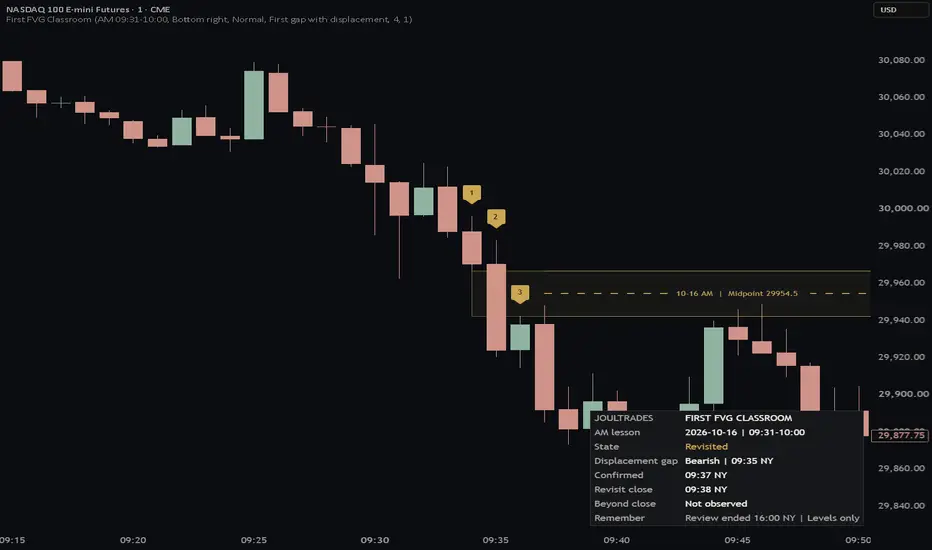
Learn how a first fair value gap forms, why it qualifies, and when it becomes knowable. First FVG Classroom is a free educational overlay for standard 1-minute charts. It shows one lesson at a time: three numbered formation candles, the original gap boundaries, a dashed midpoint, and a compact card recording later observations.
WHY A SEPARATE CLASSROOM?
The existing JoulTrades first-gap model combines the market open, morning range and sweeps. Classroom preserves that model for its current users while offering a focused teaching workflow: numbered formation candles, explicit confirmation times, AM or PM lessons, revisit and boundary-close observations, and missing-data warnings. It shares the AM displacement test; it does not claim to invent fair value gaps or offer a new trading edge.
START HERE
1. Use standard Candles or Bars on a 1-minute chart. Chart checks used NQ1! with extended trading hours. Other symbols can produce different results and have not received the same chart checks.
2. Choose AM or PM. All lesson times use America/New_York, including daylight saving changes.
3. Find candles 1, 2 and 3. In a bullish gap, candle 3's low is above candle 1's high. In a bearish gap, candle 3's high is below candle 1's low.
4. Read the confirmation time. The gap is only confirmed when candle 3 closes. Numbers on candles 1 and 2 are added retrospectively at that moment; they are not earlier signals.
The shaded box is also added only after candle 3 closes, then drawn back to candle 1 to explain the formation. It was not available at that earlier time. Boundary and midpoint lines begin at confirmation. Scrolling to older candles does not rewind the latest-date lesson card; historical observations may include later bars already loaded on the chart.
WHAT COUNTS AS DISPLACEMENT HERE?
The default is First gap with displacement. Candle 2 must close in the gap direction and beyond every earlier high (bullish) or low (bearish) since the lesson's reference start. Its own high/low and candle 3 are excluded from that prior range. AM reference begins at 09:30 NY. PM reference begins at 13:29 NY, allowing a first middle candle at 13:30.
This is JoulTrades' explicit mechanical interpretation, carried over from the existing JT first-gap model for the AM window. It is not a universal numerical definition taught by ICT. The default minimum gap is 4 ticks, also a JoulTrades choice. A long wick alone does not meet this close-through test.
Advanced settings offer First geometric gap. Both modes still apply the minimum size. Set that minimum to zero in geometric mode for the literal first positive wick gap.
WINDOWS AND TIMESTAMPS
AM: candle 2 begins at or after 09:31 and before 10:00 NY.
PM: candle 2 begins at or after 13:30 and before 14:00 NY.
The middle candle names the gap. For example, a 09:35 middle candle has a 09:36 third candle and becomes confirmed at 09:37. This naming convention is explicit; it is not a claim that every teacher labels gaps identically. The contextual 09:30 exception is excluded. Classroom stops searching at its selected window; the older JT model searches longer.
READING THE LESSON CARD
Confirmed: candle 3 closed and the selected gap qualified.
Revisited: a later closed candle's wick range overlapped the original gap, including its edges. The recorded time is that candle's close, not the exact intrabar touch.
Closed beyond boundary: a later candle closed below a bullish gap's original lower edge or above a bearish gap's original upper edge. A wick or exact equal close is insufficient. This is an observation, not a reversal forecast.
No eligible gap: the full search window was available, but no gap met the selected rules.
Incomplete data: required minute bars were missing, so the script cannot establish which gap was first.
The original boundaries remain fixed, including after a close beyond them. Revisit and boundary events are tracked separately: a jump across the whole gap need not count as a revisit. Review ends at 16:00 NY. Later missing bars make recorded times observed events rather than guaranteed first events. The card describes the latest loaded NY date, not whichever historical candles are under the cursor. Retain up to five dates in Advanced settings.
DESIGN
The default view contains only one AM lesson, readable gold levels, lightly shaded space, numbered candles and a lower-right lesson card. Hover the midpoint label for exact boundaries and event times. Quarter levels and historical dates are optional. No buy/sell arrows, orders, alerts, win rates or profitability claims are included.
EXERCISE
Before reading the card, identify the three candles, the prior range that candle 2 closed beyond, and the earliest time the gap could have been confirmed. Then compare with the labels. Repeat on a day without a qualifying gap and a day that closes beyond its original boundary.
CREDIT AND LIMITS
The underlying fair value gap and first-presented-gap concepts are taught by The Inner Circle Trader (ICT). This script's precise close-through test, four-tick threshold, PM reference anchor, naming convention, states and review cutoff are JoulTrades implementation choices. It is not affiliated with or endorsed by ICT.
Closed-bar logic avoids confirming an unfinished third candle. Historical data corrections, feed differences, session settings and missing bars can still change results. This is a chart-reading tool, not a tested trading strategy or recommendation. Free source code does not include exchange data or remove TradingView plan limits.

Clause de non-responsabilité
Les informations et publications ne sont pas destinées à être, et ne constituent pas, des conseils ou recommandations financiers, d'investissement, de trading ou autres fournis ou approuvés par TradingView. Pour en savoir plus, consultez les Conditions d'utilisation.
Clause de non-responsabilité
Les informations et publications ne sont pas destinées à être, et ne constituent pas, des conseils ou recommandations financiers, d'investissement, de trading ou autres fournis ou approuvés par TradingView. Pour en savoir plus, consultez les Conditions d'utilisation.