Mis à jour
941 Signature
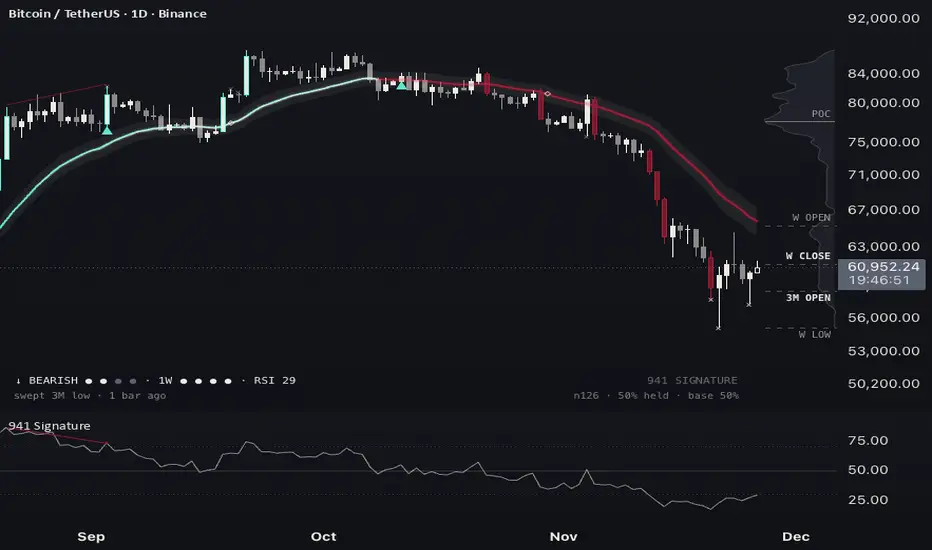
941 Signature is a single-script chart read. It draws a trend ribbon, higher-timeframe levels, a volume-by-price contour and an RSI pane, and it states the chart in one plain headline. Its purpose is accountability: every mark the script grades is printed next to its base rate, which is what any bar on the same chart did over the same horizon. The script does not forecast. It reports what has been confirmed and how the same kind of mark has done on the history your chart has loaded.
Built for crypto first, then stocks: high-volatility markets.
What you see
The grade
In the lower right the script grades its own triangles on the loaded history: the number of signals, the share that held, and the base rate. A signal holds when the close three bars later is beyond the signal close in the signal's direction. The base rate is what any bar on the chart did over the same three bars, weighted to the same mix of bullish and bearish signals. On many charts the two numbers sit close together. Printing both is the point: you can see how much, or how little, a mark has added on the chart in front of you. At publication, the Bitcoin daily chart above reads 128 signals, 51% held, base 50%.
The dip read
On daily S&P 500 and Nasdaq 100 charts only, the script adds one fixed and well-known rule, the RSI(2) pullback popularized by Larry Connors: the first close with RSI(2) under 10 while price is above its 200-bar simple average. Each dip gets a dotted ring under its low. Three bars later the ring fills if the close is higher and stays hollow if it is not. A state line shows BELOW 200, ABOVE 200 or DIP with the bar count, next to the dip hold rate and its own base rate, which is every close above the average graded the same way. It is a read with a receipt. It has no entry, exit or size logic. It is off on the Bitcoin chart above.
Alerts
Eight alert conditions cover EMA crosses, score alignment, reversal watches and the confirmed signals. An alert set to "Any alert() function call" sends one JSON snapshot at the bar close with the states, grades, base rates and confirmed events of that bar. The Feed cadence input chooses between event bars and every bar. The snapshot carries no order fields.
How to use it
Start with the headline, then check the grade for the chart you are on. Essential view keeps the candles, ribbon, headline, signals and divergences. Levels adds the levels, the volume contour and sweep marks. Full adds repeat dots and session details. Clean mode turns everything monochrome. 941 Signature is dark mode only. The script draws its own candles and hides the native bodies. For the exact look in the picture, use a dark chart and switch off the symbol's own borders and wick in the chart settings. On a light chart the script lays down its own dark canvas in both panes, but TradingView's own legend text can be hard to read against it, so a dark chart theme gives the cleanest result.
Limits
Why it is original
The parts are standard tools: EMAs, RSI, ATR and volume by price. What is new is the accountability layer that ties them together: a self-grade with its base rate on every chart, a receipt on every dip, and a snapshot feed that reports only confirmed states. The script describes a chart. It is not financial advice.
Built for crypto first, then stocks: high-volatility markets.
What you see
- Ribbon. A spine through the midpoint of the 21-period EMAs of the high and the low, inside a soft cloud. Its side changes only on a closed bar, when the spine has moved by more than a small fraction of ATR(14) over two bars.
- Triangles. The first confirmed signal of each ribbon run, and any change of direction. The default model is a fast EMA reclaim: the close crosses the 9 EMA while the 21 EMA is on the matching side of the 55 EMA. Two other models are in the settings.
- Score. Four votes on the chart timeframe and on one higher timeframe: 21 EMA against 55 EMA, close against 55 EMA, RSI(14) against 50, and RSI against its signal line. Higher-timeframe values come from the last completed bar, so they do not repaint.
- Levels (Levels and Full views). Prior high, low, open and close from higher timeframes that adapt to the chart: 1H, 4H and D up to 30 minutes, then 4H, D and W, then D, W and M, then W, M and 3M on daily charts.
- Volume contour (Levels and Full views). Volume by price for the candles in view, with the point of control. Each candle's volume is spread evenly from its low to its high, so the rows are an estimate.
- RSI pane. Wilder RSI(14) with regular divergences between consecutive confirmed swings, echoed on price.
- Small marks. A cross where a bar traded through a prior high or low and closed back inside. A diamond where a squeeze of six bars or more ended, a squeeze being two standard deviations of the close sitting inside 1.5 ATR over 20 bars.
- Headline. Trend, score, RSI, and one line that names the latest confirmed event in plain words.
The grade
In the lower right the script grades its own triangles on the loaded history: the number of signals, the share that held, and the base rate. A signal holds when the close three bars later is beyond the signal close in the signal's direction. The base rate is what any bar on the chart did over the same three bars, weighted to the same mix of bullish and bearish signals. On many charts the two numbers sit close together. Printing both is the point: you can see how much, or how little, a mark has added on the chart in front of you. At publication, the Bitcoin daily chart above reads 128 signals, 51% held, base 50%.
The dip read
On daily S&P 500 and Nasdaq 100 charts only, the script adds one fixed and well-known rule, the RSI(2) pullback popularized by Larry Connors: the first close with RSI(2) under 10 while price is above its 200-bar simple average. Each dip gets a dotted ring under its low. Three bars later the ring fills if the close is higher and stays hollow if it is not. A state line shows BELOW 200, ABOVE 200 or DIP with the bar count, next to the dip hold rate and its own base rate, which is every close above the average graded the same way. It is a read with a receipt. It has no entry, exit or size logic. It is off on the Bitcoin chart above.
Alerts
Eight alert conditions cover EMA crosses, score alignment, reversal watches and the confirmed signals. An alert set to "Any alert() function call" sends one JSON snapshot at the bar close with the states, grades, base rates and confirmed events of that bar. The Feed cadence input chooses between event bars and every bar. The snapshot carries no order fields.
How to use it
Start with the headline, then check the grade for the chart you are on. Essential view keeps the candles, ribbon, headline, signals and divergences. Levels adds the levels, the volume contour and sweep marks. Full adds repeat dots and session details. Clean mode turns everything monochrome. 941 Signature is dark mode only. The script draws its own candles and hides the native bodies. For the exact look in the picture, use a dark chart and switch off the symbol's own borders and wick in the chart settings. On a light chart the script lays down its own dark canvas in both panes, but TradingView's own legend text can be hard to read against it, so a dark chart theme gives the cleanest result.
Limits
- Grades are in-sample counts on the history your chart loads. They change with the symbol, the timeframe and the history depth. They are before fees. They are not forecasts.
- Signals, events and receipts print on closed bars. The ribbon and the candle of the open bar update live.
- The volume contour and the optional prior-session POC are estimates.
- Level captions can crowd when two levels sit close together.
- The dip read was studied on daily S&P 500 and Nasdaq 100 data only and is switched off everywhere else.
Why it is original
The parts are standard tools: EMAs, RSI, ATR and volume by price. What is new is the accountability layer that ties them together: a self-grade with its base rate on every chart, a receipt on every dip, and a snapshot feed that reports only confirmed states. The script describes a chart. It is not financial advice.
Notes de version
Layout fix: the signature block now sits beside the level captions instead of over them, so a caption low on a short chart is no longer covered. No change to signals, grades, alerts or inputs. The cover chart was retaken. Its grade reads 126 signals, 50% held, base 50%. At first publication it read 128 and 51%. Same code. The grade counts only the history the chart loads, and that history can differ between loads.
Clause de non-responsabilité
Les informations et publications ne sont pas destinées à être, et ne constituent pas, des conseils ou recommandations financiers, d'investissement, de trading ou autres fournis ou approuvés par TradingView. Pour en savoir plus, consultez les Conditions d'utilisation.
Clause de non-responsabilité
Les informations et publications ne sont pas destinées à être, et ne constituent pas, des conseils ou recommandations financiers, d'investissement, de trading ou autres fournis ou approuvés par TradingView. Pour en savoir plus, consultez les Conditions d'utilisation.