OPEN-SOURCE SCRIPT
BK AK-Tomahawk
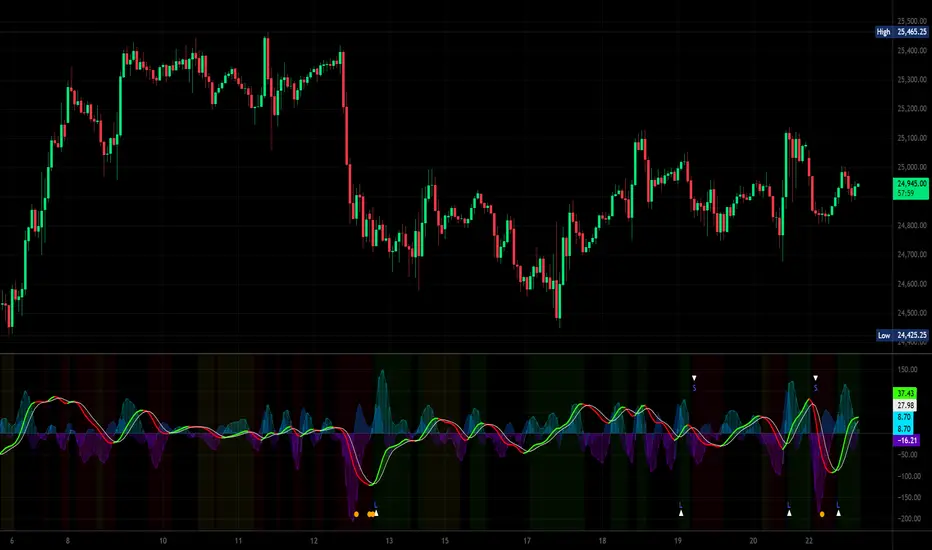
🚀 BK AK–TOMAHAWK — Momentum / Velocity / Acceleration Strike Engine 🚀
🙏 All glory to G-d — the source of wisdom, restraint, and right timing.
Respect to my mentor A.K. — discipline, patience, and structure over noise. He gave freely what most people gatekeep, and I’m grateful for that standard.
Update / Record
A previous version of this publication was hidden due to insufficient description. This republish is a complete explanation of what the script does, how it works, how to interpret it, and how to use it.
What Tomahawk is
Tomahawk is a normalized momentum engine that tracks force in three layers so you stop trading “a crossover” and start trading commitment:
Momentum = directional pressure (normalized ROC)
Velocity = ignition / rate-of-change of momentum
Acceleration = continuation vs failure of ignition
Then it adds permission gates (optional) so the L / S thrust markers only print when the move is authorized by your chosen filters:
Squeeze → Expansion (stored energy → release)
VWAP (intraday) / Trend EMA / Volume gate
HTF alignment
NY session gate
This is not “a color oscillator.” It’s a guidance + permission system.
What you see on the chart (outputs)
Lines & fills
Momentum line (green/red)
Signal line (“ice”)
Fill between momentum and signal (matches momentum color)
Force layers
Velocity (neon columns + optional line)
Acceleration (area under velocity)
Background context
Optional bull/bear zone background (based on most recent confirmed cross + velocity sign)
Optional squeeze background (yellow) during squeeze conditions
Markers
L / S thrust markers = qualified strike events (not every cross)
Exhaustion dots = fuel warning at extremes when acceleration flips against the push
Markers can be drawn in the pane or on the price chart (toggle).
The critical concept: “Early Flip” color is about ignition
Tomahawk can color the momentum line in two ways:
1) Velocity (Early) (default)
Momentum color flips based on velocity with a deadband + memory:
If velocity pushes above leadTh, momentum color flips bullish early.
If velocity drops below −leadTh, it flips bearish early.
If velocity is inside the deadband, it keeps prior state to reduce flicker.
This is designed to show early ignition, not to “predict” direction.
2) Signal (Classic)
Momentum color simply follows mom ≥ signal (traditional oscillator style).
How it works (self-contained, step by step)
1) Momentum core (normalized)
Compute ROC(src, momLen)
Normalize via Z-score over normLen
Scale to oscillator range (× 50)
Smooth into Momentum using your chosen smoother and length
2) Signal line
Smooth Momentum again over sigLen → Signal
3) Velocity + Acceleration (force layers)
Velocity raw = Δ(Momentum)
Normalize velocity (Z-score over velNormLen), scale, smooth → Velocity
Acceleration = Δ(Velocity)
4) Squeeze → Expansion gate (optional)
Uses the standard deviation of velocity raw:
Squeeze when velStd < velStdAvg × sqMult
Expansion when velStd > velStdAvg × expMult
Release = a squeeze occurred and expansion arrives
If enabled, thrust signals can be gated to fire only when squeeze is not active / or on release (per settings logic).
5) HTF alignment (optional)
Runs the same oscillator on your HTF and requires:
Long: HTF mom ≥ HTF signal AND HTF velocity > 0
Short: HTF mom ≤ HTF signal AND HTF velocity < 0
6) Filters (optional)
Trend EMA: long only above EMA / short only below EMA
VWAP (intraday only): long above VWAP / short below VWAP
Volume gate: volume > SMA(volume, volLen) × volMult
NY session gate (optional time filter)
What actually prints “L / S” (Thrust = permission)
A thrust is NOT “cross = entry.”
A thrust requires:
Cross with minimum quality: |mom − signal| ≥ minSep
Ignition: |velocity| ≥ velTh
Continuation: acceleration agrees with the thrust direction
Filters pass (trend/vwap/volume/session if enabled)
HTF alignment passes (if enabled)
Squeeze gate passes (if enabled)
Thrust Long (L)
mom crosses above signal (quality separation)
velocity > velTh
accel > 0
long filters ok + HTF ok + session ok + squeeze gate ok
Thrust Short (S)
mom crosses below signal (quality separation)
velocity < −velTh
accel < 0
short filters ok + HTF ok + session ok + squeeze gate ok
Exhaustion dots (fuel warning, not “magic reversal”)
Exhaustion prints when force is extreme and acceleration flips against it:
Exhaust Up: momentum/velocity extreme while accel turns negative
Exhaust Down: momentum/velocity extreme while accel turns positive
Use it as: trim / protect / stop pressing, not as a guaranteed reversal call.
How to use Tomahawk (simple execution)
If you enable squeeze: wait for release (or you’re early by definition).
Trade L/S thrust markers, not raw crosses.
Use HTF alignment to stop fighting the bigger posture.
Treat exhaustion dots as a greed-check: protect, don’t chase.
Tune quality controls:
minSep cuts spam
velTh demands real ignition
leadTh controls how early color flips (higher = calmer)
Settings that matter most
momLen / normLen: responsiveness vs stability
smoother + momSmoothL + sigLen: “feel” of the engine
leadTh: early flip sensitivity (deadband)
minSep / velTh: signal quality + ignition requirement
useSqueeze + thresholds: best for filtering chop
HTF timeframe: keeps you aligned with the higher engine
VWAP + trend EMA + volume: institutional permission stack
Alerts included
Thrust Long / Thrust Short
Exhaustion Up / Exhaustion Down
What makes it original
Tomahawk isn’t just ROC or a crossover. The edge is the stacked force model + permission doctrine:
momentum normalized (Z-score) so it scales across tickers
velocity and acceleration layers (ignition + continuation)
early color logic with deadband/memory (less flicker, earlier read)
squeeze→expansion gate on velocity volatility
HTF alignment using the same oscillator tuple
optional institutional gates (VWAP / volume / session / trend EMA)
It’s a strike engine built to reduce “pretty cross” entries and demand confirmed force.
Disclaimer
This indicator is for educational/analytical use only and is not financial advice. No indicator guarantees results. Use risk management and test on your market/timeframe.
🙏 All glory to G-d.
🚀 BK AK–Tomahawk — guidance on, permission verified, strike clean. 🚀
🙏 All glory to G-d — the source of wisdom, restraint, and right timing.
Respect to my mentor A.K. — discipline, patience, and structure over noise. He gave freely what most people gatekeep, and I’m grateful for that standard.
Update / Record
A previous version of this publication was hidden due to insufficient description. This republish is a complete explanation of what the script does, how it works, how to interpret it, and how to use it.
What Tomahawk is
Tomahawk is a normalized momentum engine that tracks force in three layers so you stop trading “a crossover” and start trading commitment:
Momentum = directional pressure (normalized ROC)
Velocity = ignition / rate-of-change of momentum
Acceleration = continuation vs failure of ignition
Then it adds permission gates (optional) so the L / S thrust markers only print when the move is authorized by your chosen filters:
Squeeze → Expansion (stored energy → release)
VWAP (intraday) / Trend EMA / Volume gate
HTF alignment
NY session gate
This is not “a color oscillator.” It’s a guidance + permission system.
What you see on the chart (outputs)
Lines & fills
Momentum line (green/red)
Signal line (“ice”)
Fill between momentum and signal (matches momentum color)
Force layers
Velocity (neon columns + optional line)
Acceleration (area under velocity)
Background context
Optional bull/bear zone background (based on most recent confirmed cross + velocity sign)
Optional squeeze background (yellow) during squeeze conditions
Markers
L / S thrust markers = qualified strike events (not every cross)
Exhaustion dots = fuel warning at extremes when acceleration flips against the push
Markers can be drawn in the pane or on the price chart (toggle).
The critical concept: “Early Flip” color is about ignition
Tomahawk can color the momentum line in two ways:
1) Velocity (Early) (default)
Momentum color flips based on velocity with a deadband + memory:
If velocity pushes above leadTh, momentum color flips bullish early.
If velocity drops below −leadTh, it flips bearish early.
If velocity is inside the deadband, it keeps prior state to reduce flicker.
This is designed to show early ignition, not to “predict” direction.
2) Signal (Classic)
Momentum color simply follows mom ≥ signal (traditional oscillator style).
How it works (self-contained, step by step)
1) Momentum core (normalized)
Compute ROC(src, momLen)
Normalize via Z-score over normLen
Scale to oscillator range (× 50)
Smooth into Momentum using your chosen smoother and length
2) Signal line
Smooth Momentum again over sigLen → Signal
3) Velocity + Acceleration (force layers)
Velocity raw = Δ(Momentum)
Normalize velocity (Z-score over velNormLen), scale, smooth → Velocity
Acceleration = Δ(Velocity)
4) Squeeze → Expansion gate (optional)
Uses the standard deviation of velocity raw:
Squeeze when velStd < velStdAvg × sqMult
Expansion when velStd > velStdAvg × expMult
Release = a squeeze occurred and expansion arrives
If enabled, thrust signals can be gated to fire only when squeeze is not active / or on release (per settings logic).
5) HTF alignment (optional)
Runs the same oscillator on your HTF and requires:
Long: HTF mom ≥ HTF signal AND HTF velocity > 0
Short: HTF mom ≤ HTF signal AND HTF velocity < 0
6) Filters (optional)
Trend EMA: long only above EMA / short only below EMA
VWAP (intraday only): long above VWAP / short below VWAP
Volume gate: volume > SMA(volume, volLen) × volMult
NY session gate (optional time filter)
What actually prints “L / S” (Thrust = permission)
A thrust is NOT “cross = entry.”
A thrust requires:
Cross with minimum quality: |mom − signal| ≥ minSep
Ignition: |velocity| ≥ velTh
Continuation: acceleration agrees with the thrust direction
Filters pass (trend/vwap/volume/session if enabled)
HTF alignment passes (if enabled)
Squeeze gate passes (if enabled)
Thrust Long (L)
mom crosses above signal (quality separation)
velocity > velTh
accel > 0
long filters ok + HTF ok + session ok + squeeze gate ok
Thrust Short (S)
mom crosses below signal (quality separation)
velocity < −velTh
accel < 0
short filters ok + HTF ok + session ok + squeeze gate ok
Exhaustion dots (fuel warning, not “magic reversal”)
Exhaustion prints when force is extreme and acceleration flips against it:
Exhaust Up: momentum/velocity extreme while accel turns negative
Exhaust Down: momentum/velocity extreme while accel turns positive
Use it as: trim / protect / stop pressing, not as a guaranteed reversal call.
How to use Tomahawk (simple execution)
If you enable squeeze: wait for release (or you’re early by definition).
Trade L/S thrust markers, not raw crosses.
Use HTF alignment to stop fighting the bigger posture.
Treat exhaustion dots as a greed-check: protect, don’t chase.
Tune quality controls:
minSep cuts spam
velTh demands real ignition
leadTh controls how early color flips (higher = calmer)
Settings that matter most
momLen / normLen: responsiveness vs stability
smoother + momSmoothL + sigLen: “feel” of the engine
leadTh: early flip sensitivity (deadband)
minSep / velTh: signal quality + ignition requirement
useSqueeze + thresholds: best for filtering chop
HTF timeframe: keeps you aligned with the higher engine
VWAP + trend EMA + volume: institutional permission stack
Alerts included
Thrust Long / Thrust Short
Exhaustion Up / Exhaustion Down
What makes it original
Tomahawk isn’t just ROC or a crossover. The edge is the stacked force model + permission doctrine:
momentum normalized (Z-score) so it scales across tickers
velocity and acceleration layers (ignition + continuation)
early color logic with deadband/memory (less flicker, earlier read)
squeeze→expansion gate on velocity volatility
HTF alignment using the same oscillator tuple
optional institutional gates (VWAP / volume / session / trend EMA)
It’s a strike engine built to reduce “pretty cross” entries and demand confirmed force.
Disclaimer
This indicator is for educational/analytical use only and is not financial advice. No indicator guarantees results. Use risk management and test on your market/timeframe.
🙏 All glory to G-d.
🚀 BK AK–Tomahawk — guidance on, permission verified, strike clean. 🚀
Script open-source
Dans l'esprit TradingView, le créateur de ce script l'a rendu open source afin que les traders puissent examiner et vérifier ses fonctionnalités. Bravo à l'auteur! Bien que vous puissiez l'utiliser gratuitement, n'oubliez pas que la republication du code est soumise à nos Règles.

Clause de non-responsabilité
Les informations et publications ne sont pas destinées à être, et ne constituent pas, des conseils ou recommandations financiers, d'investissement, de trading ou autres fournis ou approuvés par TradingView. Pour en savoir plus, consultez les Conditions d'utilisation.
Script open-source
Dans l'esprit TradingView, le créateur de ce script l'a rendu open source afin que les traders puissent examiner et vérifier ses fonctionnalités. Bravo à l'auteur! Bien que vous puissiez l'utiliser gratuitement, n'oubliez pas que la republication du code est soumise à nos Règles.
Clause de non-responsabilité
Les informations et publications ne sont pas destinées à être, et ne constituent pas, des conseils ou recommandations financiers, d'investissement, de trading ou autres fournis ou approuvés par TradingView. Pour en savoir plus, consultez les Conditions d'utilisation.