
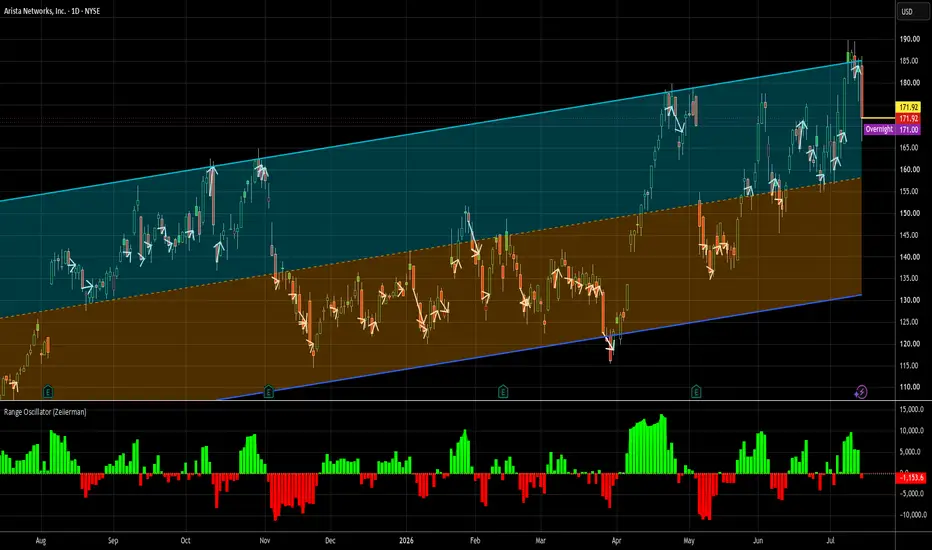
This trade is a little different than what I usually do. It's something I've been playing around with for use during tough times. It's still a mean reversion, but with a little safety net just in case. It could involve a realized loss, so beware if you are used to my trades that don't go that route.
Things feel shaky in this market right now. The fact that they FEEL shaky doesn't mean that they ARE shaky, though. But as with much of trading, I'm no prognosticator where markets are headed - that's way above my pay grade. My normal trading methods are great in choppy non-trending markets, ok but locked out a lot in uptrending regimes and can be downright rough (though almost always ultimately profitable) in downtrends. This is a compromise for in case that last one is where ANET is headed.
As always, the goal here is a quick flip. Essentially there are 3 ways to play those - aggressively trying to squeeze every drop out of the trade; a more neutral version where exits are usually quick but stubborn holds until profit are part of the equation; and then a conservative version - which is the one I'm doing here.
The entry here is based on an abnormally large downward move. The twist is the exit which is based on a 4 part decision tree.
Part one - if the next bar opens above my entry price, I close and walk away with whatever profit I get. These are often small wins. But my game is to beat the average daily return of the market and do it all over again with that same money as soon as the trade clears. So the bar isn't high: more than .043% in one day puts me ahead of the game. If I can get 6x that (about .25%) once every week, I'd beat the market's long term average return. So I have no problem with a small quick win here and that is my preference.
Part 2: If that fails and the stock opens below my entry price tomorrow, then my next target becomes an above median move from that point. Now, if it Is a large gap down at the open, this option may immediately come off the table, as even a move to that level would still be below my entry price and I'm not taking a loss this quickly. But if the median high is above my entry price, I set a limit order at that level and I hope for the best.
Part 3 - If that target does not get hit, I will revisit the trade near the end of the trading day. If closing at that point gives me a profit I take it. And if not...
Part 4 - do it all over again tomorrow the same way. If that bar's open is above my entry, I close. etc. If, however, at the end of the 2nd day I'm still in the red, I eat the loss.
Some general notes about this. First, the most common result is out the next day. For ANET, this technique has had a win rate of 82% over the past year, with an average trade being about .33% with losing trades included in that average. That's around 7.5x the average market return and a level that if annualized, is an around 80% rate of return. Not too shabby. About 75% of the trades have been day 1 wins. Once you get to day 2, it becomes closer to a coin toss.
However, and this is important, losses tend to be asymmetrically large. The key is that they are almost never huge. The average loss was 3.2% over the past year while the average gain was only 1.2%. But an 80% win rate, even with smaller magnitude wins overwhelms the losses. This is not a fluke of recent strength in the stock, either. The dynamics are similar, though a bit weaker, over the long haul.
Over the 12 years since ANET went public, covering 650 backtested and live trades, the win rate on this is around 70%, but the discrepancy between win and loss magnitude is smaller, producing an average daily return on invested capital of .25% - still a 63% annualized rate of return.
The more aggressive ways to trade this would, predictably, lower win rate and raise average gains overall, but jeopardize per day returns (capital efficiency). Given the run that ANET and its cohorts have been on and the weakness this part of the market keeps flirting with, after ANET has clocked a price jump of almost 50% just in the last 3 months, I'm choosing the path fraught with the least amount of short term danger.
If there is a market meltdown, I want my capital available and not tied up for months or years waiting to get back to even. This guarantees not to lock up capital. The biggest loss in the last 12 months on ANET doing this has been 6%. I can make that much on a single trade on one good day. I'll risk the loss for safety and liquidity right now.
By the way, stacking additional lots is possible, provided my entry criteria are met. Additional lots follow the same rules. I'll keep this idea live until all lots have been closed.
As always - this is intended as "edutainment" and my perspective on what I am or would be doing, not a recommendation for you to buy or sell. Act accordingly and invest at your own risk. DYOR and only make investments that make good financial sense for you in your current situation.
Things feel shaky in this market right now. The fact that they FEEL shaky doesn't mean that they ARE shaky, though. But as with much of trading, I'm no prognosticator where markets are headed - that's way above my pay grade. My normal trading methods are great in choppy non-trending markets, ok but locked out a lot in uptrending regimes and can be downright rough (though almost always ultimately profitable) in downtrends. This is a compromise for in case that last one is where ANET is headed.
As always, the goal here is a quick flip. Essentially there are 3 ways to play those - aggressively trying to squeeze every drop out of the trade; a more neutral version where exits are usually quick but stubborn holds until profit are part of the equation; and then a conservative version - which is the one I'm doing here.
The entry here is based on an abnormally large downward move. The twist is the exit which is based on a 4 part decision tree.
Part one - if the next bar opens above my entry price, I close and walk away with whatever profit I get. These are often small wins. But my game is to beat the average daily return of the market and do it all over again with that same money as soon as the trade clears. So the bar isn't high: more than .043% in one day puts me ahead of the game. If I can get 6x that (about .25%) once every week, I'd beat the market's long term average return. So I have no problem with a small quick win here and that is my preference.
Part 2: If that fails and the stock opens below my entry price tomorrow, then my next target becomes an above median move from that point. Now, if it Is a large gap down at the open, this option may immediately come off the table, as even a move to that level would still be below my entry price and I'm not taking a loss this quickly. But if the median high is above my entry price, I set a limit order at that level and I hope for the best.
Part 3 - If that target does not get hit, I will revisit the trade near the end of the trading day. If closing at that point gives me a profit I take it. And if not...
Part 4 - do it all over again tomorrow the same way. If that bar's open is above my entry, I close. etc. If, however, at the end of the 2nd day I'm still in the red, I eat the loss.
Some general notes about this. First, the most common result is out the next day. For ANET, this technique has had a win rate of 82% over the past year, with an average trade being about .33% with losing trades included in that average. That's around 7.5x the average market return and a level that if annualized, is an around 80% rate of return. Not too shabby. About 75% of the trades have been day 1 wins. Once you get to day 2, it becomes closer to a coin toss.
However, and this is important, losses tend to be asymmetrically large. The key is that they are almost never huge. The average loss was 3.2% over the past year while the average gain was only 1.2%. But an 80% win rate, even with smaller magnitude wins overwhelms the losses. This is not a fluke of recent strength in the stock, either. The dynamics are similar, though a bit weaker, over the long haul.
Over the 12 years since ANET went public, covering 650 backtested and live trades, the win rate on this is around 70%, but the discrepancy between win and loss magnitude is smaller, producing an average daily return on invested capital of .25% - still a 63% annualized rate of return.
The more aggressive ways to trade this would, predictably, lower win rate and raise average gains overall, but jeopardize per day returns (capital efficiency). Given the run that ANET and its cohorts have been on and the weakness this part of the market keeps flirting with, after ANET has clocked a price jump of almost 50% just in the last 3 months, I'm choosing the path fraught with the least amount of short term danger.
If there is a market meltdown, I want my capital available and not tied up for months or years waiting to get back to even. This guarantees not to lock up capital. The biggest loss in the last 12 months on ANET doing this has been 6%. I can make that much on a single trade on one good day. I'll risk the loss for safety and liquidity right now.
By the way, stacking additional lots is possible, provided my entry criteria are met. Additional lots follow the same rules. I'll keep this idea live until all lots have been closed.
As always - this is intended as "edutainment" and my perspective on what I am or would be doing, not a recommendation for you to buy or sell. Act accordingly and invest at your own risk. DYOR and only make investments that make good financial sense for you in your current situation.
Catatan
So obviously, that did not go as planned, but hey, that's trading. I closed this lot for a 2 day loss of -1.93%. I've decided, just for the heck of it, to keep the idea open and do it again the next time ANET rates a buy. On average, that's just under once a week over the last 14 years. But unless it goes on a heater, it will likely be once a week or so. So far this year, there have been about 4.7 signals per month, so that's about 1 a week. I'll keep an eye on it and post here if something happens.Current results (total = -1.93% / -0.97% per lot per day):
Lot 1: -1.93% in 2 trading days (x) - x = closed
Catatan
A little follow up on why I am not sad about the first lot loss and why I do this type of trading in times of "stress" for a stock. First of all, let's be clear - I expect to make money on every trade. I have a positive long term bias working in my favor. But it doesn't always work and that's just trading. Sometimes you just run into a bad beat. But IF this was or is the beginning of a down market for ANET, the image below is why I'm not scared. It represents the last 3 large corrections in ANET, each involving a drawdown of a buy and hold position of 20% or more. The text boxes with yellow text represent the difference in returns between trading it this way (the first number), and buying and holding from peak to trough. That consistent outperformance during drawdowns is a function of 2 things built into this method.
The first is that I harvest wins on some days that would otherwise be down days by either selling at the open or intraday at my sell limit point. There were 14 times during those 3 drawdown events where I turned what would otherwise have been a daily loss into a gain and also avoided further downside risk by closing my position doing that.
The second is that during the drops, I'm not in every day. On this trade, for example, I entered on July 15th at the close, but I did not add on the next close even though the stock was down that day, because it just wasn't down ENOUGH. Now that cost me a whole nickel on that particular non-trade and sometimes it costs me more. But it generally saves me a lot more money than it loses me.
On this most recent downtrend, for example I was not in on July 13th or 15th. I got in at the END of both those days, avoiding their drops. Combined, those 2 days have produced 8.04% of the current 9.81% drawdown. On the 14th I got out at the open with a +1.52% gain and we all know how this trade went. But combined, I have only lost 0.41% while the stock dropped 9.81% since the July 12 closing high. That is typical for how this method works. You occasionally catch the whole downward move, but it's rare if there's any real size to that move and it takes place over at least several days and not all at once.
The other big reason I can shrug this trade off, even though it is a loss, is what typically happens once the pullback bottoms. Check out the white horizontal arrows. Those mark the move from the pre-drawdown peak to the close of the bar when buy and hold would get back to even. In all 3 of the pullbacks shown here, because I didn't lose nearly as much as the stock did, by the time the stock is back to even, I've outperformed. Almost always, that outperformance is also profitable. After that 50% drawdown, for example, the stock had to rise over 100% just to get back to even. I didn't have to do that. While I will get outperformed by a lot on relentless bull runs, this is how I dramatically outperform on the way down.
The side benefit, too, is that it smooths my equity curve and limits my portfolio's volatility as a result. You just don't understand how much less psychologically draining trading is when you don't worry about catastrophic losses. It's almost impossible on a portfolio level for me to have to endure a catastrophic loss with this trading method. Not losing a ton of capital allows me to benefit from compounding more than I would if I was constantly having to make back all the money I'd lost in the last big correction.
Finally, perhaps the biggest piece of this that isn't possible to visualize here is the difference in time invested. Those 3 pullbacks and the time it took to get back to even represent over a year of "dead money" from a buy and hold perspective. If you look at the white horizontal arrows, they also show the disparity between the total time my capital was locked up here by comparison - about 1/3 that of buy and hold.
Now that may not seem like a big deal, but I do not give my cash time off if I can help it. Every day new tickers flash buy signals, and every day capital is locked up here is one less opportunity for me to make money elsewhere. The average trade length on these trades is well less than 2 days. That gets me my money (or a quick loss) in time for me to deploy the cash elsewhere - and that's a massive win that does not show up here.
For example - during these 3 arguably poor periods, I made about .43% per lot invested per day. But that means that on the over 200 days my money WASN"T here, it could have been making .43% somewhere else, potentially. Obviously I'm ignoring cash drag resulting from the T+1 clearing rules, but even if only 2/3 of the days it wasn't here the capital was deployed making that much elsewhere, that would add another 58% to my gains. Even if it only earned an average daily market return of 10x less than that (doubtful), I still get almost 6% tacked onto what I made here. There is a real capital efficiency/opportunity cost drag to buying and holding through downtrends that most people fail to realize.
I just wanted to add some context that wasn't part of the original idea that gives a little more of a window into the method and rationale behind my madness. I hope this helps.
Catatan
Just a quick clarification of something I said above that requires context. I mentioned that it was almost impossible for me to have a catastrophic loss on a portfolio level. That is emphatically NOT a call to plunk down a ton of money on one of these trades - ESPECIALLY if you are near earnings. The reason it's almost impossible for me to lose catastrophically is only partly because I don't lose as much during drawdowns. It has as much or more to do with the fact that it is unlikely, given how I construct my portfolio, for ALL of my stocks to plummet at once. But during the worst market actions (2008, the COVID meltdown, etc) correlations approach one an everything goes down. But usually not all on the same day and like the examples above, not even close to the same magnitude as the stocks themselves undergo.The other part, which I may also do a post on at some point, is position sizing from a risk perspective. The ANET position at MOST, could have 3% of my portfolio allocated to it. That means if by some chance, I'm holding 2 lots (my max here) on a day when ANET drops 50%, my portfolio is only dented by 1.5% by that move. I'm not a gambler, even though I think about risk and odds like one. My goal is a relentlessly and incrementally rising equity curve, not the kind of boom and bust drops you get when you plunk your whole wad of cash down on red at the roulette wheel (or SPCX here in the market). Be smart with your capital.

Pernyataan Penyangkalan
Informasi dan publikasi ini tidak dimaksudkan, dan bukan merupakan, saran atau rekomendasi keuangan, investasi, trading, atau jenis lainnya yang diberikan atau didukung oleh TradingView. Baca selengkapnya di Ketentuan Penggunaan.
Pernyataan Penyangkalan
Informasi dan publikasi ini tidak dimaksudkan, dan bukan merupakan, saran atau rekomendasi keuangan, investasi, trading, atau jenis lainnya yang diberikan atau didukung oleh TradingView. Baca selengkapnya di Ketentuan Penggunaan.