
1. Introduction
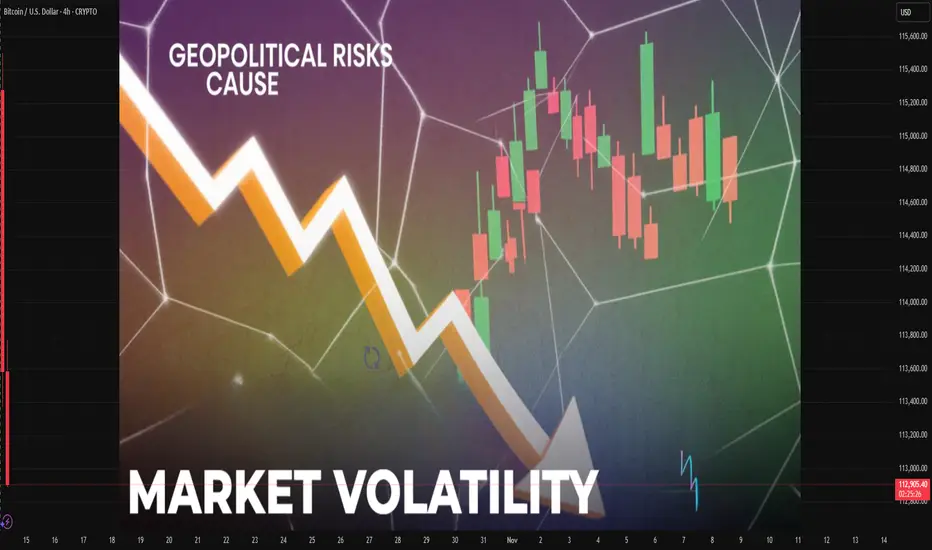
Financial markets thrive on stability, transparency, and predictability. However, the world is rarely stable — political tensions, wars, trade disputes, and diplomatic breakdowns often disrupt this equilibrium. These disruptions, known as geopolitical risks, can trigger market volatility — sharp fluctuations in asset prices as investors react to uncertainty. In the modern interconnected world, where economies are tightly woven through trade and capital flows, even a local conflict can send ripples across global markets.
The interplay between geopolitics and market volatility is not new. From oil shocks in the 1970s to Russia’s invasion of Ukraine in 2022, geopolitical events have consistently tested global investors’ ability to manage uncertainty. Today, as the world faces new risks — shifting power dynamics, energy crises, cyber warfare, and climate-related security threats — understanding how geopolitics drives market behavior has become essential for policymakers, investors, and businesses.
2. Understanding Geopolitical Risk
Geopolitical risk refers to the probability that political, social, or military events will adversely impact the global economy or financial markets. These risks often arise from the actions of states, non-state actors, or changes in global governance systems. Unlike financial or operational risks, geopolitical risks are exogenous — they originate outside the economic system and are harder to predict or quantify.
2.1 Types of Geopolitical Risks
Military Conflicts and Wars
Wars directly disrupt trade, energy supply, and investment flows. For example, the 2022 Russia–Ukraine war reshaped global energy markets and led to inflationary shocks in Europe and beyond.
Trade Wars and Economic Sanctions
When major economies impose tariffs or sanctions, global supply chains are affected. The U.S.–China trade war (2018–2020) disrupted global technology and manufacturing sectors, reducing investor confidence.
Political Instability and Regime Change
Coups, elections, or political transitions can create uncertainty about policy continuity. Investors tend to withdraw capital from politically unstable regions, leading to currency depreciation and stock market sell-offs.
Terrorism and Security Threats
Terrorist attacks, such as those on September 11, 2001, can cause short-term panic and long-term risk repricing in financial markets.
Resource Conflicts and Energy Security
Countries competing for oil, gas, or rare earth minerals can destabilize markets. For instance, tensions in the Strait of Hormuz — through which 20% of the world’s oil passes — often cause crude prices to spike.
Cyber Warfare and Information Attacks
State-sponsored cyberattacks on financial institutions or critical infrastructure can disrupt global capital markets and reduce trust in digital systems.
Global Alliances and Sanctions Regimes
Shifting alliances like BRICS expansion, NATO dynamics, or Western sanctions can reshape global trade, currency reserves, and capital flows.
3. Mechanisms Linking Geopolitics to Market Volatility
Geopolitical events affect markets through multiple channels, both direct and indirect.
3.1 Investor Sentiment and Risk Aversion
When geopolitical tensions rise, investors tend to move from risky assets (equities, emerging-market bonds) to safer ones (U.S. Treasuries, gold, and the U.S. dollar). This phenomenon, called the “flight to safety”, leads to a sell-off in risk assets and a rally in safe havens. For example:
During the Russia–Ukraine conflict, gold prices surged above $2,000 per ounce as investors sought refuge.
U.S. Treasury yields fell as investors bought bonds, despite inflation concerns.
3.2 Impact on Trade and Supply Chains
Wars, sanctions, or tariffs can disrupt global supply chains, raising production costs and slowing growth. For example:
The Red Sea shipping disruptions and Taiwan Strait tensions have threatened semiconductor and energy transport routes.
Higher logistics costs translate to inflation, which affects central bank policies and, in turn, financial markets.
3.3 Energy and Commodity Prices
Energy markets are particularly sensitive to geopolitical risk. Oil prices react sharply to conflicts in the Middle East, OPEC decisions, or Russian production cuts. Since energy costs feed into nearly all economic sectors, geopolitical shocks often lead to global inflation.
3.4 Currency and Capital Flows
Political instability often leads to currency depreciation as investors withdraw capital. Emerging markets are especially vulnerable — for instance, Turkey’s lira or Argentina’s peso tend to fall during domestic or regional instability. Conversely, “safe-haven” currencies such as the U.S. dollar, Swiss franc, and Japanese yen typically strengthen.
3.5 Central Bank and Policy Reactions
Geopolitical risks force central banks to navigate between inflation control and financial stability. For example:
The European Central Bank (ECB) struggled to balance energy-driven inflation with growth risks following the Ukraine war.
The U.S. Federal Reserve may slow rate hikes during heightened uncertainty to prevent market collapse.
4. Historical Case Studies of Geopolitical Volatility
4.1 The 1973 Oil Crisis
Triggered by the Arab–Israeli conflict and OPEC’s oil embargo, crude oil prices quadrupled within months. Global inflation soared, causing recessions in Western economies. Stock markets worldwide plunged, and the crisis redefined energy security as a core geopolitical concern.
4.2 The Gulf Wars (1990–1991, 2003)
Both Gulf Wars caused spikes in oil prices and temporary global market corrections. While short-lived, these shocks reinforced the sensitivity of markets to Middle Eastern instability.
4.3 9/11 Terrorist Attacks (2001)
The September 11 attacks led to the closure of U.S. stock exchanges for nearly a week. When trading resumed, the Dow Jones Industrial Average fell over 7% in one day — the largest single-day drop at the time. The shock also reshaped global security spending and introduced new risk metrics into financial modeling.
4.4 The U.S.–China Trade War (2018–2020)
The imposition of tariffs on billions of dollars of goods disrupted supply chains, hurt technology stocks, and weakened global growth forecasts. Investors fled emerging markets, and volatility indices like the VIX surged repeatedly during trade negotiations.
4.5 Russia–Ukraine Conflict (2022–Present)
This conflict triggered one of the largest market disruptions since 2008. Energy prices soared, European equities dropped sharply, and inflation rose globally. The war accelerated global de-dollarization trends, strengthened NATO alliances, and spurred defense sector growth — all while increasing market uncertainty.
5. Measuring Geopolitical Risk
5.1 The Geopolitical Risk Index (GPR)
Developed by Caldara and Iacoviello (2018), the GPR Index quantifies geopolitical tensions using newspaper coverage of wars, terrorist acts, and political crises. It provides a statistical measure to correlate geopolitical shocks with financial volatility.
5.2 Market Volatility Index (VIX)
Known as the “fear index,” the VIX measures implied volatility in S&P 500 options. During geopolitical crises, the VIX typically spikes — reflecting investors’ anxiety about future price swings.
5.3 Credit Default Swaps (CDS) and Bond Spreads
When geopolitical risks rise, sovereign bond spreads widen, and CDS prices increase — signaling that investors demand higher premiums for holding risky debt.
6. Asset Class Responses to Geopolitical Shocks
6.1 Equities
Short-term reaction: Immediate sell-offs due to uncertainty.
Medium-term: Recovery often depends on how the conflict evolves.
Sector performance: Defense, energy, and cybersecurity stocks often outperform during crises.
6.2 Fixed Income
Government bonds — especially U.S. Treasuries — act as safe havens. Yields typically fall as bond prices rise. However, inflation-linked bonds may perform better when geopolitical shocks cause price spikes.
6.3 Commodities
Gold, silver, and oil are the most sensitive commodities to geopolitical risk.
Gold = hedge against uncertainty.
Oil = reflects conflict-related supply fears.
Agricultural commodities = affected by sanctions or export bans (e.g., Ukraine’s grain crisis).
6.4 Currencies
Safe-haven currencies (USD, JPY, CHF) gain during crises, while risk-sensitive ones (AUD, emerging-market FX) weaken. Sanctions can cause currency collapses, as seen with the Russian ruble in early 2022.
6.5 Cryptocurrencies
Bitcoin and other digital assets have shown mixed reactions — sometimes acting as alternative hedges, though volatility remains high. During the Russia–Ukraine war, crypto transfers surged as citizens sought to bypass banking disruptions.
7. The Role of Media, Information, and Speculation
In the digital age, information speed amplifies volatility. News outlets, social media, and algorithmic trading systems react instantly to geopolitical headlines. False or exaggerated reports can cause flash crashes or speculative bubbles.
For instance, a single tweet about potential military action or sanctions can trigger billions in market movements within seconds. This information-driven volatility underscores the role of behavioral finance — where investor psychology magnifies reactions to uncertainty.
8. Managing Geopolitical Risk in Investment Strategy
8.1 Diversification
Geographically diversified portfolios can cushion against regional shocks. Holding assets across continents or currencies reduces exposure to any single geopolitical event.
8.2 Safe-Haven Allocation
Investors often include gold, U.S. Treasuries, or defensive stocks (utilities, consumer staples) in portfolios to offset riskier holdings during crises.
8.3 Hedging Instruments
Options, futures, and currency forwards allow investors to hedge geopolitical risk. For instance, crude oil futures can protect against energy price spikes.
8.4 Scenario Analysis and Stress Testing
Institutional investors model “what-if” scenarios (e.g., China–Taiwan conflict, Middle East escalation) to assess portfolio resilience. Stress testing helps anticipate extreme outcomes.
8.5 Political Risk Insurance
Multinational corporations use political risk insurance to mitigate losses from expropriation, contract breaches, or civil unrest.
9. Emerging Geopolitical Themes Affecting Markets
9.1 U.S.–China Rivalry
Beyond trade, competition extends into technology (AI, semiconductors, 5G) and global governance. “Tech decoupling” may reshape global supply chains and capital flows.
9.2 The Rise of Multipolarity
The post-Cold War unipolar world is giving way to a multipolar one — where the U.S., China, Russia, India, and regional powers like Saudi Arabia assert influence. This creates overlapping alliances and uncertainty in global trade.
9.3 Energy Transition and Green Geopolitics
As nations shift toward renewable energy, control over critical minerals (lithium, cobalt, nickel) becomes strategic. The geopolitical race for green resources could replicate past oil conflicts.
9.4 Cyber and Information Warfare
Modern conflicts often occur in cyberspace — targeting infrastructure, elections, or corporate systems. The financial cost of cyber incidents can exceed physical warfare impacts.
9.5 Middle East and Energy Stability
Tensions involving Iran, Israel, and Gulf states continue to influence oil and gas supply expectations, shaping inflation and central bank decisions.
9.6 Climate and Migration Pressures
Climate-induced displacement, food insecurity, and water scarcity are emerging geopolitical flashpoints that can trigger political instability and financial disruption.
10. Long-Term Implications for Global Markets
Geopolitical risks are no longer isolated shocks — they are structural forces shaping long-term investment strategy. Globalization is evolving toward “selective interdependence”, where nations collaborate in some areas but compete fiercely in others. Investors must adapt to a world where volatility is structural, not temporary.
10.1 Regionalization of Trade and Finance
Global supply chains are being reconfigured toward “friend-shoring” — producing goods in politically aligned countries. This reduces efficiency but enhances resilience.
10.2 Defense and Security Spending Boom
Nations are ramping up defense budgets, benefitting aerospace and cybersecurity sectors. Investors view these as long-term growth areas.
10.3 Inflationary Geopolitics
Energy and commodity disruptions keep inflation structurally higher, challenging central banks and altering interest rate expectations.
10.4 Financial Fragmentation
The global financial system may divide along geopolitical lines — with parallel payment systems, currency blocs, and reserve diversification away from the U.S. dollar.
11. Conclusion
Geopolitical risks and market volatility are inseparable components of the global financial ecosystem. From oil shocks and trade wars to cyber conflicts and power shifts, political dynamics shape investor sentiment, asset prices, and capital flows.
While technology has made markets faster and more efficient, it has also magnified the speed at which geopolitical uncertainty spreads. The challenge for investors is not to avoid geopolitical risk — which is impossible — but to understand, anticipate, and adapt to it.
In a world where power is diffused, alliances are shifting, and crises are increasingly interconnected, the ability to interpret geopolitical signals will define the next generation of successful investors and policymakers.
Ultimately, geopolitical awareness is not optional — it is a strategic necessity in managing portfolios, protecting economies, and ensuring stability in an unpredictable global landscape.
Financial markets thrive on stability, transparency, and predictability. However, the world is rarely stable — political tensions, wars, trade disputes, and diplomatic breakdowns often disrupt this equilibrium. These disruptions, known as geopolitical risks, can trigger market volatility — sharp fluctuations in asset prices as investors react to uncertainty. In the modern interconnected world, where economies are tightly woven through trade and capital flows, even a local conflict can send ripples across global markets.
The interplay between geopolitics and market volatility is not new. From oil shocks in the 1970s to Russia’s invasion of Ukraine in 2022, geopolitical events have consistently tested global investors’ ability to manage uncertainty. Today, as the world faces new risks — shifting power dynamics, energy crises, cyber warfare, and climate-related security threats — understanding how geopolitics drives market behavior has become essential for policymakers, investors, and businesses.
2. Understanding Geopolitical Risk
Geopolitical risk refers to the probability that political, social, or military events will adversely impact the global economy or financial markets. These risks often arise from the actions of states, non-state actors, or changes in global governance systems. Unlike financial or operational risks, geopolitical risks are exogenous — they originate outside the economic system and are harder to predict or quantify.
2.1 Types of Geopolitical Risks
Military Conflicts and Wars
Wars directly disrupt trade, energy supply, and investment flows. For example, the 2022 Russia–Ukraine war reshaped global energy markets and led to inflationary shocks in Europe and beyond.
Trade Wars and Economic Sanctions
When major economies impose tariffs or sanctions, global supply chains are affected. The U.S.–China trade war (2018–2020) disrupted global technology and manufacturing sectors, reducing investor confidence.
Political Instability and Regime Change
Coups, elections, or political transitions can create uncertainty about policy continuity. Investors tend to withdraw capital from politically unstable regions, leading to currency depreciation and stock market sell-offs.
Terrorism and Security Threats
Terrorist attacks, such as those on September 11, 2001, can cause short-term panic and long-term risk repricing in financial markets.
Resource Conflicts and Energy Security
Countries competing for oil, gas, or rare earth minerals can destabilize markets. For instance, tensions in the Strait of Hormuz — through which 20% of the world’s oil passes — often cause crude prices to spike.
Cyber Warfare and Information Attacks
State-sponsored cyberattacks on financial institutions or critical infrastructure can disrupt global capital markets and reduce trust in digital systems.
Global Alliances and Sanctions Regimes
Shifting alliances like BRICS expansion, NATO dynamics, or Western sanctions can reshape global trade, currency reserves, and capital flows.
3. Mechanisms Linking Geopolitics to Market Volatility
Geopolitical events affect markets through multiple channels, both direct and indirect.
3.1 Investor Sentiment and Risk Aversion
When geopolitical tensions rise, investors tend to move from risky assets (equities, emerging-market bonds) to safer ones (U.S. Treasuries, gold, and the U.S. dollar). This phenomenon, called the “flight to safety”, leads to a sell-off in risk assets and a rally in safe havens. For example:
During the Russia–Ukraine conflict, gold prices surged above $2,000 per ounce as investors sought refuge.
U.S. Treasury yields fell as investors bought bonds, despite inflation concerns.
3.2 Impact on Trade and Supply Chains
Wars, sanctions, or tariffs can disrupt global supply chains, raising production costs and slowing growth. For example:
The Red Sea shipping disruptions and Taiwan Strait tensions have threatened semiconductor and energy transport routes.
Higher logistics costs translate to inflation, which affects central bank policies and, in turn, financial markets.
3.3 Energy and Commodity Prices
Energy markets are particularly sensitive to geopolitical risk. Oil prices react sharply to conflicts in the Middle East, OPEC decisions, or Russian production cuts. Since energy costs feed into nearly all economic sectors, geopolitical shocks often lead to global inflation.
3.4 Currency and Capital Flows
Political instability often leads to currency depreciation as investors withdraw capital. Emerging markets are especially vulnerable — for instance, Turkey’s lira or Argentina’s peso tend to fall during domestic or regional instability. Conversely, “safe-haven” currencies such as the U.S. dollar, Swiss franc, and Japanese yen typically strengthen.
3.5 Central Bank and Policy Reactions
Geopolitical risks force central banks to navigate between inflation control and financial stability. For example:
The European Central Bank (ECB) struggled to balance energy-driven inflation with growth risks following the Ukraine war.
The U.S. Federal Reserve may slow rate hikes during heightened uncertainty to prevent market collapse.
4. Historical Case Studies of Geopolitical Volatility
4.1 The 1973 Oil Crisis
Triggered by the Arab–Israeli conflict and OPEC’s oil embargo, crude oil prices quadrupled within months. Global inflation soared, causing recessions in Western economies. Stock markets worldwide plunged, and the crisis redefined energy security as a core geopolitical concern.
4.2 The Gulf Wars (1990–1991, 2003)
Both Gulf Wars caused spikes in oil prices and temporary global market corrections. While short-lived, these shocks reinforced the sensitivity of markets to Middle Eastern instability.
4.3 9/11 Terrorist Attacks (2001)
The September 11 attacks led to the closure of U.S. stock exchanges for nearly a week. When trading resumed, the Dow Jones Industrial Average fell over 7% in one day — the largest single-day drop at the time. The shock also reshaped global security spending and introduced new risk metrics into financial modeling.
4.4 The U.S.–China Trade War (2018–2020)
The imposition of tariffs on billions of dollars of goods disrupted supply chains, hurt technology stocks, and weakened global growth forecasts. Investors fled emerging markets, and volatility indices like the VIX surged repeatedly during trade negotiations.
4.5 Russia–Ukraine Conflict (2022–Present)
This conflict triggered one of the largest market disruptions since 2008. Energy prices soared, European equities dropped sharply, and inflation rose globally. The war accelerated global de-dollarization trends, strengthened NATO alliances, and spurred defense sector growth — all while increasing market uncertainty.
5. Measuring Geopolitical Risk
5.1 The Geopolitical Risk Index (GPR)
Developed by Caldara and Iacoviello (2018), the GPR Index quantifies geopolitical tensions using newspaper coverage of wars, terrorist acts, and political crises. It provides a statistical measure to correlate geopolitical shocks with financial volatility.
5.2 Market Volatility Index (VIX)
Known as the “fear index,” the VIX measures implied volatility in S&P 500 options. During geopolitical crises, the VIX typically spikes — reflecting investors’ anxiety about future price swings.
5.3 Credit Default Swaps (CDS) and Bond Spreads
When geopolitical risks rise, sovereign bond spreads widen, and CDS prices increase — signaling that investors demand higher premiums for holding risky debt.
6. Asset Class Responses to Geopolitical Shocks
6.1 Equities
Short-term reaction: Immediate sell-offs due to uncertainty.
Medium-term: Recovery often depends on how the conflict evolves.
Sector performance: Defense, energy, and cybersecurity stocks often outperform during crises.
6.2 Fixed Income
Government bonds — especially U.S. Treasuries — act as safe havens. Yields typically fall as bond prices rise. However, inflation-linked bonds may perform better when geopolitical shocks cause price spikes.
6.3 Commodities
Gold, silver, and oil are the most sensitive commodities to geopolitical risk.
Gold = hedge against uncertainty.
Oil = reflects conflict-related supply fears.
Agricultural commodities = affected by sanctions or export bans (e.g., Ukraine’s grain crisis).
6.4 Currencies
Safe-haven currencies (USD, JPY, CHF) gain during crises, while risk-sensitive ones (AUD, emerging-market FX) weaken. Sanctions can cause currency collapses, as seen with the Russian ruble in early 2022.
6.5 Cryptocurrencies
Bitcoin and other digital assets have shown mixed reactions — sometimes acting as alternative hedges, though volatility remains high. During the Russia–Ukraine war, crypto transfers surged as citizens sought to bypass banking disruptions.
7. The Role of Media, Information, and Speculation
In the digital age, information speed amplifies volatility. News outlets, social media, and algorithmic trading systems react instantly to geopolitical headlines. False or exaggerated reports can cause flash crashes or speculative bubbles.
For instance, a single tweet about potential military action or sanctions can trigger billions in market movements within seconds. This information-driven volatility underscores the role of behavioral finance — where investor psychology magnifies reactions to uncertainty.
8. Managing Geopolitical Risk in Investment Strategy
8.1 Diversification
Geographically diversified portfolios can cushion against regional shocks. Holding assets across continents or currencies reduces exposure to any single geopolitical event.
8.2 Safe-Haven Allocation
Investors often include gold, U.S. Treasuries, or defensive stocks (utilities, consumer staples) in portfolios to offset riskier holdings during crises.
8.3 Hedging Instruments
Options, futures, and currency forwards allow investors to hedge geopolitical risk. For instance, crude oil futures can protect against energy price spikes.
8.4 Scenario Analysis and Stress Testing
Institutional investors model “what-if” scenarios (e.g., China–Taiwan conflict, Middle East escalation) to assess portfolio resilience. Stress testing helps anticipate extreme outcomes.
8.5 Political Risk Insurance
Multinational corporations use political risk insurance to mitigate losses from expropriation, contract breaches, or civil unrest.
9. Emerging Geopolitical Themes Affecting Markets
9.1 U.S.–China Rivalry
Beyond trade, competition extends into technology (AI, semiconductors, 5G) and global governance. “Tech decoupling” may reshape global supply chains and capital flows.
9.2 The Rise of Multipolarity
The post-Cold War unipolar world is giving way to a multipolar one — where the U.S., China, Russia, India, and regional powers like Saudi Arabia assert influence. This creates overlapping alliances and uncertainty in global trade.
9.3 Energy Transition and Green Geopolitics
As nations shift toward renewable energy, control over critical minerals (lithium, cobalt, nickel) becomes strategic. The geopolitical race for green resources could replicate past oil conflicts.
9.4 Cyber and Information Warfare
Modern conflicts often occur in cyberspace — targeting infrastructure, elections, or corporate systems. The financial cost of cyber incidents can exceed physical warfare impacts.
9.5 Middle East and Energy Stability
Tensions involving Iran, Israel, and Gulf states continue to influence oil and gas supply expectations, shaping inflation and central bank decisions.
9.6 Climate and Migration Pressures
Climate-induced displacement, food insecurity, and water scarcity are emerging geopolitical flashpoints that can trigger political instability and financial disruption.
10. Long-Term Implications for Global Markets
Geopolitical risks are no longer isolated shocks — they are structural forces shaping long-term investment strategy. Globalization is evolving toward “selective interdependence”, where nations collaborate in some areas but compete fiercely in others. Investors must adapt to a world where volatility is structural, not temporary.
10.1 Regionalization of Trade and Finance
Global supply chains are being reconfigured toward “friend-shoring” — producing goods in politically aligned countries. This reduces efficiency but enhances resilience.
10.2 Defense and Security Spending Boom
Nations are ramping up defense budgets, benefitting aerospace and cybersecurity sectors. Investors view these as long-term growth areas.
10.3 Inflationary Geopolitics
Energy and commodity disruptions keep inflation structurally higher, challenging central banks and altering interest rate expectations.
10.4 Financial Fragmentation
The global financial system may divide along geopolitical lines — with parallel payment systems, currency blocs, and reserve diversification away from the U.S. dollar.
11. Conclusion
Geopolitical risks and market volatility are inseparable components of the global financial ecosystem. From oil shocks and trade wars to cyber conflicts and power shifts, political dynamics shape investor sentiment, asset prices, and capital flows.
While technology has made markets faster and more efficient, it has also magnified the speed at which geopolitical uncertainty spreads. The challenge for investors is not to avoid geopolitical risk — which is impossible — but to understand, anticipate, and adapt to it.
In a world where power is diffused, alliances are shifting, and crises are increasingly interconnected, the ability to interpret geopolitical signals will define the next generation of successful investors and policymakers.
Ultimately, geopolitical awareness is not optional — it is a strategic necessity in managing portfolios, protecting economies, and ensuring stability in an unpredictable global landscape.

Publikasi terkait
Pernyataan Penyangkalan
Informasi dan publikasi ini tidak dimaksudkan, dan bukan merupakan, saran atau rekomendasi keuangan, investasi, trading, atau jenis lainnya yang diberikan atau didukung oleh TradingView. Baca selengkapnya di Ketentuan Penggunaan.
Publikasi terkait
Pernyataan Penyangkalan
Informasi dan publikasi ini tidak dimaksudkan, dan bukan merupakan, saran atau rekomendasi keuangan, investasi, trading, atau jenis lainnya yang diberikan atau didukung oleh TradingView. Baca selengkapnya di Ketentuan Penggunaan.