
🔵 Stop-Loss Blueprint: How to Quit Getting Wicked Out Early
Difficulty: 🐳🐳🐋🐋🐋 (Beginner-Friendly)
It is the most frustrating feeling in trading: you entry a trade, price moves directly to your stop-loss, "wicks" you out by a single pip, and then immediately runs toward your take-profit target. In this blueprint, you will learn how to hide your stops behind institutional walls so you can stay in the move.

🔵 THE RETAIL MISTAKE: THE "RANDOM NUMBER" STOP
Most beginners place their stop-losses based on a random number of pips (e.g., "I always use a 10-pip stop") or right at an obvious support line.
The problem? The interbank algorithms are designed to hunt these exact areas to collect liquidity before expanding. If your stop-loss is resting right where everyone else's is, it becomes a target.
The Institutional Rule: Your stop-loss should never be placed where you hope price won't go. It must be placed where the setup is completely invalidated.
🔵 HIDING BEHIND CONFLUENCE WALLS
Think of your stop-loss like a shield. You don't want to leave it out in the open; you want to hide it behind solid walls.
When analyzing market structure, you have three major structural walls to protect your trade:

Professional Takeaway: When multiple walls overlap, you have a high-confluence zone. You can place a tight, highly secure stop-loss just underneath and catch massive 4+ Risk-to-Reward moves easily.
🔵 HOW TO PLACE YOUR STOP LIKE A PRO
1. The "Protected Low" Strategy (Long Setups)
When buying after a Market Structure Shift (MSS) or CISD, do not place your stop right at the entry trigger candle. Place it 2–3 pips below the swing low that swept the liquidity.

If price returns to break that low, it means the manipulation wasn't a fakeout—it means the trend is actually broken. Your setup is dead, and you want to be out.

2. The "Breaker" Shield
If you are entering on a Breaker Block or a mitigation play, hide your stop-loss just behind the invalidation level of that specific block. If the algorithm respects the zone, price should not cross into the invalidation area.

🔵 THE RISK-TO-REWARD (R:R) SOLUTION
Traders often use tight, dangerous stops because they want a huge Risk-to-Reward ratio (like 1:10). But a 1:10 trade is useless if you get stopped out 90% of the time.
The Fix: Give your trade room to breathe. A wider, structurally safe stop-loss combined with a target at a major Liquidity Void will give you a higher win rate and a cleaner, stress-free execution.
🔵 EXAMPLE TRADING CHECKLIST
The "Safe Shield" Framework
🔵 CONCLUSION
Stop letting the algorithm use your account as fuel. By placing your stop-loss behind valid structural invalidation levels instead of random pip counts, you transform your stop from an easy target into a highly protected fortress.
Do you use a fixed pip count for your stops, or do you hide them behind structural wicks? Let us know your approach below!
Difficulty: 🐳🐳🐋🐋🐋 (Beginner-Friendly)
It is the most frustrating feeling in trading: you entry a trade, price moves directly to your stop-loss, "wicks" you out by a single pip, and then immediately runs toward your take-profit target. In this blueprint, you will learn how to hide your stops behind institutional walls so you can stay in the move.
🔵 THE RETAIL MISTAKE: THE "RANDOM NUMBER" STOP
Most beginners place their stop-losses based on a random number of pips (e.g., "I always use a 10-pip stop") or right at an obvious support line.
The problem? The interbank algorithms are designed to hunt these exact areas to collect liquidity before expanding. If your stop-loss is resting right where everyone else's is, it becomes a target.
The Institutional Rule: Your stop-loss should never be placed where you hope price won't go. It must be placed where the setup is completely invalidated.
🔵 HIDING BEHIND CONFLUENCE WALLS
Think of your stop-loss like a shield. You don't want to leave it out in the open; you want to hide it behind solid walls.
When analyzing market structure, you have three major structural walls to protect your trade:
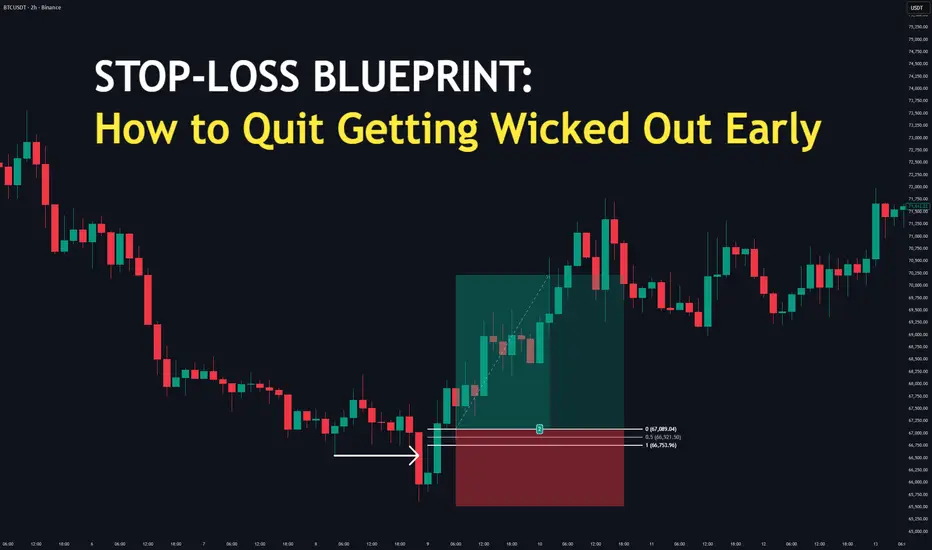
- Wall 1: The Manipulation Wick (The Floor): Look at the horizontal white arrow at the bottom left. This wick hunted the weak retail stops. Your ultimate structural invalidation point lives safely below the low of this wick.
- Wall 2: The Order Block Anchor (The Blue Box): The blue shaded rectangle highlights the institutional order block candle at the absolute bottom. The opening price of this block acts as the heavy defensive floor.
- Wall 3: The Equilibrium Level (0.5): Look at the Fibonacci grid on the right. The 0.5 level (66,462.45) marks the middle of the pullback range. Notice how price pulls back through equilibrium to mitigate the order block below it before violently exploding into profit.
Professional Takeaway: When multiple walls overlap, you have a high-confluence zone. You can place a tight, highly secure stop-loss just underneath and catch massive 4+ Risk-to-Reward moves easily.
🔵 HOW TO PLACE YOUR STOP LIKE A PRO
1. The "Protected Low" Strategy (Long Setups)
When buying after a Market Structure Shift (MSS) or CISD, do not place your stop right at the entry trigger candle. Place it 2–3 pips below the swing low that swept the liquidity.
If price returns to break that low, it means the manipulation wasn't a fakeout—it means the trend is actually broken. Your setup is dead, and you want to be out.
2. The "Breaker" Shield
If you are entering on a Breaker Block or a mitigation play, hide your stop-loss just behind the invalidation level of that specific block. If the algorithm respects the zone, price should not cross into the invalidation area.
🔵 THE RISK-TO-REWARD (R:R) SOLUTION
Traders often use tight, dangerous stops because they want a huge Risk-to-Reward ratio (like 1:10). But a 1:10 trade is useless if you get stopped out 90% of the time.
The Fix: Give your trade room to breathe. A wider, structurally safe stop-loss combined with a target at a major Liquidity Void will give you a higher win rate and a cleaner, stress-free execution.
🔵 EXAMPLE TRADING CHECKLIST
The "Safe Shield" Framework
- Identify your entry trigger (FVG, CISD, or Order Block).
- Locate the nearest institutional manipulation wick or structural anchor.
- Place the stop-loss 2–5 pips past that structural anchor.
- Ensure the distance to your Take Profit target provides at least a 1:2 or 1:3 R:R.
- If the R:R is too low, skip the trade and wait for a deeper discount entry.
🔵 CONCLUSION
Stop letting the algorithm use your account as fuel. By placing your stop-loss behind valid structural invalidation levels instead of random pip counts, you transform your stop from an easy target into a highly protected fortress.
Do you use a fixed pip count for your stops, or do you hide them behind structural wicks? Let us know your approach below!

🔵Gain access to our powerful tools : bigbeluga.com/tv
🔵Join our free discord for updates : discord.com/invite/FuW63RKgdc
All scripts & content provided by BigBeluga are for informational & educational purposes only.
🔵Join our free discord for updates : discord.com/invite/FuW63RKgdc
All scripts & content provided by BigBeluga are for informational & educational purposes only.
Publikasi terkait
Pernyataan Penyangkalan
Informasi dan publikasi ini tidak dimaksudkan, dan bukan merupakan, saran atau rekomendasi keuangan, investasi, trading, atau jenis lainnya yang diberikan atau didukung oleh TradingView. Baca selengkapnya di Ketentuan Penggunaan.
🔵Gain access to our powerful tools : bigbeluga.com/tv
🔵Join our free discord for updates : discord.com/invite/FuW63RKgdc
All scripts & content provided by BigBeluga are for informational & educational purposes only.
🔵Join our free discord for updates : discord.com/invite/FuW63RKgdc
All scripts & content provided by BigBeluga are for informational & educational purposes only.
Publikasi terkait
Pernyataan Penyangkalan
Informasi dan publikasi ini tidak dimaksudkan, dan bukan merupakan, saran atau rekomendasi keuangan, investasi, trading, atau jenis lainnya yang diberikan atau didukung oleh TradingView. Baca selengkapnya di Ketentuan Penggunaan.