
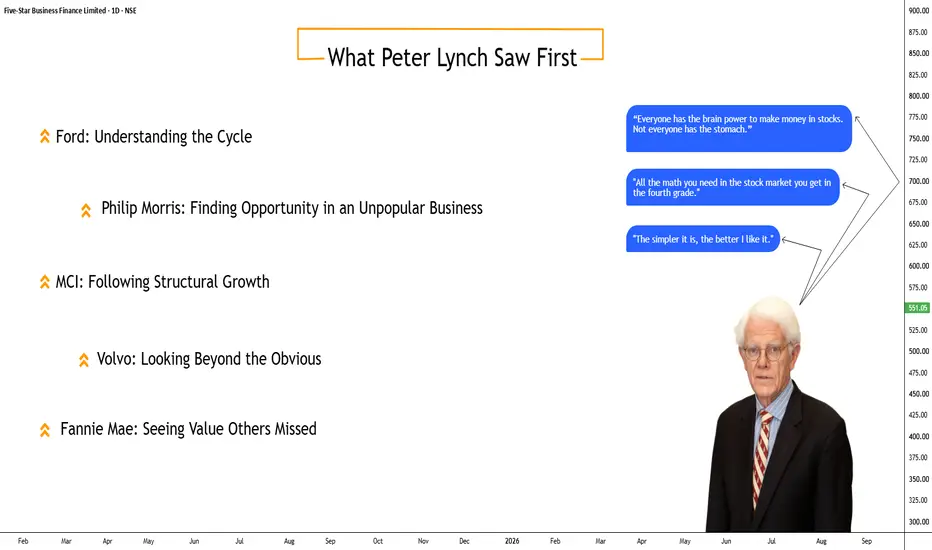
Peter Lynch became one of the most respected investors of his generation by doing something that sounds simple but is extremely difficult: finding businesses that were worth more than the market believed. From 1977 to 1990, he managed the Fidelity Magellan Fund and generated an exceptional long-term return. His approach was not about predicting every market move or finding the next hot stock. It was about understanding businesses, identifying changes in their fundamentals, and recognizing when the market had not yet fully appreciated those changes.
1. Fannie Mae: Seeing Value Others Missed
Fannie Mae became one of Peter Lynch's most successful investments and reportedly generated hundreds of millions of dollars in profit for Magellan. What made the investment interesting was not simply that the stock eventually went higher. Lynch kept studying the company's improving fundamentals and became increasingly convinced that the market was undervaluing its earning potential. He increased his position as his thesis became stronger. The lesson is important: a rising stock is not automatically a reason to sell if the business is improving even faster. Lynch was watching the company, not just the chart.
2. Ford: Understanding the Cycle
Ford showed another side of Lynch's investment style. The automobile industry is highly cyclical, which means earnings can change dramatically as economic conditions improve or deteriorate. Lynch recognized that Ford's earnings outlook was improving and understood that the market was beginning to revalue the company. Instead of assuming that a stock had become too expensive simply because it had already risen, he looked at whether the underlying business justified the new valuation. His approach highlights an important distinction: the question isn't simply whether a stock has gone up, but whether the company's future has improved enough to support the higher price.
3. Philip Morris: Finding Opportunity in an Unpopular Business
Philip Morris was another major winner for Magellan, and it demonstrated Lynch's willingness to invest in businesses that were not necessarily popular with the public. The company had powerful consumer brands and strong cash-generating characteristics, but its reputation could easily make investors overlook the underlying economics. Lynch focused on the business rather than the emotional reaction surrounding it. This is an important investing lesson because a company does not need to be admired to be a good investment. Sometimes the greatest opportunities exist where the business is stronger than the perception surrounding it.
4. MCI: Following Structural Growth
MCI gave Lynch exposure to the rapidly changing telecommunications industry and became one of Magellan's important successful investments. The opportunity was connected to a broader structural shift in the industry, where competition and technology were changing the way telecommunications businesses operated. Lynch understood that strong growth could create significant investment opportunities when the market had not fully priced the future potential. The key wasn't simply buying a company because its industry was growing. Lynch needed to understand how that growth translated into revenue, earnings and ultimately shareholder value.
5. Volvo: Looking Beyond the Obvious
Volvo demonstrated that Lynch was not restricted to familiar American companies. The Swedish automobile manufacturer became another meaningful contributor to Magellan's performance. International investing gave Lynch access to businesses that could be overlooked by investors focused entirely on the US market. But geographical diversification alone was not the reason for the investment. Lynch still needed to understand the company's business, competitive position and earnings potential. The lesson is straightforward: “invest in what you know” does not mean investing only in companies from your own country. It means refusing to invest in something you cannot understand.
The Pattern Behind the Winners
These five investments came from completely different industries, yet they shared something important. Lynch was constantly looking for a gap between **what the business was becoming and what the market believed it was worth**. Sometimes that gap came from improving earnings, sometimes from a cyclical recovery, sometimes from structural growth and sometimes from an unpopular business being underestimated. The industry itself was not the secret. The ability to recognize a change in the underlying business was.
That is where Lynch's philosophy becomes more interesting than the usual “buy what you know” advice. Seeing a popular product or a successful company is only the beginning. The real work starts when you ask why the company is succeeding, whether that success can continue, what the market already expects, and whether the current valuation leaves room for further upside. A great company can still be a terrible investment if everyone has already priced in its success.
The Real Peter Lynch Lesson:
Lynch did not need to predict exactly where the market would go next. He needed to find situations where reality could turn out to be better than expectations. That is why his biggest winners were not simply stocks that went up. They were businesses where the fundamental story became stronger than the market initially anticipated.
The most useful lesson from Peter Lynch is therefore not to copy his old stock picks. Fannie Mae, Ford, Philip Morris, MCI and Volvo belonged to a different market and a different era. The better lesson is to ask the same question Lynch was asking decades ago:
That question is still relevant today.
By BrightRally_Research
1. Fannie Mae: Seeing Value Others Missed
Fannie Mae became one of Peter Lynch's most successful investments and reportedly generated hundreds of millions of dollars in profit for Magellan. What made the investment interesting was not simply that the stock eventually went higher. Lynch kept studying the company's improving fundamentals and became increasingly convinced that the market was undervaluing its earning potential. He increased his position as his thesis became stronger. The lesson is important: a rising stock is not automatically a reason to sell if the business is improving even faster. Lynch was watching the company, not just the chart.
2. Ford: Understanding the Cycle
Ford showed another side of Lynch's investment style. The automobile industry is highly cyclical, which means earnings can change dramatically as economic conditions improve or deteriorate. Lynch recognized that Ford's earnings outlook was improving and understood that the market was beginning to revalue the company. Instead of assuming that a stock had become too expensive simply because it had already risen, he looked at whether the underlying business justified the new valuation. His approach highlights an important distinction: the question isn't simply whether a stock has gone up, but whether the company's future has improved enough to support the higher price.
3. Philip Morris: Finding Opportunity in an Unpopular Business
Philip Morris was another major winner for Magellan, and it demonstrated Lynch's willingness to invest in businesses that were not necessarily popular with the public. The company had powerful consumer brands and strong cash-generating characteristics, but its reputation could easily make investors overlook the underlying economics. Lynch focused on the business rather than the emotional reaction surrounding it. This is an important investing lesson because a company does not need to be admired to be a good investment. Sometimes the greatest opportunities exist where the business is stronger than the perception surrounding it.
4. MCI: Following Structural Growth
MCI gave Lynch exposure to the rapidly changing telecommunications industry and became one of Magellan's important successful investments. The opportunity was connected to a broader structural shift in the industry, where competition and technology were changing the way telecommunications businesses operated. Lynch understood that strong growth could create significant investment opportunities when the market had not fully priced the future potential. The key wasn't simply buying a company because its industry was growing. Lynch needed to understand how that growth translated into revenue, earnings and ultimately shareholder value.
5. Volvo: Looking Beyond the Obvious
Volvo demonstrated that Lynch was not restricted to familiar American companies. The Swedish automobile manufacturer became another meaningful contributor to Magellan's performance. International investing gave Lynch access to businesses that could be overlooked by investors focused entirely on the US market. But geographical diversification alone was not the reason for the investment. Lynch still needed to understand the company's business, competitive position and earnings potential. The lesson is straightforward: “invest in what you know” does not mean investing only in companies from your own country. It means refusing to invest in something you cannot understand.
The Pattern Behind the Winners
These five investments came from completely different industries, yet they shared something important. Lynch was constantly looking for a gap between **what the business was becoming and what the market believed it was worth**. Sometimes that gap came from improving earnings, sometimes from a cyclical recovery, sometimes from structural growth and sometimes from an unpopular business being underestimated. The industry itself was not the secret. The ability to recognize a change in the underlying business was.
That is where Lynch's philosophy becomes more interesting than the usual “buy what you know” advice. Seeing a popular product or a successful company is only the beginning. The real work starts when you ask why the company is succeeding, whether that success can continue, what the market already expects, and whether the current valuation leaves room for further upside. A great company can still be a terrible investment if everyone has already priced in its success.
The Real Peter Lynch Lesson:
Lynch did not need to predict exactly where the market would go next. He needed to find situations where reality could turn out to be better than expectations. That is why his biggest winners were not simply stocks that went up. They were businesses where the fundamental story became stronger than the market initially anticipated.
The most useful lesson from Peter Lynch is therefore not to copy his old stock picks. Fannie Mae, Ford, Philip Morris, MCI and Volvo belonged to a different market and a different era. The better lesson is to ask the same question Lynch was asking decades ago:
What is changing inside this business that the market may not have fully recognized yet?
That question is still relevant today.
By BrightRally_Research

Publikasi terkait
Pernyataan Penyangkalan
Informasi dan publikasi ini tidak dimaksudkan, dan bukan merupakan, saran atau rekomendasi keuangan, investasi, trading, atau jenis lainnya yang diberikan atau didukung oleh TradingView. Baca selengkapnya di Ketentuan Penggunaan.
Publikasi terkait
Pernyataan Penyangkalan
Informasi dan publikasi ini tidak dimaksudkan, dan bukan merupakan, saran atau rekomendasi keuangan, investasi, trading, atau jenis lainnya yang diberikan atau didukung oleh TradingView. Baca selengkapnya di Ketentuan Penggunaan.