
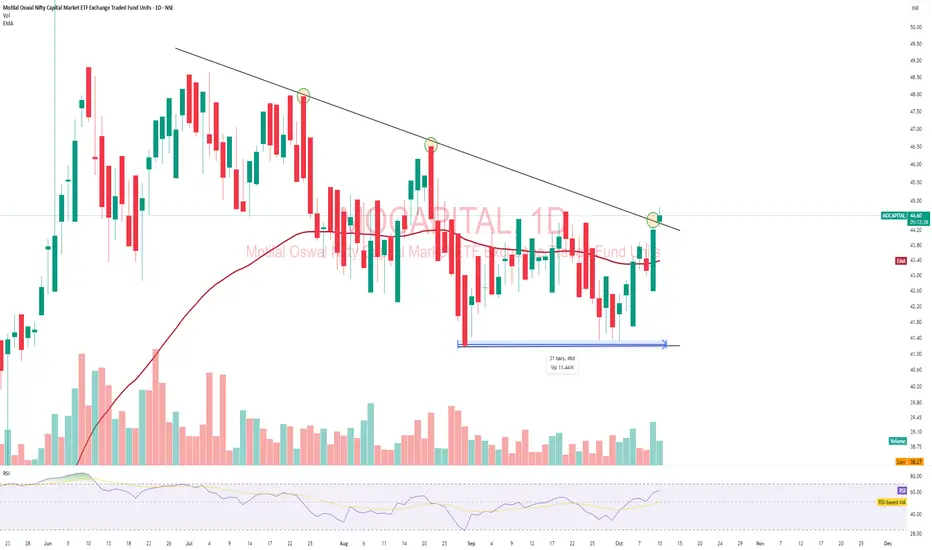
MOCAPITAL: Short Breakout after 46 day's consolidations.
Looks good for 46, 48, 50 in few months.
Why MOCAPITAL is pocket portfolio ETF's ?
Motilal Oswal Nifty Capital Market ETF (MO Capital Market ETF), which tracks India’s listed capital markets ecosystem (broking, AMCs, exchanges, depositories, wealth managers)
Why it matters
1. Direct, pure-play exposure to India’s capital markets cycle: rising demat accounts, SIP flows, retail participation, and market depth can translate into operating leverage for constituents.
2. Complements core index funds by adding a structural-financials tilt beyond banks/insurers, capturing brokerage, AMC, exchange and market-infrastructure economics.
3.Transparent, rules-based exposure with the convenience and cost-efficiency of an ETF; no active stock-picking required.
What it tracks
1. Replicates the Nifty Capital Market Index, a sectoral index within financial services focused on market infrastructure and intermediaries.
2. Includes brokers, exchanges, AMCs, depositories, and diversified capital market platforms; free-float market-cap weighted with periodic rebalancing.
Holdings snapshot (typical constituents)
1. Exchanges and infra: NSE’s listed peer (BSE), CDSL
2. Brokers/wealth: Angel One, IIFL Finance/IIFL Securities, 360 One, Anand Rathi Wealth, Motilal Oswal Financial Services
3. AMCs: HDFC AMC, Nippon Life India AMC, UTI AMC, ABSL AMC
Pros:
1. Plays financialization trend: higher equity ownership, SIP penetration, and market volumes can drive revenue growth and margin expansion.
2. Capital-light, high operating leverage businesses can scale profit pools faster than GDP in bull markets.
3. Sector ETF avoids single-stock risk while maintaining targeted exposure.
Risks:
1. Pro-cyclical: earnings are sensitive to market turnover, valuations, and risk appetite; drawdowns can be sharp in bear phases.
2. Regulatory risk: fee caps, disclosure rules, margin norms, or product restrictions can impact profitability across brokers/AMCs.
3. Concentration: sector-specific and often top-heavy; expect higher volatility versus diversified indices.
Portfolio fit (simple use)
1. Satellite allocation of 5–10% around a diversified core (Nifty 50/Next 50 or flexi-cap index).
2. Maintain a minimum 3–5 year horizon; avoid short-term timing around policy or budget events.
3. Monitor three things: AUM/liquidity, tracking difference, and expense ratio; use limit orders for better execution.
Current perspective
1. Structural tailwinds: steady SIP inflows, growing demat base, deepening derivatives and passive products, and rising household equity allocation.
2. Cyclical watchpoints: market volumes, broking yields, AMC flows/market share, and valuation multiples that can compress in risk-off phases.
3. Expect leadership to rotate within the basket—exchanges/depositories tend to be steadier; brokers/AMCs more cyclical with higher beta.
Bottom line
The Motilal Oswal Nifty Capital Market ETF is a focused way to ride India’s financialization and equity-market depth, best used as a modest, long-horizon satellite alongside broad market holdings.
Looks good for 46, 48, 50 in few months.
Why MOCAPITAL is pocket portfolio ETF's ?
Motilal Oswal Nifty Capital Market ETF (MO Capital Market ETF), which tracks India’s listed capital markets ecosystem (broking, AMCs, exchanges, depositories, wealth managers)
Why it matters
1. Direct, pure-play exposure to India’s capital markets cycle: rising demat accounts, SIP flows, retail participation, and market depth can translate into operating leverage for constituents.
2. Complements core index funds by adding a structural-financials tilt beyond banks/insurers, capturing brokerage, AMC, exchange and market-infrastructure economics.
3.Transparent, rules-based exposure with the convenience and cost-efficiency of an ETF; no active stock-picking required.
What it tracks
1. Replicates the Nifty Capital Market Index, a sectoral index within financial services focused on market infrastructure and intermediaries.
2. Includes brokers, exchanges, AMCs, depositories, and diversified capital market platforms; free-float market-cap weighted with periodic rebalancing.
Holdings snapshot (typical constituents)
1. Exchanges and infra: NSE’s listed peer (BSE), CDSL
2. Brokers/wealth: Angel One, IIFL Finance/IIFL Securities, 360 One, Anand Rathi Wealth, Motilal Oswal Financial Services
3. AMCs: HDFC AMC, Nippon Life India AMC, UTI AMC, ABSL AMC
Pros:
1. Plays financialization trend: higher equity ownership, SIP penetration, and market volumes can drive revenue growth and margin expansion.
2. Capital-light, high operating leverage businesses can scale profit pools faster than GDP in bull markets.
3. Sector ETF avoids single-stock risk while maintaining targeted exposure.
Risks:
1. Pro-cyclical: earnings are sensitive to market turnover, valuations, and risk appetite; drawdowns can be sharp in bear phases.
2. Regulatory risk: fee caps, disclosure rules, margin norms, or product restrictions can impact profitability across brokers/AMCs.
3. Concentration: sector-specific and often top-heavy; expect higher volatility versus diversified indices.
Portfolio fit (simple use)
1. Satellite allocation of 5–10% around a diversified core (Nifty 50/Next 50 or flexi-cap index).
2. Maintain a minimum 3–5 year horizon; avoid short-term timing around policy or budget events.
3. Monitor three things: AUM/liquidity, tracking difference, and expense ratio; use limit orders for better execution.
Current perspective
1. Structural tailwinds: steady SIP inflows, growing demat base, deepening derivatives and passive products, and rising household equity allocation.
2. Cyclical watchpoints: market volumes, broking yields, AMC flows/market share, and valuation multiples that can compress in risk-off phases.
3. Expect leadership to rotate within the basket—exchanges/depositories tend to be steadier; brokers/AMCs more cyclical with higher beta.
Bottom line
The Motilal Oswal Nifty Capital Market ETF is a focused way to ride India’s financialization and equity-market depth, best used as a modest, long-horizon satellite alongside broad market holdings.
Trading ditutup: target tercapai
Full target achieved of Rs. 48, upgrading for RS. 50 within few weeks!
Pernyataan Penyangkalan
Informasi dan publikasi ini tidak dimaksudkan, dan bukan merupakan, saran atau rekomendasi keuangan, investasi, trading, atau jenis lainnya yang diberikan atau didukung oleh TradingView. Baca selengkapnya di Ketentuan Penggunaan.
Pernyataan Penyangkalan
Informasi dan publikasi ini tidak dimaksudkan, dan bukan merupakan, saran atau rekomendasi keuangan, investasi, trading, atau jenis lainnya yang diberikan atau didukung oleh TradingView. Baca selengkapnya di Ketentuan Penggunaan.