
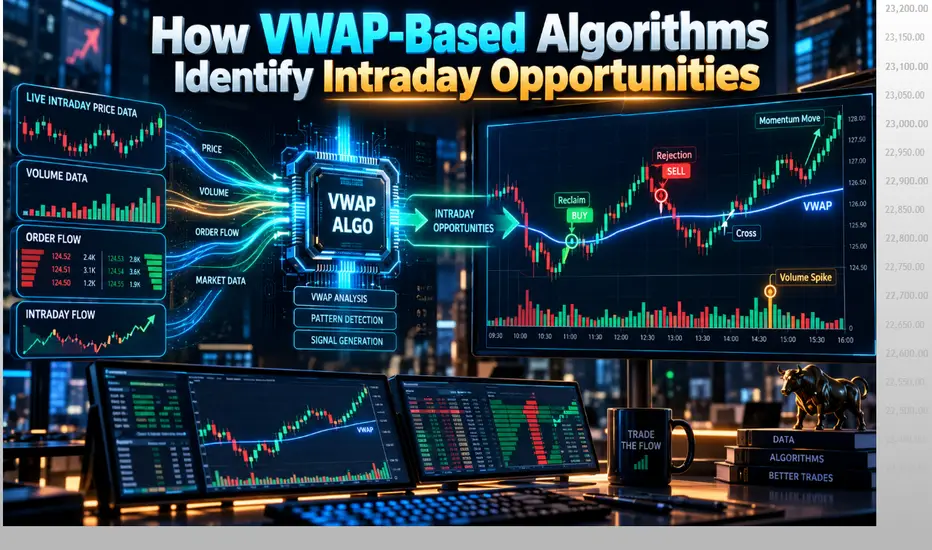
📊 How VWAP-Based Algorithms Identify Intraday Opportunities
VWAP is one of the most useful intraday benchmarks because it shows the market's **volume-weighted average price for the session**.
But a professional algorithm should not simply use:
Price Above VWAP = Buy
Price Below VWAP = Sell
The important question is:
**What is price doing around VWAP — and what type of session are we in?**
---------------------------------
📈 Price + VWAP Direction
A stronger bullish environment may show:
✅ Price above VWAP
✅ VWAP rising
✅ Pullbacks holding near VWAP
✅ Higher highs and higher lows
A stronger bearish environment may show:
✅ Price below VWAP
✅ VWAP falling
✅ Rallies failing near VWAP
✅ Lower highs and lower lows
But:
Flat VWAP + Repeated Crosses
= Possible Sideways Market
---------------------------------
🎯 VWAP Pullback Setup
One common algorithmic setup is:
**Trend → Pullback to VWAP → Confirmation → Continuation**
For a bullish trade, the system may require:
• VWAP rising
• Price pulls back toward VWAP
• Higher low forms
• Selling volume weakens
• Bullish candle confirms
• Recent swing high breaks
Only then:
**LONG SIGNAL**
This avoids chasing price far above VWAP.
---------------------------------
🔄 VWAP Reclaim
Another useful setup is:
Price below VWAP
→ Higher low
→ Close above VWAP
→ Retest holds
→ Swing high breaks
This can signal that intraday control is shifting from sellers toward buyers.
But one candle above VWAP is usually not enough.
Acceptance matters.
---------------------------------
⚠️ Trend Day vs Range Day
VWAP logic should change with the market regime.
Trend Day:
• VWAP clearly slopes
• Price stays mostly on one side
• Pullbacks hold
Better for trend continuation.
Range Day:
• VWAP flat
• Price crosses repeatedly
• Breakouts fail
Better to reduce trend trades or use separate mean-reversion logic.
---------------------------------
📊 Avoid Chasing Far From VWAP
A bullish setup can still be a poor entry if price is already highly extended.
The algorithm can measure:
• % distance from VWAP
• ATR distance
• VWAP deviation bands
If price is too stretched:
**WAIT**
Correct direction does not automatically mean good R:R.
---------------------------------
📊 Price Structure Still Matters
VWAP should provide context.
Price action should provide the trigger.
For longs:
• Higher low
• Resistance breakout
• Support hold
For shorts:
• Lower high
• Support breakdown
• Resistance rejection
Think:
**VWAP = Context**
**Structure = Trigger**
---------------------------------
📊 For Option Traders
Use both the underlying and the option premium.
Underlying:
✅ Above rising VWAP
✅ Structure bullish
✅ Resistance breaks
CE Premium:
✅ Above premium VWAP
✅ Fresh swing-high breakout
✅ Healthy liquidity
**Underlying gives direction.**
**Option premium confirms execution.**
---------------------------------
🛡️ Risk Still Comes First
A VWAP signal should still pass:
• Structural stop check
• Position-size check
• R:R check
• Daily risk limit
Do not use arbitrary fixed stops simply because VWAP generated the setup.
---------------------------------
📊 Simple Formula
Rising VWAP + Price Acceptance + Bullish Structure + Volume + Defined Risk
= Higher-Quality Intraday Long Setup
But:
Flat VWAP + Repeated Crosses + Weak Structure
= Chop / Whipsaw Risk
---------------------------------
📊 Finally, the important point to note is:
VWAP is not a magical buy/sell line.
It is a **session-value framework**.
A good algorithm asks:
“Where is price relative to VWAP?”
“Is VWAP rising, falling or flat?”
“Is price accepting or rejecting the area?”
“Does structure confirm the trade?”
The professional sequence is:
**VWAP Regime → Price Location → Structure → Volume → Risk → Execution**
---------------------------------
Educational Purpose Only.

⭐For Live Trading Courses And Trading Community 📈
Contact ⬇️
📱wa.me/919322295961
📱t.me/+UgF9lES_XxA0MTk9
⭐Advanced courses
⭐Fully Automated Algo Trading
⭐Daily F&O Trade tips
📱 t.me/+UgF9lES_XxA0MTk9
Contact ⬇️
📱wa.me/919322295961
📱t.me/+UgF9lES_XxA0MTk9
⭐Advanced courses
⭐Fully Automated Algo Trading
⭐Daily F&O Trade tips
📱 t.me/+UgF9lES_XxA0MTk9
Publikasi terkait
Pernyataan Penyangkalan
Informasi dan publikasi ini tidak dimaksudkan, dan bukan merupakan, saran atau rekomendasi keuangan, investasi, trading, atau jenis lainnya yang diberikan atau didukung oleh TradingView. Baca selengkapnya di Ketentuan Penggunaan.