Pembelian
D-Wave: Quantum Leap or Valuation Bubble?
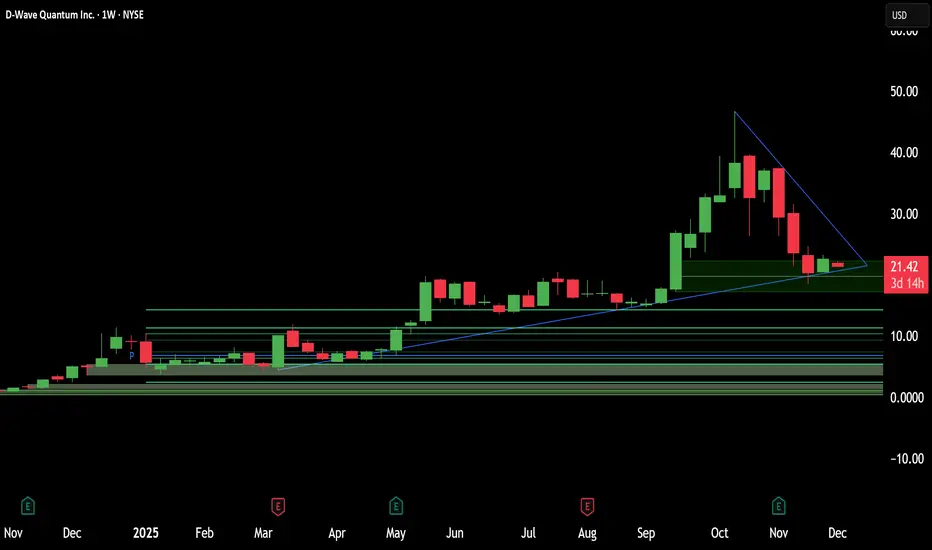
D-Wave Quantum (QBTS) has outperformed peers in 2025, but a divergence between practical defense contracts and insider selling signals a critical pivot point for 2026.
D-Wave Quantum has emerged as the surprise breakout of the year, decoupling from competitors like IonQ and Rigetti to deliver triple-digit gains before a recent correction. While the stock has pulled back from its October highs, the fundamental thesis has shifted from speculative "science projects" to deployable national security assets. The question for 2026 is whether revenue execution can catch up to an $8 billion market cap that currently trades at a premium to reality.
Geostrategy & Geopolitics: The Huntsville Stronghold
The most significant development for D-Wave is not in Silicon Valley, but in Huntsville, Alabama. The installation of the Advantage2™ system at Davidson Technologies places D-Wave at the heart of the US missile defense ecosystem. In a geostrategic landscape defined by US-China technological decoupling, D-Wave has effectively become a "dual-use" asset. The system is now operational for Department of Defense (DoD) applications, specifically targeting contested logistics and radar resource deployment—problems where seconds determine survival.
Technology & Science: The Annealing Advantage
While competitors chase the "gate-model" holy grail, D-Wave’s dominance in quantum annealing offers immediate utility. The sixth-generation Advantage2 system is not theoretical; it is solving energy-minimization problems today. This scientific pragmatism was validated when Fast Company recognized D-Wave in its "Next Big Things in Tech" awards. The technology's ability to handle 20-way connectivity allows for higher-fidelity modeling of real-world chaos, distinguishing it from peers still stuck in error-correction limbo.
Business Models & Innovation: Quantum-as-a-Service (QaaS)
D-Wave is successfully transitioning from hardware sales to a high-margin recurring revenue model via its Leap™ cloud service. By offering "Quantum-as-a-Service," the company allows clients like NTT DOCOMO to access solvers remotely, reducing paging signal traffic by 15% without capital-intensive hardware purchases. This business model innovation mirrors the early SaaS evolution, creating sticky ecosystems where customers build proprietary hybrid applications on top of D-Wave’s architecture, increasing switching costs and lifetime value.
Macroeconomics & Economics: The Valuation Disconnect
Despite the bullish narrative, the economic fundamentals demand caution. D-Wave trades at a price-to-sales ratio exceeding 300x, a valuation that assumes flawless execution. While third-quarter revenue doubled to $3.7 million, the company reported a $27.7 million operating loss. However, the balance sheet is a fortress: with **$836.2 million in cash**, D-Wave is insulated from the high-interest-rate environment that crushes capital-poor tech firms. This capital buffer allows them to burn cash on R&D through 2027 without immediate dilution risks.
Management & Leadership: Vision vs. Execution
Leadership signals are currently mixed. CEO Alan Baratz has been a vocal defender of the company's "commercial-first" strategy, effectively countering skeptics in *The Wall Street Journal*. However, insider activity paints a complex picture. Baratz sold approximately $3.9 million in stock in mid-November, a move that often rattles retail sentiment. Investors must weigh this liquidity event against the strategic clarity the governing council has provided regarding the company's roadmap toward profitability.
Industry Trends & Cyber: The Real-World ROI
The industry is moving from "quantum supremacy" experiments to ROI-driven case studies. D-Wave is leading this trend across multiple verticals:
* Public Safety: A joint project with **North Wales Police** reduced incident response planning from months to minutes.
* Cyber-Logistics: The US Army utilizes the tech to optimize fuel breaks for wildfire management, a critical infrastructure protection capability.
These applications prove that D-Wave is solving "NP-hard" optimization problems that classical supercomputers struggle to process efficiently.
Patent Analysis & Intellectual Property
D-Wave has constructed a formidable defensive moat with over 250 U.S. patents. Their IP strategy focuses heavily on the hybridization of quantum and classical processing, ensuring they own the interface where business problems meet quantum solvers. This patent portfolio makes them a potential acquisition target for hyperscalers seeking to bypass years of R&D in the annealing space.
Strategic Outlook
D-Wave is no longer a penny stock gamble; it is a capitalized institutional play with backing from the Swiss National Bank. However, the current valuation prices are based on years of growth upfront. The stock is a "Hold" for conservative portfolios but a strategic "Buy" on dips for those betting on the US defense sector’s rapid adoption of quantum logistics.
D-Wave Quantum has emerged as the surprise breakout of the year, decoupling from competitors like IonQ and Rigetti to deliver triple-digit gains before a recent correction. While the stock has pulled back from its October highs, the fundamental thesis has shifted from speculative "science projects" to deployable national security assets. The question for 2026 is whether revenue execution can catch up to an $8 billion market cap that currently trades at a premium to reality.
Geostrategy & Geopolitics: The Huntsville Stronghold
The most significant development for D-Wave is not in Silicon Valley, but in Huntsville, Alabama. The installation of the Advantage2™ system at Davidson Technologies places D-Wave at the heart of the US missile defense ecosystem. In a geostrategic landscape defined by US-China technological decoupling, D-Wave has effectively become a "dual-use" asset. The system is now operational for Department of Defense (DoD) applications, specifically targeting contested logistics and radar resource deployment—problems where seconds determine survival.
Technology & Science: The Annealing Advantage
While competitors chase the "gate-model" holy grail, D-Wave’s dominance in quantum annealing offers immediate utility. The sixth-generation Advantage2 system is not theoretical; it is solving energy-minimization problems today. This scientific pragmatism was validated when Fast Company recognized D-Wave in its "Next Big Things in Tech" awards. The technology's ability to handle 20-way connectivity allows for higher-fidelity modeling of real-world chaos, distinguishing it from peers still stuck in error-correction limbo.
Business Models & Innovation: Quantum-as-a-Service (QaaS)
D-Wave is successfully transitioning from hardware sales to a high-margin recurring revenue model via its Leap™ cloud service. By offering "Quantum-as-a-Service," the company allows clients like NTT DOCOMO to access solvers remotely, reducing paging signal traffic by 15% without capital-intensive hardware purchases. This business model innovation mirrors the early SaaS evolution, creating sticky ecosystems where customers build proprietary hybrid applications on top of D-Wave’s architecture, increasing switching costs and lifetime value.
Macroeconomics & Economics: The Valuation Disconnect
Despite the bullish narrative, the economic fundamentals demand caution. D-Wave trades at a price-to-sales ratio exceeding 300x, a valuation that assumes flawless execution. While third-quarter revenue doubled to $3.7 million, the company reported a $27.7 million operating loss. However, the balance sheet is a fortress: with **$836.2 million in cash**, D-Wave is insulated from the high-interest-rate environment that crushes capital-poor tech firms. This capital buffer allows them to burn cash on R&D through 2027 without immediate dilution risks.
Management & Leadership: Vision vs. Execution
Leadership signals are currently mixed. CEO Alan Baratz has been a vocal defender of the company's "commercial-first" strategy, effectively countering skeptics in *The Wall Street Journal*. However, insider activity paints a complex picture. Baratz sold approximately $3.9 million in stock in mid-November, a move that often rattles retail sentiment. Investors must weigh this liquidity event against the strategic clarity the governing council has provided regarding the company's roadmap toward profitability.
Industry Trends & Cyber: The Real-World ROI
The industry is moving from "quantum supremacy" experiments to ROI-driven case studies. D-Wave is leading this trend across multiple verticals:
* Public Safety: A joint project with **North Wales Police** reduced incident response planning from months to minutes.
* Cyber-Logistics: The US Army utilizes the tech to optimize fuel breaks for wildfire management, a critical infrastructure protection capability.
These applications prove that D-Wave is solving "NP-hard" optimization problems that classical supercomputers struggle to process efficiently.
Patent Analysis & Intellectual Property
D-Wave has constructed a formidable defensive moat with over 250 U.S. patents. Their IP strategy focuses heavily on the hybridization of quantum and classical processing, ensuring they own the interface where business problems meet quantum solvers. This patent portfolio makes them a potential acquisition target for hyperscalers seeking to bypass years of R&D in the annealing space.
Strategic Outlook
D-Wave is no longer a penny stock gamble; it is a capitalized institutional play with backing from the Swiss National Bank. However, the current valuation prices are based on years of growth upfront. The stock is a "Hold" for conservative portfolios but a strategic "Buy" on dips for those betting on the US defense sector’s rapid adoption of quantum logistics.

Pernyataan Penyangkalan
Informasi dan publikasi ini tidak dimaksudkan, dan bukan merupakan, saran atau rekomendasi keuangan, investasi, trading, atau jenis lainnya yang diberikan atau didukung oleh TradingView. Baca selengkapnya di Ketentuan Penggunaan.
Pernyataan Penyangkalan
Informasi dan publikasi ini tidak dimaksudkan, dan bukan merupakan, saran atau rekomendasi keuangan, investasi, trading, atau jenis lainnya yang diberikan atau didukung oleh TradingView. Baca selengkapnya di Ketentuan Penggunaan.