
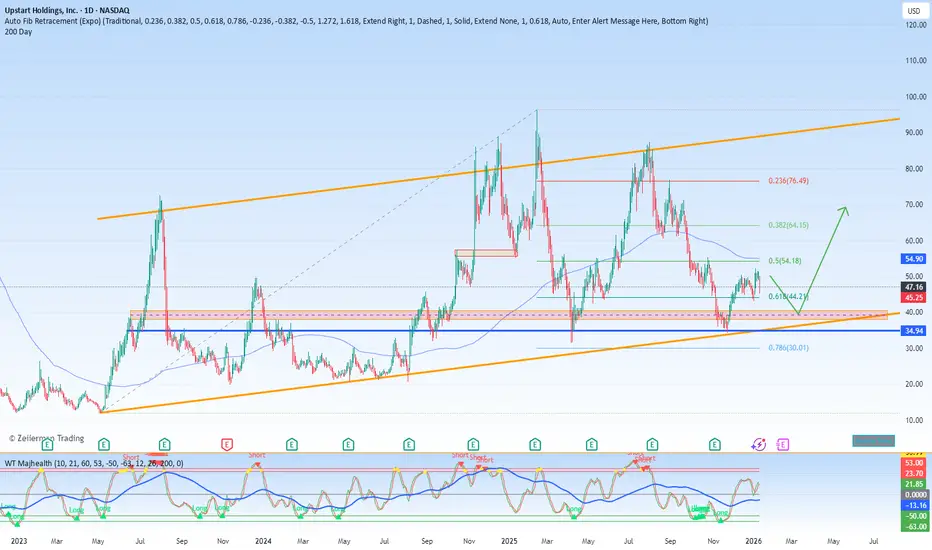
Upstart Holdings, Inc. (NASDAQ: UPST), a prominent fintech company that utilizes artificial intelligence to facilitate and automate the loan origination process, delivered a year of significant operational progress in 2025, yet its stock performance told a more complex and volatile story. While the underlying business demonstrated robust growth and a notable return to profitability driven by a new AI model and a more favorable interest rate environment, escalating macroeconomic anxieties surrounding credit risk—particularly within the auto loan sector—cast a persistent shadow over investor sentiment. Consequently, despite periods of strong rally, the stock concluded 2025 down approximately 29%, encapsulating the ongoing tug-of-war between the company's impressive execution and broader systemic financial concerns.
The 2025 Narrative: Strong Fundamentals Clash with Macroeconomic Fears
Upstart's journey through 2025 was emblematic of its inherent volatility. The stock experienced two separate rallies exceeding 25%, only to surrender those gains each time as macroeconomic headwinds intensified. This pattern underscores a market grappling with two competing narratives: one of a company successfully executing a turnaround, and another of a potentially deteriorating credit environment.
On the operational front, Upstart's progress was substantial:
Financial Performance: For the first three quarters of 2025, revenue surged 79% year-over-year to $747.8 million. More critically, the company reported a GAAP net income of $35 million, a dramatic reversal from a loss of $125.8 million in the prior-year period. This improvement was largely attributed to the successful rollout of a more advanced AI underwriting model and the tailwind of falling interest rates, which helped stimulate loan demand.
Strategic Position: Management's strong fourth-quarter guidance signaled confidence in continued growth and improved profitability, suggesting the operational turnaround initiated after the severe 2022 tech bear market was gaining solid traction.
However, these strong fundamentals were persistently challenged by external factors:
Credit Risk Concerns: Despite management's assurances that its own AI models showed no material degradation in performance, broader indicators sparked fear. A weakening labor market in the latter half of the year, struggling consumer discretionary spending, and notably, a well-publicized rise in auto loan delinquencies created a risk-off sentiment across the credit market. For a platform like Upstart, whose model depends on investor appetite for the loans it facilitates, this environment proved to be a significant overhang.
The 2026 Outlook: A Crucible of Risk and Opportunity
As we move into 2026, Upstart appears poised to confront a similar set of macroeconomic crosscurrents. A persistently softening labor market remains the primary threat, as rising unemployment typically leads directly to higher loan delinquencies, which could pressure Upstart's platform volume and investor trust.
Nevertheless, several factors differentiate Upstart's position in 2026 from its vulnerable state in 2022:
A Stronger Business Foundation: The company's revenue base is more substantial, its AI model is more sophisticated and battle-tested, and it has achieved GAAP profitability. This provides a crucial buffer against economic headwinds.
Attractive Valuation and Growth Metrics: Trading at a recent close of $49.12, Upstart's valuation presents a compelling case. The stock currently sports a Forward P/E ratio of 19.13, which, while at a premium to the industry average of 11.81, must be evaluated in the context of its exceptional growth profile. Analysts project earnings per share to skyrocket by 940% for the full year to $1.68, with revenue expected to reach $1.04 billion. For the upcoming quarter, consensus estimates point to an 80.77% rise in EPS to $0.47 and a 31.74% increase in revenue to $288.47 million.
Analyst Sentiment and the Zacks Rank: Upstart currently holds a Zacks Rank of #3 (Hold), indicating a neutral near-term outlook from analysts. It is noteworthy that consensus EPS estimates have remained stable over the past month, suggesting analysts are in a "wait-and-see" mode regarding how the macro environment will impact the company's stellar growth trajectory. Historical data shows that stocks with the highest Zacks Rank (#1 Strong Buy) have generated an average annual return of +25% since 1988, highlighting the importance of future estimate revisions.
Investment Thesis: A High-Potential, High-Risk Contrarian Play
In conclusion, Upstart Holdings represents a classic high-risk, high-reward investment proposition at its current juncture. The company has demonstrably proven its ability to grow revenue exponentially and achieve profitability through technological innovation. The long-term thesis of AI disrupting traditional, FICO-based credit assessment remains intact and potent.
However, the stock's near-term path is inextricably linked to the health of the consumer and the credit cycle. The primary risk is that a significant economic slowdown or recession overpowers the efficacy of Upstart's AI models, leading to underperformance that erodes platform credibility.
For investors, the decision hinges on conviction in two areas: first, that Upstart's AI-driven underwriting is genuinely superior and more resilient than traditional methods in an economic downturn; and second, that the current share price already discounts a substantial amount of macroeconomic pessimism. Given its dramatic fall from previous highs, strong growth metrics, and profitable footing, Upstart could be positioned for a powerful rebound should the credit environment stabilize or its next earnings reports convincingly demonstrate the durability of its model. Therefore, while not without significant volatility, Upstart may appeal to growth-oriented investors seeking a contrarian position in fintech innovation, with the understanding that macroeconomic data points in early 2026 will be a critical catalyst for direction.
The 2025 Narrative: Strong Fundamentals Clash with Macroeconomic Fears
Upstart's journey through 2025 was emblematic of its inherent volatility. The stock experienced two separate rallies exceeding 25%, only to surrender those gains each time as macroeconomic headwinds intensified. This pattern underscores a market grappling with two competing narratives: one of a company successfully executing a turnaround, and another of a potentially deteriorating credit environment.
On the operational front, Upstart's progress was substantial:
Financial Performance: For the first three quarters of 2025, revenue surged 79% year-over-year to $747.8 million. More critically, the company reported a GAAP net income of $35 million, a dramatic reversal from a loss of $125.8 million in the prior-year period. This improvement was largely attributed to the successful rollout of a more advanced AI underwriting model and the tailwind of falling interest rates, which helped stimulate loan demand.
Strategic Position: Management's strong fourth-quarter guidance signaled confidence in continued growth and improved profitability, suggesting the operational turnaround initiated after the severe 2022 tech bear market was gaining solid traction.
However, these strong fundamentals were persistently challenged by external factors:
Credit Risk Concerns: Despite management's assurances that its own AI models showed no material degradation in performance, broader indicators sparked fear. A weakening labor market in the latter half of the year, struggling consumer discretionary spending, and notably, a well-publicized rise in auto loan delinquencies created a risk-off sentiment across the credit market. For a platform like Upstart, whose model depends on investor appetite for the loans it facilitates, this environment proved to be a significant overhang.
The 2026 Outlook: A Crucible of Risk and Opportunity
As we move into 2026, Upstart appears poised to confront a similar set of macroeconomic crosscurrents. A persistently softening labor market remains the primary threat, as rising unemployment typically leads directly to higher loan delinquencies, which could pressure Upstart's platform volume and investor trust.
Nevertheless, several factors differentiate Upstart's position in 2026 from its vulnerable state in 2022:
A Stronger Business Foundation: The company's revenue base is more substantial, its AI model is more sophisticated and battle-tested, and it has achieved GAAP profitability. This provides a crucial buffer against economic headwinds.
Attractive Valuation and Growth Metrics: Trading at a recent close of $49.12, Upstart's valuation presents a compelling case. The stock currently sports a Forward P/E ratio of 19.13, which, while at a premium to the industry average of 11.81, must be evaluated in the context of its exceptional growth profile. Analysts project earnings per share to skyrocket by 940% for the full year to $1.68, with revenue expected to reach $1.04 billion. For the upcoming quarter, consensus estimates point to an 80.77% rise in EPS to $0.47 and a 31.74% increase in revenue to $288.47 million.
Analyst Sentiment and the Zacks Rank: Upstart currently holds a Zacks Rank of #3 (Hold), indicating a neutral near-term outlook from analysts. It is noteworthy that consensus EPS estimates have remained stable over the past month, suggesting analysts are in a "wait-and-see" mode regarding how the macro environment will impact the company's stellar growth trajectory. Historical data shows that stocks with the highest Zacks Rank (#1 Strong Buy) have generated an average annual return of +25% since 1988, highlighting the importance of future estimate revisions.
Investment Thesis: A High-Potential, High-Risk Contrarian Play
In conclusion, Upstart Holdings represents a classic high-risk, high-reward investment proposition at its current juncture. The company has demonstrably proven its ability to grow revenue exponentially and achieve profitability through technological innovation. The long-term thesis of AI disrupting traditional, FICO-based credit assessment remains intact and potent.
However, the stock's near-term path is inextricably linked to the health of the consumer and the credit cycle. The primary risk is that a significant economic slowdown or recession overpowers the efficacy of Upstart's AI models, leading to underperformance that erodes platform credibility.
For investors, the decision hinges on conviction in two areas: first, that Upstart's AI-driven underwriting is genuinely superior and more resilient than traditional methods in an economic downturn; and second, that the current share price already discounts a substantial amount of macroeconomic pessimism. Given its dramatic fall from previous highs, strong growth metrics, and profitable footing, Upstart could be positioned for a powerful rebound should the credit environment stabilize or its next earnings reports convincingly demonstrate the durability of its model. Therefore, while not without significant volatility, Upstart may appeal to growth-oriented investors seeking a contrarian position in fintech innovation, with the understanding that macroeconomic data points in early 2026 will be a critical catalyst for direction.

Pernyataan Penyangkalan
Informasi dan publikasi ini tidak dimaksudkan, dan bukan merupakan, saran atau rekomendasi keuangan, investasi, trading, atau jenis lainnya yang diberikan atau didukung oleh TradingView. Baca selengkapnya di Ketentuan Penggunaan.
Pernyataan Penyangkalan
Informasi dan publikasi ini tidak dimaksudkan, dan bukan merupakan, saran atau rekomendasi keuangan, investasi, trading, atau jenis lainnya yang diberikan atau didukung oleh TradingView. Baca selengkapnya di Ketentuan Penggunaan.