
Most traders don’t actually have a strategy problem.
They have a separation problem.
They don’t know how to separate what they think from what they do.
And in trading, that difference is everything.
1. Having a Bias Is Normal — Even Necessary
Every time you look at a chart, your brain asks: “What’s more likely to happen next?”
That answer becomes your bias.
Bullish or Bearish.
Without it, you’re not analyzing — you’re just watching candles move.
So let’s be clear:
Having a bias is not a mistake. It’s part of the process.
2. Where It Starts Going Wrong
The problem begins when a simple idea turns into attachment.
You start with:
“I think the market will go down.”
Then it slowly becomes:
“I want the market to go down.”
And without noticing:
“I need the market to go down.”
At that point, you’re no longer reading the market.
You’re defending your opinion.
3. A Bias Costs Nothing. A Trade Costs Money
This is the line most traders blur.
- A bias is just a perspective
- A trade is exposure to risk
- Thinking is free.
- Execution is not.
Opening a trade means:
- You accept uncertainty
- You accept being wrong
- You accept a potential loss
But many traders act as if placing a trade is just “expressing an opinion”.
It isn’t.
It’s a financial decision.
4. Real Example: Silver
Let’s make this practical.
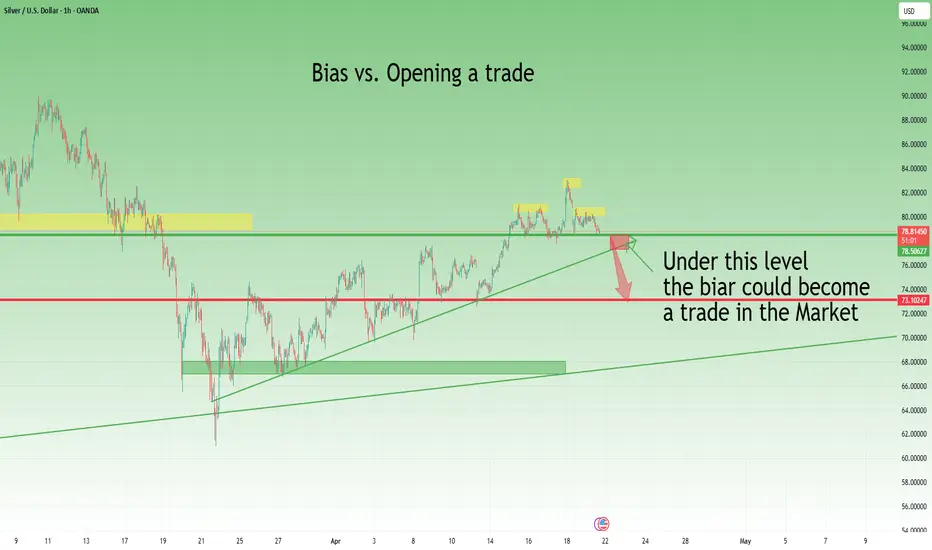
In today's analysis, I stated clearly: My bias on Silver is bearish.
Now the key question: Does that mean I immediately open a sell trade?
No.
A bias is not a trigger.
The Context Matters
Two weeks earlier, I also said: Silver could continue higher, even toward 80, before any real reversal.
What happened next?
Price didn’t stop at 80.
It pushed further — all the way to 83 on Friday.
Now here’s where most traders fail.
They look at this and say: “I was wrong.”
But that’s only true if you acted on it.
5. You’re Only Wrong If You Commit Capital
If you had:
- Sold at 80 with an 82-83 stop
- Ignored structure
- Ignored confirmation
Then yes — you were wrong and you paid for it.
But if your approach was:
- “This is a potential reversal zone”
- “I need confirmation before entering”
- “Until then, I stay out”
Then nothing is wrong.
Because you didn’t trade the idea.
You respected the process.
6. Waiting Is Also a Position
This is uncomfortable for many traders.
They feel like: “If I’m not in a trade, I’m missing something.”
But in reality: Not trading is often the most professional decision you can make.
In the Silver case:
- Bias: bearish
- Market behavior: still above confluence support
- Decision: wait
That’s not hesitation.
That’s discipline.
7. Don’t Trade the Bias. Trade the Confirmation
A bias should guide your attention.
A trade should be triggered by confirmation.
That confirmation can look like:
- Rejection from a key level
- A break of structure
- A clear shift in momentum
Until that happens, your role is simple: Observe, not participate.
8. The Real Reason Traders Lose
Most traders don’t lose because their idea is wrong.
They lose because:
- They are too early
- They force trades
- They can’t stay inactive
In the Silver example, price going to 83 didn’t invalidate the bearish idea.
It only showed one thing: The timing was not there yet, and, especially in these market conditions, the price can spike hard
9. A Simple Question That Changes Everything
Before opening any trade, ask yourself: “Am I trading a setup… or just acting on a bias?”
If you hesitate, you already have your answer.
Wait.
Final Thought:
A bias is a direction.
A trade is a decision.
And the space between them… that’s where discipline lives.
Most traders collapse that space.
Professionals protect it.
They have a separation problem.
They don’t know how to separate what they think from what they do.
And in trading, that difference is everything.
1. Having a Bias Is Normal — Even Necessary
Every time you look at a chart, your brain asks: “What’s more likely to happen next?”
That answer becomes your bias.
Bullish or Bearish.
Without it, you’re not analyzing — you’re just watching candles move.
So let’s be clear:
Having a bias is not a mistake. It’s part of the process.
2. Where It Starts Going Wrong
The problem begins when a simple idea turns into attachment.
You start with:
“I think the market will go down.”
Then it slowly becomes:
“I want the market to go down.”
And without noticing:
“I need the market to go down.”
At that point, you’re no longer reading the market.
You’re defending your opinion.
3. A Bias Costs Nothing. A Trade Costs Money
This is the line most traders blur.
- A bias is just a perspective
- A trade is exposure to risk
- Thinking is free.
- Execution is not.
Opening a trade means:
- You accept uncertainty
- You accept being wrong
- You accept a potential loss
But many traders act as if placing a trade is just “expressing an opinion”.
It isn’t.
It’s a financial decision.
4. Real Example: Silver
Let’s make this practical.
In today's analysis, I stated clearly: My bias on Silver is bearish.
Now the key question: Does that mean I immediately open a sell trade?
No.
A bias is not a trigger.
The Context Matters
Two weeks earlier, I also said: Silver could continue higher, even toward 80, before any real reversal.
What happened next?
Price didn’t stop at 80.
It pushed further — all the way to 83 on Friday.
Now here’s where most traders fail.
They look at this and say: “I was wrong.”
But that’s only true if you acted on it.
5. You’re Only Wrong If You Commit Capital
If you had:
- Sold at 80 with an 82-83 stop
- Ignored structure
- Ignored confirmation
Then yes — you were wrong and you paid for it.
But if your approach was:
- “This is a potential reversal zone”
- “I need confirmation before entering”
- “Until then, I stay out”
Then nothing is wrong.
Because you didn’t trade the idea.
You respected the process.
6. Waiting Is Also a Position
This is uncomfortable for many traders.
They feel like: “If I’m not in a trade, I’m missing something.”
But in reality: Not trading is often the most professional decision you can make.
In the Silver case:
- Bias: bearish
- Market behavior: still above confluence support
- Decision: wait
That’s not hesitation.
That’s discipline.
7. Don’t Trade the Bias. Trade the Confirmation
A bias should guide your attention.
A trade should be triggered by confirmation.
That confirmation can look like:
- Rejection from a key level
- A break of structure
- A clear shift in momentum
Until that happens, your role is simple: Observe, not participate.
8. The Real Reason Traders Lose
Most traders don’t lose because their idea is wrong.
They lose because:
- They are too early
- They force trades
- They can’t stay inactive
In the Silver example, price going to 83 didn’t invalidate the bearish idea.
It only showed one thing: The timing was not there yet, and, especially in these market conditions, the price can spike hard
9. A Simple Question That Changes Everything
Before opening any trade, ask yourself: “Am I trading a setup… or just acting on a bias?”
If you hesitate, you already have your answer.
Wait.
Final Thought:
A bias is a direction.
A trade is a decision.
And the space between them… that’s where discipline lives.
Most traders collapse that space.
Professionals protect it.

🎯 Want More Trading Ideas?
📈 Join the FREE Forex & Gold Channel
👉 t.me/intradaytradingsignals
💎 Join the FREE Crypto Channel
👉 t.me/FanCryptocurrency
📈 Join the FREE Forex & Gold Channel
👉 t.me/intradaytradingsignals
💎 Join the FREE Crypto Channel
👉 t.me/FanCryptocurrency
Publikasi terkait
Pernyataan Penyangkalan
Informasi dan publikasi ini tidak dimaksudkan, dan bukan merupakan, saran atau rekomendasi keuangan, investasi, trading, atau jenis lainnya yang diberikan atau didukung oleh TradingView. Baca selengkapnya di Ketentuan Penggunaan.
🎯 Want More Trading Ideas?
📈 Join the FREE Forex & Gold Channel
👉 t.me/intradaytradingsignals
💎 Join the FREE Crypto Channel
👉 t.me/FanCryptocurrency
📈 Join the FREE Forex & Gold Channel
👉 t.me/intradaytradingsignals
💎 Join the FREE Crypto Channel
👉 t.me/FanCryptocurrency
Publikasi terkait
Pernyataan Penyangkalan
Informasi dan publikasi ini tidak dimaksudkan, dan bukan merupakan, saran atau rekomendasi keuangan, investasi, trading, atau jenis lainnya yang diberikan atau didukung oleh TradingView. Baca selengkapnya di Ketentuan Penggunaan.