Residual Persistence Breakdown Map [Pineify]
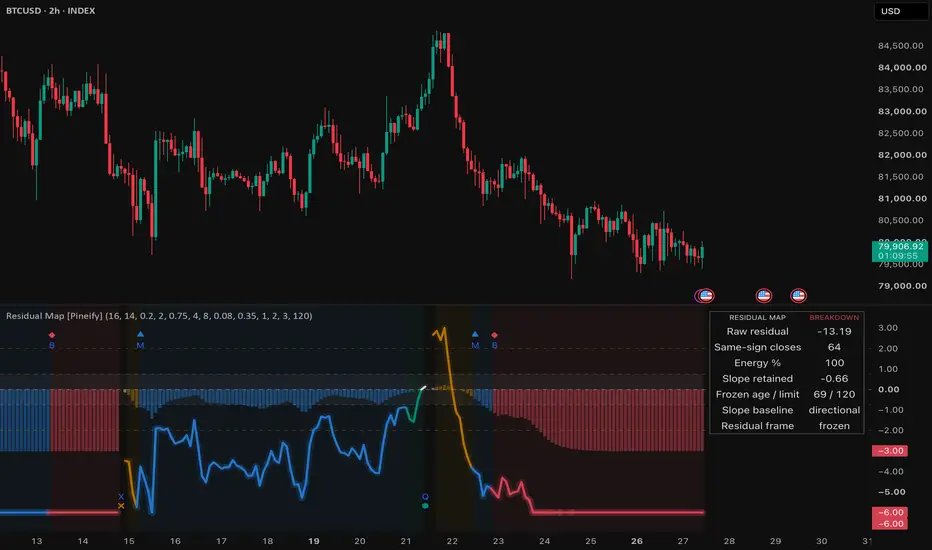
Residual Persistence Breakdown Map [Pineify]
Overview
This residual persistence indicator separates a brief price departure from sustained drift relative to a prior price model. Its bipolar track and state colors describe each episode.
Problem Definition
A close outside a regression band can be a solitary spike or the start of sustained displacement. A rolling fit can absorb that displacement and make residuals shrink before price returns. A fixed threshold equates spikes with repeated departures. The invariant here is a common model and scale throughout each observation, so normalization cannot silently redefine recovery.
Design Rationale
Median paired slopes and a median intercept reduce isolated-price influence without using full Theil-Sen regression. A prior ATR floor prevents a nearly perfect line from producing a microscopic denominator. Freezing the model preserves the question asked at entry; continuous refitting was rejected. The cost is an aging reference, controlled by expiry. Same-sign duration rejects alternation; capped energy limits one spike's influence; slope retention tests whether a directional baseline survives.
Key Features
States are neutral, anomaly, migration, breakdown and recovery watch. The table reports residual, run, energy, slope retention, age and eligibility. Quiet recovery, expiry and data loss have separate alerts.
How It Works
At each close, take the preceding 2H closes, excluding the current one. Pair the first half with the second half H bars apart; the median price difference divided by H is slope. The median of price minus slope times chronological index is intercept. Project one step to the current close. Scale is the largest of 1.4826 times median absolute training residual, prior ATR times the floor fraction, and one tick.
A rolling residual beyond the entry threshold freezes forecast, slope and scale. Later residuals subtract the frozen forecast advanced by slope times episode age. Beyond the quiet band, equal signs extend a run; a sign change restarts it and its energy. Energy averages squared, capped excess beyond the quiet band: divide excess by six, cap at one, square, then smooth with 2/(memory+1). Quiet closes reset the run and decay energy. Migration needs run and energy gates. Breakdown additionally needs directional slope loss. Retention is current rolling slope aligned with frozen slope, divided by its absolute size; a too-flat baseline disables that test.
How Multiple Indicators Work Together
The rolling fit supplies entry and a fresh slope comparator; the frozen fit measures the episode. Duration and energy establish persistence before slope loss can label breakdown. State-specific lower migration gates and a higher breakdown exit gate provide hysteresis, followed by consecutive candidate confirmation. Without freezing, baseline motion could imitate repair; without the flat-slope gate, a tiny divisor could exaggerate slope loss.
Trading Ideas and Insights
Compare departures of similar size with different run lengths. A sustained migration with retained slope differs from one that loses its earlier trend direction. Breakdown means loss of this defined relationship, not proof of a reversal. Use it as price-structure context; it supplies no execution rules.
Unique Aspects
The contribution relative to a rolling regression oscillator is episode-frozen residual accounting coupled to sign-reset energy and an eligibility-gated slope-retention test. Quiet recovery requires consecutive returns to the same frozen reference. Expiry instead ends an aging observation and cannot trigger the recovery alert. These constraints distinguish three reset causes.
How to Use
Start on standard 1H-1W candles with sufficient prior history. The residual track clips at plus/minus six; read raw magnitude in the table or Data Window. Amber denotes anomaly, blue migration, coral breakdown and teal recovery watch. M/B/Q/X markers denote migration, breakdown, quiet recovery and expiry. Gaps mark frame resets or unavailable data. Entry guides apply to the rolling test. Columns are signed 3x energy; halo opacity rises with energy.
Customization
Half window sets both training size and pair separation. ATR length and floor tune denominator protection. Entry, quiet band, run length, energy memory/gate, slope retention and minimum baseline span control classification. Candidate count delays transitions; quiet count ends episodes independently. Expiry limits frozen age. Defaults are starting points, not optimal settings. Energy columns, halo, background, markers and table can be disabled independently.
Assumptions and Limitations
Warm-up needs a complete prior training window and positive prior ATR. Missing closes or invalid scale clear the episode; no volume, external symbols, pivots or future bars are used. All stored values and alerts update at chart close, holding the preceding snapshot intrabar. Longer fits and confirmation introduce lag; thresholds and floors change outcomes. Curved trends, gaps and prolonged displacements can defeat a frozen straight line. Flat baselines cannot receive breakdown classification. Recovery proves only return to this reference; data revisions can change recalculation. No profitability or future probability is established.
Conclusion
Read residual size together with persistence and eligible slope retention. The map distinguishes continuing displacement, reference recovery and observation expiry with explicit meanings.

🚀🚀🚀 Pineify - pineify.app
Essential Toolkit for Every Trader
- AI Pine Script Generator
- Finance AI Agent
- AI Stock Picker
- Pine Script Visual Editor
- Invited indicators
- Strategy Optimizer
- Trading Journal
- Backtest Report
Essential Toolkit for Every Trader
- AI Pine Script Generator
- Finance AI Agent
- AI Stock Picker
- Pine Script Visual Editor
- Invited indicators
- Strategy Optimizer
- Trading Journal
- Backtest Report
Pernyataan Penyangkalan
Informasi dan publikasi ini tidak dimaksudkan, dan bukan merupakan, saran atau rekomendasi keuangan, investasi, trading, atau jenis lainnya yang diberikan atau didukung oleh TradingView. Baca selengkapnya di Ketentuan Penggunaan.