MONeY Phlow
Every money flow index or oscillator keeps a memory, though almost none says how long it lasts. A reading that has favored buyers for twenty bars might describe a crowd that keeps renewing its bids. Then again, it might also describe a crowd that left fifteen bars ago while the arithmetic of a thirteen-bar window kept its old verdict on the screen. The two cases may draw an identical line, and call for opposite faces of patience.
MONeY Phlow (short title "MONeYφ") adds the missing clock.
The tool draws a Money Flow Index with a regime heatmap, a pulse, event markers and a compact readout. Then counts how often ownership of the flow changes hands and converts that count into a half-life a trader can hold in mind. A table prints what the pane can only imply. The sections below explain the pane, the memory engine, and an hourly reading of Moderna chart at the time of writing.
Six Layers in One Pane
The flow line is a 13-bar Money Flow Index on each bar's typical price, colored by tier: orchid above 80 or below 20, lime from 60 to 80, peach from 20 to 40, and lemon through the neutral middle. Ownership passes to buyers when the line rises above 55 and to sellers when it falls below 45, and between those levels the previous owner keeps it. The band works like the dead travel in a ship's wheel, which keeps the rudder from twitching every time the helmsman's hand trembles.
The pulse beneath the line is the smoothed one-bar change of the flow line, green while flow is rising and red while it is falling. The table's Impulse row restates it as a z-score against 34 bars of the line's own volatility. In the physics of this instrument the line is speed and the pulse is acceleration; one says where the flow sits, and the other says where it is heading.
The background shades each bar with one of eight regimes: Bull Expansion, Bear Expansion, Accumulation, Distribution, Exhaustion, Capitulation, Dead Zone and Drift. Each has a stated rule, a new regime must persist for a few bars before the heatmap commits to it, and its opacity rises with Strength. A lemon readout beside the last bar prints Strength and Flow Age, such as 73 | 5. Strength runs from 0 to 100 and weighs depth, pulse and persistence, less divergence and compression, while Flow Age counts only the bars on which control was strong.
Triangles on the zero line mark boundary events: continuations through 60 and 40, a fade back through 80, and reversal pressure up through 20. A triangle whose line crosses back through 50 inside its cooldown has failed, and the instrument draws nothing for it; the failure instead raises a disagreement score that quietly drains Strength. Diamonds at the floor and ceiling of the pane mark sharp turns in the pulse, scaled to the line's own volatility and thinned by a threshold set at the golden ratio.
Turn-Wise Memory
A turn is a change of ownership, the line crossing the band from one side to the other. The instrument counts turns inside an 89-bar window and computes φ as one minus the share of bars on which a turn occurred, so six turns in 89 bars gives a φ of 0.933. The count works like a census of abdications. It never asks why each owner fell, only how often owners fall here.
A survival rate per bar is hard to feel, so the table converts it into a half-life, the age by which half of all ownerships would have turned at the window's rate. The Memory row prints that half-life in bars and in trading time, the bars multiplied by the chart's interval, with the word "traded" as a reminder that session gaps are not counted. The Retained row raises φ to the current ownership's age, which gives the share of ownerships that survive that long, and it turns yellow at two half-lives.
Retained measures how unusual an ownership's age is, not how close its end has come, because the rate behind it does not change from bar to bar. The Control row decides what an unusual age means. Ownership age counts every bar since the last turn, while Flow Age counts only the bars on which control was exercised; the gap between them is a tenure measured against a timesheet.
Reading the Chart
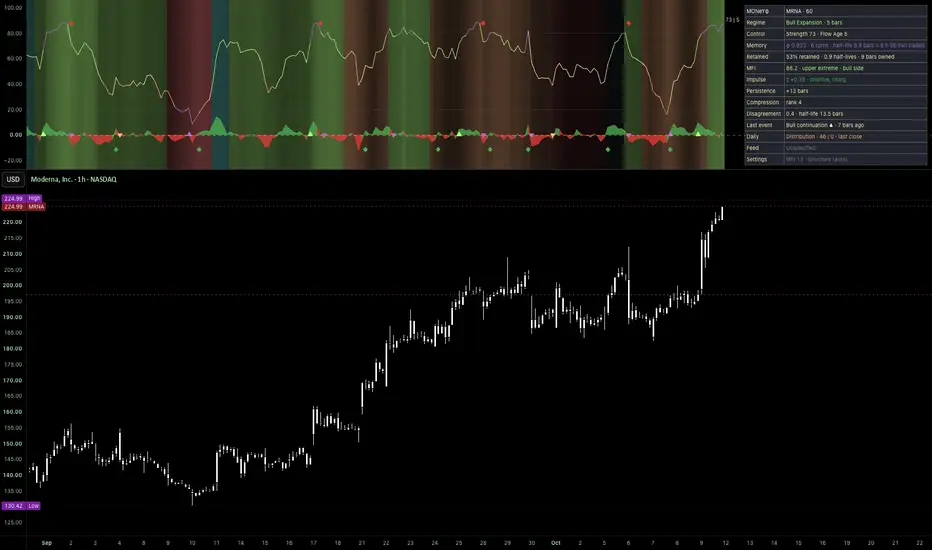
The chart above shows Moderna (MRNA) on the hourly clock from September through the close of 9 October. The stock has climbed from a 130.42 low on 10 September to a 224.99 high, and it closed the week at that high. Every number in the pane comes from the stock's own money flow.
The table reads Bull Expansion five bars old, Strength 73 and Flow Age 5, which matches the readout. Memory reads φ 0.933 from six turns, a half-life of 9.9 bars, or close to ten hours traded. Retained reads 53 percent at 0.9 half-lives with nine bars owned, so the current buyers have lived roughly one ordinary lifetime for this market and no longer. The flow line sits at 88.2 in its upper extreme with the pulse positive and rising, persistence runs 13 bars, compression ranks 4, and disagreement reads 0.4, which says no divergence is weighing on the reading.
Two rows complicate the picture. The flow line sits above 80, yet the regime is not Exhaustion, because Exhaustion requires the pulse to stall or fall at that height; the first hour in which the pulse turns down will hand the engine an Exhaustion candidate. The Daily row, which reruns the same engine on the last closed day and never repaints, reads Distribution with Strength 46 and Flow Age 0. The hourly buyers are pressing a fresh expansion into the extreme while the daily crowd is selling into strength.
Where MONeYφ Fits During a Trade
MONeY Phlow is a supplementary instrument cut for the five-minute through hourly charts, where ownership turns often enough to be counted and a half-life can be measured in hours a trader actually watches. Outside that range the table's title turns yellow, since slower clocks turn too rarely to count and faster ones count noise. (Consider setting the visibility defaults to Off except for minutes and hours.) Volume read bar by bar, a supertrend-style trailing stop and a single moving average make natural companions, and the pane never says when to act.
The table reports the last closed bar while a bar is still forming, and it flags tick-volume feeds, which count activity rather than money. Every value behind the pane, from Strength and Flow Age to φ, half-life, ownership age and Retained, appears in the Data Window as a number or a code. The instrument raises no alerts by design, as it was built for a discretionary trader at the desk.
A Thesis Has a Half-Life
The Moderna table holds two true statements in the same week. Hourly buyers own the flow at an upper extreme with their expansion five bars old, and the daily engine reads distribution beneath them. Neither cancels the other, and the pane does not pretend to know which will yield.
What the half-life adds is a clock on the reason for holding.
A position held for one half-life is held, on average, by the crowd that justified it, while a position held for three is held by a crowd that has turned over several times. Most stops are drawn in price, as if the only way a trade can fail is by losing ground. A trade can also keep its ground while the money that defended it changes hands. A leading indicator of that change is older ownership beside a younger Flow Age.

adrian dyer
Pernyataan Penyangkalan
Informasi dan publikasi ini tidak dimaksudkan, dan bukan merupakan, saran atau rekomendasi keuangan, investasi, trading, atau jenis lainnya yang diberikan atau didukung oleh TradingView. Baca selengkapnya di Ketentuan Penggunaan.
adrian dyer
Pernyataan Penyangkalan
Informasi dan publikasi ini tidak dimaksudkan, dan bukan merupakan, saran atau rekomendasi keuangan, investasi, trading, atau jenis lainnya yang diberikan atau didukung oleh TradingView. Baca selengkapnya di Ketentuan Penggunaan.