Diupdate
[blackcat] L3 Bias Scalper
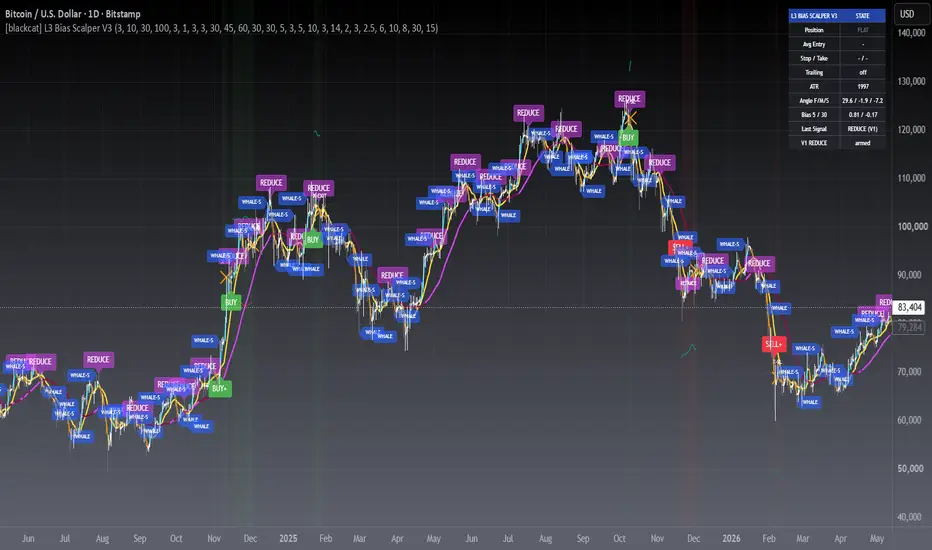
Level: 3
Background
Bias alone is a powerful tool for trading. I use SMA3, SMA10, SMA20, SMA30 to cover short and middle term of the trend for scalping. Multiple biases can be introduced for long and short entries.
Function
Use SMAs and biases for scalping with whale move alert (banker fund flow detection)
Key Signal
buy --> entry signal for long
strongbuy --> entry signal for long
add --> buy more or re-entry signal for long
reduce --> partial exit for long
exit --> complete exit for long
sell --> short entry signal
whalemove --> banker fund move detection
Pros and Cons
This script provides entry signal together with whale detection by bias algorithms, you can use whale move to predict next move of trend in large time frame. However, trading signal should be further filtered out for more precise entry signal.
Remarks
At beginning, I want to make it simple and it looks very complex at the end...
Readme
In real life, I am a prolific inventor. I have successfully applied for more than 60 international and regional patents in the past 12 years. But in the past two years or so, I have tried to transfer my creativity to the development of trading strategies. Tradingview is the ideal platform for me. I am selecting and contributing some of the hundreds of scripts to publish in Tradingview community. Welcome everyone to interact with me to discuss these interesting pine scripts.
The scripts posted are categorized into 5 levels according to my efforts or manhours put into these works.
Level 1 : interesting script snippets or distinctive improvement from classic indicators or strategy. Level 1 scripts can usually appear in more complex indicators as a function module or element.
Level 2 : composite indicator/strategy. By selecting or combining several independent or dependent functions or sub indicators in proper way, the composite script exhibits a resonance phenomenon which can filter out noise or fake trading signal to enhance trading confidence level.
Level 3 : comprehensive indicator/strategy. They are simple trading systems based on my strategies. They are commonly containing several or all of entry signal, close signal, stop loss, take profit, re-entry, risk management, and position sizing techniques. Even some interesting fundamental and mass psychological aspects are incorporated.
Level 4 : script snippets or functions that do not disclose source code. Interesting element that can reveal market laws and work as raw material for indicators and strategies. If you find Level 1~2 scripts are helpful, Level 4 is a private version that took me far more efforts to develop.
Level 5 : indicator/strategy that do not disclose source code. private version of Level 3 script with my accumulated script processing skills or a large number of custom functions. I had a private function library built in past two years. Level 5 scripts use many of them to achieve private trading strategy.
Catatan Rilis
Add alerts for buy, sell, add, reduce actions as requested.Catatan Rilis
OVERVIEWA comprehensive scalping indicator that combines multiple technical analysis components to generate precise trading signals. The L3 Bias Scalper focuses on short-term price movements while incorporating whale activity detection.
KEY FEATURES
• 📈 Multi-timeframe bias analysis
• 🐳 Advanced whale movement detection
• 🔄 Dynamic position management
• ⚡ Real-time signal generation
• 🔔 Alert notifications
TECHNICAL COMPONENTS
• Short-term bias calculation
• Mid-term angle measurement
• Long-term trend assessment
• Momentum tracking
• Acceleration monitoring
TRADE SIGNALS
• Strong Buy Signal: 🟢 Confirmed uptrend with momentum
• Add Position Signal: ➕ Additional entry opportunities
• Exit Position Signal: 🔴 Trend reversal confirmation
• Reduce Position Signal: 🔄 Partial position reduction
• Regular Buy Signal: 🟢 Entry opportunity
• Whale Movement Detection: 🐳 Large institutional activity
HOW TO USE
Add the indicator to your chart
Monitor signal labels for entry/exit points
Set up alerts for automatic notifications
Combine with other indicators for confirmation
LIMITATIONS
• Requires sufficient trading volume
• Best suited for liquid markets
• May generate false signals during volatile periods
• Not recommended for long-term investments
NOTES
• Custom functions optimize performance
• Whale detection requires high volume analysis
• Alert settings can be customized in TradingView preferences
Catatan Rilis
█ OVERVIEWblackcat L2 Dual KDJ plots a fast and a slow KDJ oscillator side by side and turns their J-line behavior into a governed, bidirectional signal system. Entries and exits are confirmed by a position state machine with cooldown control, and each signal carries ATR-based stop-loss and take-profit reference levels.
█ CONCEPTS
• Short KDJ: a fast 7-period KDJ drawn as yellow/fuchsia candles, reacting quickly to momentum shifts
• Long KDJ: a slower 17-period KDJ drawn as lime/red candles, defining the tradable structure
• Long J-Line: the slow J value (3K - 2D) plotted as a white line - the trigger engine of all signals
• Signal Governance: raw J-line triggers are filtered through a position state machine (flat/long/short), same-bar entry/exit exclusivity, and a configurable cooldown, so signals fire only once per regime change
Long triggers require the J-line to cross back above its previous value while printing a short-term bottom extreme - deep in the oversold zone (re-entry style) or inside the mid zone (additional style). The sell trigger mirrors this near the overbought extreme with the D-line above the neutral level.
█ HOW TO USE
1 — Add the indicator to a candlestick chart; it loads in a separate pane below price
2 — Tune the KDJ periods and J thresholds in settings if your market moves faster or slower than the defaults
3 — Read candle colors and signal labels; subscribe to the alert channels for notifications
Inputs are grouped into five sections: KDJ Settings (periods and smoothing), Signal Levels (J thresholds and the neutral D level), Signal Governance (short-side switch and cooldown), Risk Management (ATR stop/take-profit multiples), and Visual (display toggles). Every input has a sensible default matching the original release.
█ FEATURES
• Dual KDJ candlesticks with momentum-colored bodies
• Governed signal labels: E (long entry), E.R (re-entry long), S (short), XL/XS (exits)
• Signal area plots for oversold, re-entry, additional, and sell conditions
• ATR-based stop-loss and take-profit reference lines per active signal
• Position background shading plus a live dashboard (position, J value, TP/SL)
• Nine alert channels: five legacy threshold alerts plus four state-machine confirmed entry/exit alerts
█ SIGNALS
• Yellow/fuchsia short-KDJ candles: fast momentum up/down
• Lime/red long-KDJ candles: slow momentum up/down
• White J-line: slow KDJ J value; its crosses create all triggers
• Yellow/orange/lime/red areas: oversold, re-entry, additional, and sell conditions
• E / E.R labels: governed long entries; S label: governed short entry
• XL / XS crosses: long/short exits
• Red/teal step lines: stop-loss and take-profit references
• Green/red pane background: current governed position is long/short
█ IMPLEMENTATION NOTES
Open-source under MPL 2.0. Built with ta.crossover, ta.crossunder, ta.atr, ta.highest/ta.lowest and a custom smoothed-average function. All signals evaluate on closed bar data with no request.security calls, so no lookahead or repainting is involved. The V2 release fixes a legacy zone-check bug, adds zero-division protection on RSV, exposes all thresholds as inputs, and adds the governance and risk layers.
█ LIMITATIONS
• Oscillator logic whipsaws in flat, range-bound markets; the cooldown reduces but does not eliminate this
• Default J thresholds (0/20/60/80) suit many liquid markets but should be tuned per symbol and timeframe
• This is an indicator, not a strategy: TP/SL lines are reference levels, not executed orders
• Signals confirm at bar close; intrabar values may change until then
█ NOTES
• Original concept and V1 by blackcat1402, Mozilla Public License 2.0
• Use the comments section below for questions and feedback
• Feel free to use and modify - attribution appreciated
═════════════════════════════════════════════════════════════════════════
For questions or feedback, use the comments section below.
Feel free to use and modify - attribution appreciated.
Catatan Rilis
█ OVERVIEWL3 Bias Scalper V3 turns a three-layer bias and angle engine into a complete trade workflow: entry, add, reduce and exit, in both directions. The scale-out signal REDUCE is unconditional again, exactly as in the first version, so it prints whenever the market produces it instead of only while the script happens to manage a position.
Every other signal is state-managed, ATR-protected and alert-ready, so the chart shows the current position state instead of painting arrows after the fact.
█ CONCEPTS
Three moving averages are read as slopes: a steep angle means the average is accelerating, a flat angle means it is stalling.
• Bias layer: distance of price from the fast and slow averages, in percent
• Angle layer: slope of each average in degrees
• Momentum layer: smoothed derivative plus acceleration of the fast average
• Volume layer: range-expansion anomaly at short-term extremes
A trigger is only accepted when the layers agree: the slow and mid layers must already be tilted before a fast-layer crossing counts.
The REDUCE trigger is the deliberate exception. It is a reading of the market, not an instruction about a position, so it is never filtered by position state, cooldown, bar-close confirmation or same-bar priority.
█ HOW TO USE
1 — Apply to a liquid, directional instrument and keep the defaults for the first pass.
2 — Read the dashboard: position, average entry, stop, target, ATR, the three angles, the last event and the REDUCE status line.
3 — Trade the labels and the background; they describe script state, not your brokerage account.
4 — Treat REDUCE as a warning that the fast layer has fallen back through the fast average while the trend layer still holds; scale out or tighten, then let the exit markers decide the rest.
5 — Enable the alert conditions you need and route them to your notification channel.
Inputs in short
• Algorithm: SMA lengths 3 / 10 / 30, angle scale 100, momentum smoothing 3 / 1 / 3 / 3
• Thresholds: strong trigger needs slow and mid angles above 30 / 45 degrees with a fast crossing at 60; add and exit crossings sit at 30; cross-count windows 5 and 3; reversal impulse 5 percent; signal hold 10 bars
• Governance: restored REDUCE on, cooldown 3 bars, short side on, flip on opposite signal on, exit priority on, bar-close confirmation on
• Risk: ATR 14, stop 2.0 ATR, target 3.0 ATR, trailing stop off at 2.5 ATR
• Visual: label, background, dashboard and level toggles, colour angles 30 / 15
• Whale: enabled, threshold 6, lookback 10, hold 8 bars
█ SIGNALS
• BUY and BUY+ (green, below bar): reversal entry and strong structural entry
• SELL and SELL+ (red, above bar): mirrored short entries
• ADD (yellow): scale-in while a position is open; the entry price is re-averaged
• REDUCE (fuchsia, above bar, normal size): the restored first-version scale-out signal; it fires on its own trigger, whether or not the script holds a position state
• REDUCE (fuchsia, small): state-managed scale-out of a managed short position
• X-SL, X-TP, X-FLIP, X-EXIT (orange cross): long exit reasons, mirrored for shorts
• WHALE and WHALE-S (blue): volume anomaly at a ten-bar low or high
• Background: light green while long, light red while short
• Lines: teal target, red stop, orange trailing stop, plus the three averages
█ FEATURES
• Unconditional REDUCE channel with its own label, alert message and alert condition, switchable as a block
• Bidirectional logic with mirrored parameters, no duplicated settings
• Position state machine: entry, add, reduce and exit cannot contradict each other on one bar
• Edge-triggered signals on held windows, which removes the repeated arrows of the first version
• ATR stop, target and optional trailing stop with a weighted average entry price
• Dashboard summary plus eleven independent alert conditions, every block switchable
█ IMPLEMENTATION NOTES
Open source. Three simple moving averages are converted to degrees with the arctangent of their percentage change and compared against the thresholds. Crossings are counted inside a lookback window instead of being tested on one bar, so a trigger survives a single-bar hesitation. A hold helper keeps a trigger valid for several bars and an edge helper reduces it to the first bar, which removes the arrow spam of earlier releases. The restored REDUCE path deliberately skips that second pass: the hold helper already emits a single bar pulse followed by a refractory countdown, so a further edge test would suppress valid events. Risk levels are ATR multiples from entry, the trailing stop uses the running extreme since entry, and no higher-timeframe request is used, so no lookahead data is fetched.
█ LIMITATIONS
• Angle thresholds and the volume anomaly score are instrument dependent; re-tune both per market and symbol
• Adds and reduces are informational; sizing them is the trader's job
• Because REDUCE is unconditional, it can appear while the script is flat; read it as market condition, not as an order
• Default ATR multiples are starting points, not optimised values
• Best suited to instruments with directional movement and clean volume data
█ NOTES
• Original concept and first version by blackcat1402; this third version restores the first-version REDUCE signal on top of the second-version governance and risk layers
• Turn off the restore switch in the governance group to return to the fully state-managed behaviour of the second version
• Dashboard, levels and labels can be hidden separately for a clean chart
• Past behaviour is not a promise of future results; sizing stays with the trader
═════════════════════════════════════════════════════════════════════════
Questions and feedback are welcome in the comments.
Feel free to use and modify this script; attribution is appreciated.

Don't miss out! The first and most important thing to do is to join my Discord chat now! Click here to start your adventure: discord.com/invite/ZTGpQJq My new github for more pine development soon: github.com/wxt-coder
Pernyataan Penyangkalan
Informasi dan publikasi ini tidak dimaksudkan, dan bukan merupakan, saran atau rekomendasi keuangan, investasi, trading, atau jenis lainnya yang diberikan atau didukung oleh TradingView. Baca selengkapnya di Ketentuan Penggunaan.