Diupdate
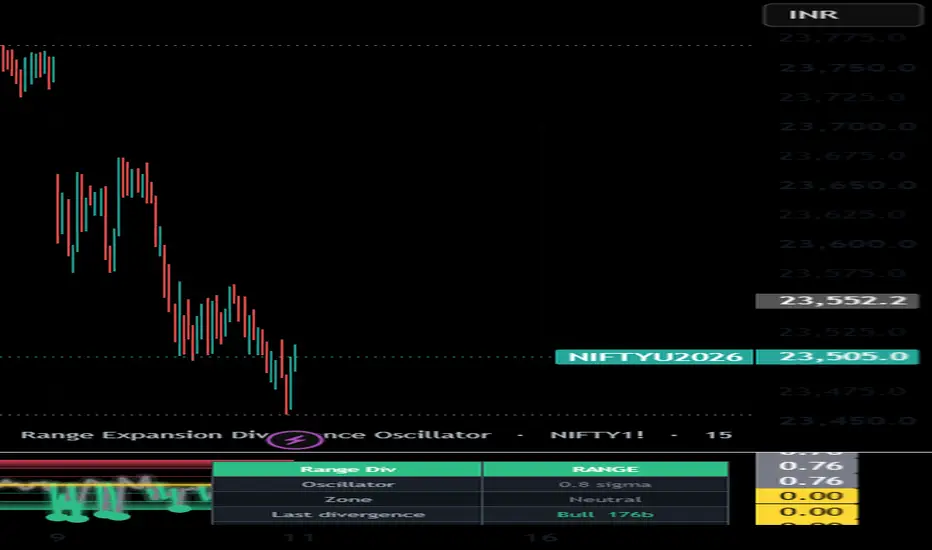
Range Expansion Divergence Oscillator
Range Expansion Divergence Oscillator
## Overview
The Range Expansion Divergence Oscillator turns **directional range expansion** - how large each bar range is versus its recent average, signed by the prevailing price direction - into a standardized, bounded oscillator, and then looks for **divergence between price and range**. The idea it tests: when price makes a new extreme on shrinking ranges, the move is "thin" and lacks effort behind it.
It is a single-pane oscillator. It needs no external data and no volume. Every data input is user-configurable, so it runs on any symbol, asset class or timeframe, in any market and on any timeframe. Defaults target NSE NIFTY index futures on intraday charts.
## What it plots
- A z-scored **range oscillator** (expanding range with the trend = up, contracting range = near zero), with a glow line and sigma-based overbought/oversold levels.
- **Extreme-zone bands** (default +/-3 sigma) with a gradient fill that deepens toward the edge.
- **Divergence lines and labels** on the oscillator - regular (reversal) and hidden (continuation), in two colors.
- **In-band reversal dots** where the oscillator turns inside an extreme zone.
- Optional **price-pane marks** at the confirmation bar (all generated by this one indicator).
- A **background-adaptive status dashboard** (oscillator value in sigma, zone, last divergence, last reversal, current range z-score).
## Why these components are combined (mashup rationale)
This script combines a **derived measure**, a **normalization stage**, a **divergence engine** and a **reversal read**, because each answers a question the others cannot and none is useful here alone:
1. **Directional range expansion (effort/participation).** Price geometry alone cannot show participation. A new high made on shrinking bar ranges is "thin"; a high on expanding ranges has effort behind it. The oscillator z-scores the bar range (high - low) versus its recent average and signs it by the net direction of price, giving the closest read to participation buildable from the bars of the instrument itself - with no volume required.
2. **Standardization (rolling z-score).** range differs in scale across instruments. The z-score expresses it in standard-deviation units, so "overbought/oversold" and the extreme bands mean the same thing on NIFTY, on a commodity future, or on a crypto instrument. Without this step the divergence thresholds would not transfer between symbols.
3. **Divergence engine.** The original payload is reading **price-versus-range disagreement at confirmed pivots**. The engine pairs each new price pivot with the oscillator value, then requires: a genuine new price extreme; the measure failing to confirm it; a minimum oscillator gap scaled to the oscillator own stdev; the two pivots within a maximum bar distance; and optionally an overbought/oversold reading at the pivot. These gates make the combination produce signal rather than noise.
4. **Reversal read.** Independently, the engine flags oscillator turns that occur inside the extreme bands - a complementary exhaustion cue.
Together the components form one pipeline: **build the signal -> make it comparable (z-score) -> surface where price and that signal disagree (divergence) and where it exhausts (reversal).** Each is incomplete alone.
## How it works (method)
bar range (high - low) is standardized to a rolling z-score, then signed by the net direction of price over the range window so that up = bullish; the result is the oscillator.
Regular and hidden divergence are detected from confirmed pivothigh/pivotlow pivots and filtered by the gates above; reversals are oscillator pivots that print inside the extreme bands. Pivots confirm a few bars after they occur, so a printed signal does not repaint. The confirmation lag equals the pivot length.
## How to use it
1. Add the indicator on any chart; no volume or external data is required.
2. Read divergence as **context, not a trigger**: a bearish divergence (price higher high, range lower high) says the new high lacks expanding range/effort; a bullish divergence says the opposite at lows. Confirm with your own structure, levels and risk process.
3. Tune the **pivot length**, **max gap** and **min oscillator gap** to your timeframe; raise them for fewer, cleaner signals.
## Originality
This is an original implementation - not a range line and not a generic divergence script, but the specific combination of range, sigma-standardization that makes the read portable across markets, a multi-gate divergence engine (magnitude + distance + extreme-zone), hidden-divergence and in-band reversal detection, and a background-adaptive dashboard. The code is written from scratch; helper functions use only their arguments and built-ins.
## Credits
Range-expansion / **effort-versus-result** analysis is a long-standing public technical-analysis approach (in the **Wyckoff** tradition). **Price/oscillator divergence** is likewise a standard, publicly documented technique. This script is not affiliated with, nor endorsed by, any third party.
## Notes / limitations
- Range is a participation proxy, not a direction call; the sign comes from a short price window, so very choppy segments can flip it.
- Divergence is descriptive context, never a guarantee of reversal.
- Confirmation lags each pivot by the pivot length.
## Disclaimer
Research and educational tool only. NOT financial advice and no guarantee of profitability or accuracy. Indicators describe past behaviour; they do not predict the future. Trading carries risk of loss. Test out-of-sample and make your own decisions. The author accepts no liability for any use of this script.
## Overview
The Range Expansion Divergence Oscillator turns **directional range expansion** - how large each bar range is versus its recent average, signed by the prevailing price direction - into a standardized, bounded oscillator, and then looks for **divergence between price and range**. The idea it tests: when price makes a new extreme on shrinking ranges, the move is "thin" and lacks effort behind it.
It is a single-pane oscillator. It needs no external data and no volume. Every data input is user-configurable, so it runs on any symbol, asset class or timeframe, in any market and on any timeframe. Defaults target NSE NIFTY index futures on intraday charts.
## What it plots
- A z-scored **range oscillator** (expanding range with the trend = up, contracting range = near zero), with a glow line and sigma-based overbought/oversold levels.
- **Extreme-zone bands** (default +/-3 sigma) with a gradient fill that deepens toward the edge.
- **Divergence lines and labels** on the oscillator - regular (reversal) and hidden (continuation), in two colors.
- **In-band reversal dots** where the oscillator turns inside an extreme zone.
- Optional **price-pane marks** at the confirmation bar (all generated by this one indicator).
- A **background-adaptive status dashboard** (oscillator value in sigma, zone, last divergence, last reversal, current range z-score).
## Why these components are combined (mashup rationale)
This script combines a **derived measure**, a **normalization stage**, a **divergence engine** and a **reversal read**, because each answers a question the others cannot and none is useful here alone:
1. **Directional range expansion (effort/participation).** Price geometry alone cannot show participation. A new high made on shrinking bar ranges is "thin"; a high on expanding ranges has effort behind it. The oscillator z-scores the bar range (high - low) versus its recent average and signs it by the net direction of price, giving the closest read to participation buildable from the bars of the instrument itself - with no volume required.
2. **Standardization (rolling z-score).** range differs in scale across instruments. The z-score expresses it in standard-deviation units, so "overbought/oversold" and the extreme bands mean the same thing on NIFTY, on a commodity future, or on a crypto instrument. Without this step the divergence thresholds would not transfer between symbols.
3. **Divergence engine.** The original payload is reading **price-versus-range disagreement at confirmed pivots**. The engine pairs each new price pivot with the oscillator value, then requires: a genuine new price extreme; the measure failing to confirm it; a minimum oscillator gap scaled to the oscillator own stdev; the two pivots within a maximum bar distance; and optionally an overbought/oversold reading at the pivot. These gates make the combination produce signal rather than noise.
4. **Reversal read.** Independently, the engine flags oscillator turns that occur inside the extreme bands - a complementary exhaustion cue.
Together the components form one pipeline: **build the signal -> make it comparable (z-score) -> surface where price and that signal disagree (divergence) and where it exhausts (reversal).** Each is incomplete alone.
## How it works (method)
bar range (high - low) is standardized to a rolling z-score, then signed by the net direction of price over the range window so that up = bullish; the result is the oscillator.
Regular and hidden divergence are detected from confirmed pivothigh/pivotlow pivots and filtered by the gates above; reversals are oscillator pivots that print inside the extreme bands. Pivots confirm a few bars after they occur, so a printed signal does not repaint. The confirmation lag equals the pivot length.
## How to use it
1. Add the indicator on any chart; no volume or external data is required.
2. Read divergence as **context, not a trigger**: a bearish divergence (price higher high, range lower high) says the new high lacks expanding range/effort; a bullish divergence says the opposite at lows. Confirm with your own structure, levels and risk process.
3. Tune the **pivot length**, **max gap** and **min oscillator gap** to your timeframe; raise them for fewer, cleaner signals.
## Originality
This is an original implementation - not a range line and not a generic divergence script, but the specific combination of range, sigma-standardization that makes the read portable across markets, a multi-gate divergence engine (magnitude + distance + extreme-zone), hidden-divergence and in-band reversal detection, and a background-adaptive dashboard. The code is written from scratch; helper functions use only their arguments and built-ins.
## Credits
Range-expansion / **effort-versus-result** analysis is a long-standing public technical-analysis approach (in the **Wyckoff** tradition). **Price/oscillator divergence** is likewise a standard, publicly documented technique. This script is not affiliated with, nor endorsed by, any third party.
## Notes / limitations
- Range is a participation proxy, not a direction call; the sign comes from a short price window, so very choppy segments can flip it.
- Divergence is descriptive context, never a guarantee of reversal.
- Confirmation lags each pivot by the pivot length.
## Disclaimer
Research and educational tool only. NOT financial advice and no guarantee of profitability or accuracy. Indicators describe past behaviour; they do not predict the future. Trading carries risk of loss. Test out-of-sample and make your own decisions. The author accepts no liability for any use of this script.
Catatan Rilis
Range Expansion Divergence Oscillator — update notesForward calibration added. Each divergence and reversal class (Reg Bull/Bear, Hidden Bull/Bear, Rev +/−) is resolved by a triple-barrier outcome, uniqueness-weighted and recency-decayed, reported as an edge over a zone-matched base rate with a Wilson interval and a multiple-testing-corrected significance star — so you can see which range-expansion (participation) divergences actually pay.
Identity strip showing name · symbol · timeframe on the chart (theme-adaptive).
Exports bus: EXP_Osc, EXP_OscZ, EXP_Zone, EXP_Bias, EXP_RegDiv, EXP_HidDiv, EXP_Reversal, EXP_BullEdge, EXP_BearEdge, plus EXP_RangeZ.
Pro dashboard adds the per-class calibration table; settings reorganized into 7 groups; all toggles default-on; NIFTY/intraday defaults retained; no volume or external data required; effort/result credit (Wyckoff tradition) kept in the header, out of the UI.
Educational only — not financial advice. Range is a participation proxy, not a direction call; calibration is in-sample, forward-measured. Validate out-of-sample.
Catatan Rilis
v1.1 — Three additive layers: robust normalization, a lag-minimal smoother, a 3-window extreme consensus, and a walk-forward out-of-sample reliability read. The directional range-expansion engine, the divergence engine and the triple-barrier zone-matched calibration are unchanged — set Normalization = "Classic (mean/stdev)" and Smoother = "EMA" for the original read.1. Robust MAD normalization + UltimateSmoother (default on). The signed range-expansion series can be standardized with a median/MAD z-score (median absolute deviation ×1.4826) instead of mean/stdev, so an outlier bar doesn't blow out the sigma bands, and smoothed with Ehlers' lag-minimal UltimateSmoother. Reversible via "Normalization" / "Smoother".
2. 3-window extreme consensus (opt-in, default off). z as the MEDIAN of the z at half, one and double the normalization window — extreme only when short, medium and long agree.
3. Walk-forward out-of-sample reliability. The first N resolved signals TRAIN; every one after is scored OUT-OF-SAMPLE and exported as EXP_OOSEdge / EXP_OOSHit — the trustworthy read.
What is unchanged. The directional range-expansion measure (range z signed by net direction), the regular + hidden divergence engine, the in-band reversal read and the entire triple-barrier zone-matched calibration (uniqueness-weighting, recency decay, Wilson interval, Šidák correction) are byte-for-byte the published version. The new layers only read existing series.
Still research/education only — NOT financial advice; no volume required (built from the bar's own range). Non-repaint: late-confirming pivots, calibration resolves on confirmed bars. Concept credits unchanged (Wyckoff-tradition effort-vs-result; López de Prado triple-barrier/uniqueness; Wilson; Šidák; Ehlers UltimateSmoother).
Catatan Rilis
v1.2 — R1 honest-stats standardization. Robust-z and the Wilson confidence half-width now come from the published calibration libraries (ml_robuststats/2, ml_calib/2), byte-identical to the prior local helpers — oscillator, divergence detection, marks and calibration numbers unchanged. Shared calibration engine across the divergence family.
Pernyataan Penyangkalan
Informasi dan publikasi ini tidak dimaksudkan, dan bukan merupakan, saran atau rekomendasi keuangan, investasi, trading, atau jenis lainnya yang diberikan atau didukung oleh TradingView. Baca selengkapnya di Ketentuan Penggunaan.
Pernyataan Penyangkalan
Informasi dan publikasi ini tidak dimaksudkan, dan bukan merupakan, saran atau rekomendasi keuangan, investasi, trading, atau jenis lainnya yang diberikan atau didukung oleh TradingView. Baca selengkapnya di Ketentuan Penggunaan.