
Over the past decade, private credit has become one of the most important segments of alternative finance. It refers to loans granted directly to companies by specialized investment funds, outside the traditional banking system. After a period of rapid expansion driven by low interest rates and strong demand for leverage, the key question today is whether this market is approaching a cyclical bottom after experiencing a sharp decline in the stock market over recent months.
The risks currently facing the sector are real but remain contained. Default rates have increased compared with the 2020–2021 period, although they remain well below systemic levels. The real concern is not so much the number of visible defaults as the emergence of more subtle warning signs: the growing use of "PIK" (Payment-in-Kind) loans, where interest is added to the outstanding debt rather than being paid in cash, the increase in discreet debt restructurings, and mounting pressure on the most highly leveraged companies financed during the 2021–2023 boom.
In this environment, not all market participants face the same level of exposure. The sector is dominated by a handful of major publicly traded platforms that combine asset management with direct corporate lending. Two distinct profiles stand out.
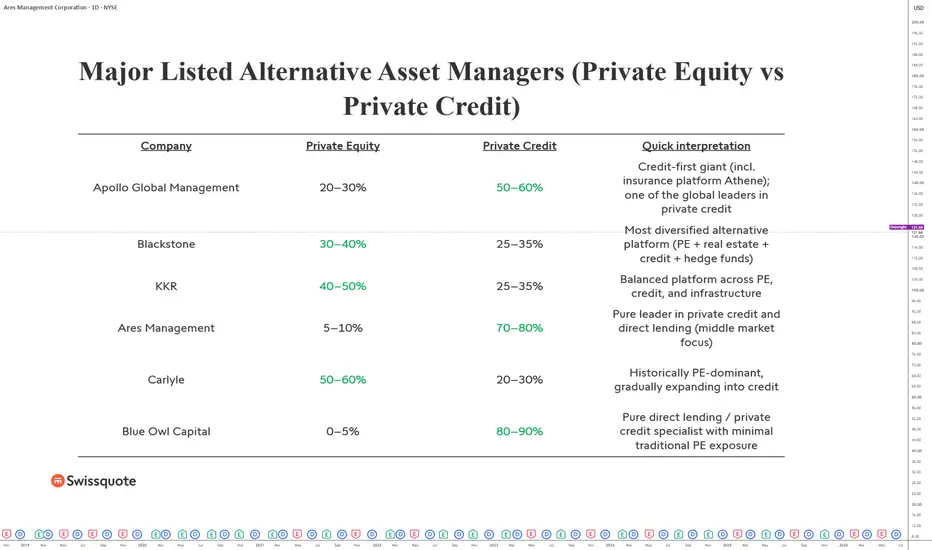
The table below presents the leading US companies in the private equity and private credit industries, together with the share of each activity within their business models. These five companies are the true barometer of the health of the private credit market. Technical analysis of their stocks can therefore provide highly valuable signals to answer the question addressed in this analysis.

On one side are diversified mega-platforms such as Apollo Global Management, Blackstone and KKR, which operate across private equity, private credit, real estate and infrastructure. Their diversification cushions market shocks but also makes them sensitive to the broader cycle of alternative assets.
On the other side are private credit specialists such as Ares Management and Blue Owl Capital, whose business models rely primarily on direct lending. These firms are more directly exposed to any deterioration in loan quality, but they also provide a clearer picture of the credit cycle.
The key point is that private credit remains a relatively young market that is now entering a more mature phase of its cycle. After years of exceptionally favorable conditions, the industry is undergoing a gradual normalization. Leading indicators, particularly the share of PIK loans and the rise in restructurings, suggest not a systemic crisis but rather a period of localized stress.
If macroeconomic conditions stabilize and interest rates begin to move lower again, private credit could gradually return to a healthier environment. However, if economic growth slows, existing pockets of weakness could intensify before any lasting stabilization occurs.
From a technical analysis perspective, the long-term monthly charts of the companies listed above show that their share prices have now returned to major support levels. However, the market will likely require several weeks or even months of stabilization before the long-term uptrend can resume, allowing investors to gain confidence that the Federal Reserve will not embark on another tightening cycle for the federal funds rate.
The chart below displays the monthly Japanese candlesticks for ARES.

The chart below displays the monthly Japanese candlesticks for Blue Owl Capital.

The chart below displays the monthly Japanese candlesticks for Blackstone.

The risks currently facing the sector are real but remain contained. Default rates have increased compared with the 2020–2021 period, although they remain well below systemic levels. The real concern is not so much the number of visible defaults as the emergence of more subtle warning signs: the growing use of "PIK" (Payment-in-Kind) loans, where interest is added to the outstanding debt rather than being paid in cash, the increase in discreet debt restructurings, and mounting pressure on the most highly leveraged companies financed during the 2021–2023 boom.
In this environment, not all market participants face the same level of exposure. The sector is dominated by a handful of major publicly traded platforms that combine asset management with direct corporate lending. Two distinct profiles stand out.
The table below presents the leading US companies in the private equity and private credit industries, together with the share of each activity within their business models. These five companies are the true barometer of the health of the private credit market. Technical analysis of their stocks can therefore provide highly valuable signals to answer the question addressed in this analysis.
On one side are diversified mega-platforms such as Apollo Global Management, Blackstone and KKR, which operate across private equity, private credit, real estate and infrastructure. Their diversification cushions market shocks but also makes them sensitive to the broader cycle of alternative assets.
On the other side are private credit specialists such as Ares Management and Blue Owl Capital, whose business models rely primarily on direct lending. These firms are more directly exposed to any deterioration in loan quality, but they also provide a clearer picture of the credit cycle.
The key point is that private credit remains a relatively young market that is now entering a more mature phase of its cycle. After years of exceptionally favorable conditions, the industry is undergoing a gradual normalization. Leading indicators, particularly the share of PIK loans and the rise in restructurings, suggest not a systemic crisis but rather a period of localized stress.
If macroeconomic conditions stabilize and interest rates begin to move lower again, private credit could gradually return to a healthier environment. However, if economic growth slows, existing pockets of weakness could intensify before any lasting stabilization occurs.
From a technical analysis perspective, the long-term monthly charts of the companies listed above show that their share prices have now returned to major support levels. However, the market will likely require several weeks or even months of stabilization before the long-term uptrend can resume, allowing investors to gain confidence that the Federal Reserve will not embark on another tightening cycle for the federal funds rate.
The chart below displays the monthly Japanese candlesticks for ARES.
The chart below displays the monthly Japanese candlesticks for Blue Owl Capital.
The chart below displays the monthly Japanese candlesticks for Blackstone.

This content is written by Vincent Ganne for Swissquote.
This content is intended for individuals who are familiar with financial markets and instruments and is for information purposes only and does not constitute investment, legal or tax advice.
This content is intended for individuals who are familiar with financial markets and instruments and is for information purposes only and does not constitute investment, legal or tax advice.
כתב ויתור
המידע והפרסומים אינם מיועדים להיות, ואינם מהווים, ייעוץ או המלצה פיננסית, השקעתית, מסחרית או מכל סוג אחר המסופקת או מאושרת על ידי TradingView. קרא עוד ב־תנאי השימוש.
This content is written by Vincent Ganne for Swissquote.
This content is intended for individuals who are familiar with financial markets and instruments and is for information purposes only and does not constitute investment, legal or tax advice.
This content is intended for individuals who are familiar with financial markets and instruments and is for information purposes only and does not constitute investment, legal or tax advice.
כתב ויתור
המידע והפרסומים אינם מיועדים להיות, ואינם מהווים, ייעוץ או המלצה פיננסית, השקעתית, מסחרית או מכל סוג אחר המסופקת או מאושרת על ידי TradingView. קרא עוד ב־תנאי השימוש.