
אינדיקטורים בלעדיים נוספים מאת BigBeluga
הירשם ל-BigBeluga Premium תמורת $66.47 לחודש כדי לקבל גישה לאינדיקטורים בלעדיים של היוצר הזה. התשלום מתבצע ישירות ב-TradingView, ואפשר להתחיל להשתמש בהם בגרפים שלך מיד.
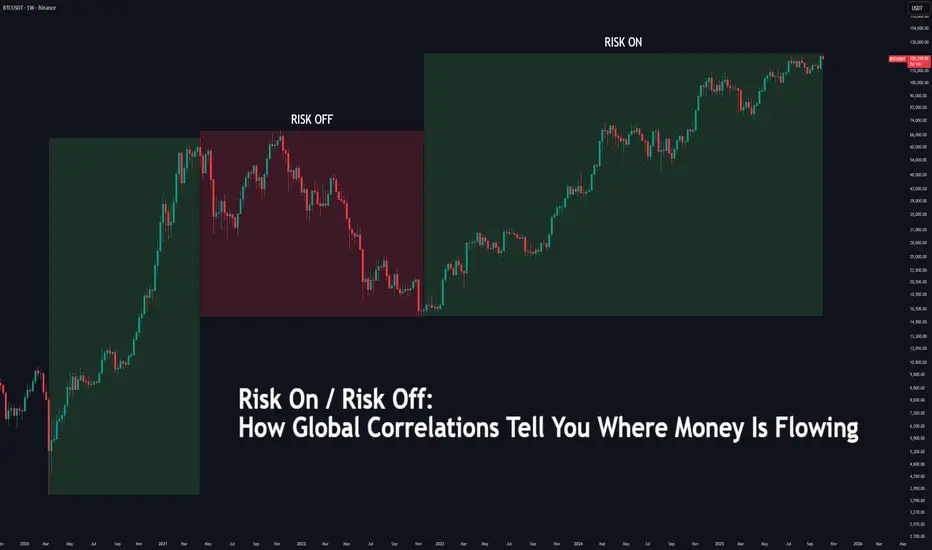
חקור BigBeluga Premium🔵 Risk On / Risk Off: How Global Correlations Tell You Where Money Is Flowing
Difficulty: 🐳🐳🐳🐋🐋 (Intermediate+)
This article is for traders who want to understand how global capital flow affects market behavior — from equities and crypto to gold and bonds. Learning to read “Risk On” and “Risk Off” regimes helps you anticipate big shifts before they hit your chart.
🔵 INTRODUCTION
Markets are not independent islands — they are connected by one universal force: liquidity flow.
When investors feel confident, they move capital into riskier assets like stocks and crypto — this is called Risk On.
When fear dominates, capital flows back into safety — bonds, gold, and the U.S. dollar — known as Risk Off.
Recognizing this rotation allows traders to align their bias with the flow of global capital rather than fighting it.

🔵 WHAT IS “RISK ON”
Risk On is a market environment where investors seek higher returns, volatility is subdued, and capital flows into assets with greater reward potential.
Typical Risk-On behavior:
In simple terms: Money chases opportunity.

🔵 WHAT IS “RISK OFF”
Risk Off describes defensive conditions — fear rises, volatility expands, and liquidity seeks safety.
Typical Risk-Off behavior:
In simple terms: Money runs to safety.

🔵 HOW TO DETECT RISK SHIFTS
Market regimes don’t flip instantly — they rotate through correlated behavior.
To identify the shift between Risk On and Risk Off, monitor key macro instruments together:
🔵 THE GLOBAL LIQUIDITY CYCLE
Liquidity always moves in phases — expansion, acceleration, contraction, and reset.
Understanding this rhythm helps traders avoid confusion when markets seem “irrational” — because they’re not, they’re simply rotating through the liquidity cycle.
🔵 USING RISK ON/OFF IN TRADING
Even technical traders benefit from recognizing global risk regimes.
By aligning with the dominant liquidity direction, setups gain higher probability.
Tip: When correlations align (e.g., DXY up, SPX down, BTC down), expect trend continuation.

When they diverge, volatility or reversals are likely.
🔵 ADVANCED TOOLS TO WATCH
🔵 CONCLUSION
All markets are connected through liquidity.
Risk On and Risk Off regimes describe how that liquidity rotates between return and safety. By tracking global correlations — equities, bonds, gold, DXY, and crypto — traders gain a powerful macro filter to stay on the right side of momentum.
Liquidity creates direction. Correlation confirms conviction.
If you learn to read the global flow, your technical analysis will finally make sense in the bigger picture.
Do you track global correlations in your analysis? What’s your favorite Risk-On or Risk-Off indicator?
Difficulty: 🐳🐳🐳🐋🐋 (Intermediate+)
This article is for traders who want to understand how global capital flow affects market behavior — from equities and crypto to gold and bonds. Learning to read “Risk On” and “Risk Off” regimes helps you anticipate big shifts before they hit your chart.
🔵 INTRODUCTION
Markets are not independent islands — they are connected by one universal force: liquidity flow.
When investors feel confident, they move capital into riskier assets like stocks and crypto — this is called Risk On.
When fear dominates, capital flows back into safety — bonds, gold, and the U.S. dollar — known as Risk Off.
Recognizing this rotation allows traders to align their bias with the flow of global capital rather than fighting it.
🔵 WHAT IS “RISK ON”
Risk On is a market environment where investors seek higher returns, volatility is subdued, and capital flows into assets with greater reward potential.
Typical Risk-On behavior:
- S&P 500, Nasdaq, and other equities trend higher
- Bitcoin and crypto assets outperform traditional markets
- U.S. Dollar Index (DXY) weakens as money moves abroad
- Bond yields rise moderately as investors leave safe assets
- Gold often consolidates or declines
In simple terms: Money chases opportunity.
🔵 WHAT IS “RISK OFF”
Risk Off describes defensive conditions — fear rises, volatility expands, and liquidity seeks safety.
Typical Risk-Off behavior:
- S&P 500 and risk assets decline
- Bitcoin and altcoins drop sharply
- DXY strengthens as investors move into USD
- Bond yields fall as money enters treasuries
- Gold rallies as a safe-haven hedge
In simple terms: Money runs to safety.
🔵 HOW TO DETECT RISK SHIFTS
Market regimes don’t flip instantly — they rotate through correlated behavior.
To identify the shift between Risk On and Risk Off, monitor key macro instruments together:
- DXY (Dollar Index): Rising DXY = Risk Off sentiment, Falling DXY = Risk On.
- SPX / NASDAQ: Strong uptrends = Risk On, persistent weakness = Risk Off.
- BTC vs DXY: Inverse correlation; BTC strength with DXY weakness = liquidity expansion.
- Bond Yields (US10Y): Rising = optimism, Falling = risk aversion.
- VIX Index: Below 15 = complacent Risk On, Above 25 = fearful Risk Off.
🔵 THE GLOBAL LIQUIDITY CYCLE
Liquidity always moves in phases — expansion, acceleration, contraction, and reset.
- Phase 1 – Liquidity Expansion: Central banks inject liquidity → Risk On begins.
- Phase 2 – Overextension: Assets rally strongly, leverage increases, volatility stays low.
- Phase 3 – Liquidity Contraction: Monetary tightening or policy shocks trigger Risk Off.
- Phase 4 – Repricing & Reset: Markets bottom as new liquidity returns.
Understanding this rhythm helps traders avoid confusion when markets seem “irrational” — because they’re not, they’re simply rotating through the liquidity cycle.
🔵 USING RISK ON/OFF IN TRADING
Even technical traders benefit from recognizing global risk regimes.
By aligning with the dominant liquidity direction, setups gain higher probability.
- Crypto traders: Use SPX, DXY, and VIX correlations to confirm momentum.
- Stock traders: Track gold and yields to gauge investor confidence.
- Forex traders: Trade USD pairs according to global sentiment.
- Swing traders: Filter trade bias by checking the current global regime.
Tip: When correlations align (e.g., DXY up, SPX down, BTC down), expect trend continuation.
When they diverge, volatility or reversals are likely.
🔵 ADVANCED TOOLS TO WATCH
- Global Liquidity Index: Track combined balance sheets of the Fed, ECB, BOJ, and PBC.
- Stablecoin Supply (Crypto): Expanding supply = liquidity entering market.
- Yield Curve (10Y–2Y spread): Falling = caution, Rising = recovery.
- Funding Rates: Confirm risk sentiment via leverage buildup.
🔵 CONCLUSION
All markets are connected through liquidity.
Risk On and Risk Off regimes describe how that liquidity rotates between return and safety. By tracking global correlations — equities, bonds, gold, DXY, and crypto — traders gain a powerful macro filter to stay on the right side of momentum.
Liquidity creates direction. Correlation confirms conviction.
If you learn to read the global flow, your technical analysis will finally make sense in the bigger picture.
Do you track global correlations in your analysis? What’s your favorite Risk-On or Risk-Off indicator?

🌐 bigbeluga.org/tv - Get access to our powerful tools & indicators.
🔵 Learn More -> docs.bigbeluga.org/
🔵 Join Discord -> go.bigbeluga.org/k65q9bfqfu
All content provided by BigBeluga is for educational purposes only
🔵 Learn More -> docs.bigbeluga.org/
🔵 Join Discord -> go.bigbeluga.org/k65q9bfqfu
All content provided by BigBeluga is for educational purposes only
כתב ויתור
המידע והפרסומים אינם מיועדים להיות, ואינם מהווים, ייעוץ או המלצה פיננסית, השקעתית, מסחרית או מכל סוג אחר המסופקת או מאושרת על ידי TradingView. קרא עוד ב־תנאי השימוש.