
Good morning traders,
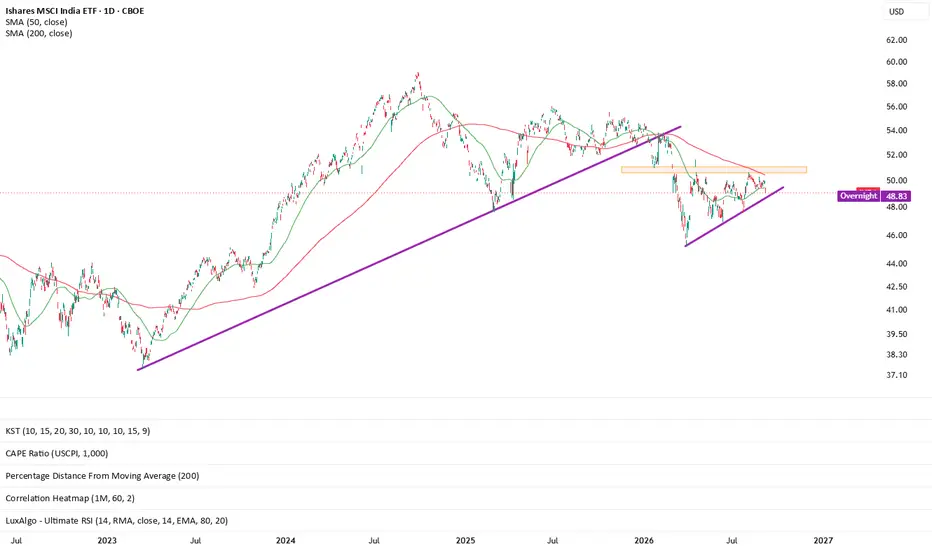
INDA ETF is still bearish unless price recovers 200 MA. Breaking down below 48 will open the door to lower lows
My 6 trading rules
1. Never add to a losing position: Avoid averaging down. Adding capital to a trade that is moving against you dramatically increases your risk exposure on a failing idea.
2. Don't be the first to buy low/sell high, and don't be the last to exit: Avoid trying to perfectly time the exact absolute top or bottom of a market. Chasing extreme momentum or staying in a position until the very last second often leads to panic selling or getting trapped.
3. Think fundamental, manage technical: Build your core trade thesis around underlying fundamental value and macroeconomic conditions, but utilize strict technical analysis (charts, support/resistance, and moving averages) to execute precise market entries and exits.
4. Keep analysis simple: Overly complex strategies and cluttering charts with too many indicators frequently lead to confusion, analysis paralysis, and poor decision-making.
5. Start small, then scale: Begin your trade with small position sizes. Only increase your lot size and scale up exposure once the market actively moves in your direction and confirms the trend.
6. The complicated position is generally the correct one: The positions that require the most patience, strict discipline, or run entirely counter to popular retail crowd sentiment are often the ones built on real market logic.
In earlier frameworks, this rule also emphasized relying on a consistent, well-tested system and diversified portfolio. My track record is public.
INDA ETF is still bearish unless price recovers 200 MA. Breaking down below 48 will open the door to lower lows
My 6 trading rules
1. Never add to a losing position: Avoid averaging down. Adding capital to a trade that is moving against you dramatically increases your risk exposure on a failing idea.
2. Don't be the first to buy low/sell high, and don't be the last to exit: Avoid trying to perfectly time the exact absolute top or bottom of a market. Chasing extreme momentum or staying in a position until the very last second often leads to panic selling or getting trapped.
3. Think fundamental, manage technical: Build your core trade thesis around underlying fundamental value and macroeconomic conditions, but utilize strict technical analysis (charts, support/resistance, and moving averages) to execute precise market entries and exits.
4. Keep analysis simple: Overly complex strategies and cluttering charts with too many indicators frequently lead to confusion, analysis paralysis, and poor decision-making.
5. Start small, then scale: Begin your trade with small position sizes. Only increase your lot size and scale up exposure once the market actively moves in your direction and confirms the trend.
6. The complicated position is generally the correct one: The positions that require the most patience, strict discipline, or run entirely counter to popular retail crowd sentiment are often the ones built on real market logic.
In earlier frameworks, this rule also emphasized relying on a consistent, well-tested system and diversified portfolio. My track record is public.

כתב ויתור
המידע והפרסומים אינם מיועדים להיות, ואינם מהווים, ייעוץ או המלצה פיננסית, השקעתית, מסחרית או מכל סוג אחר המסופקת או מאושרת על ידי TradingView. קרא עוד ב־תנאי השימוש.
כתב ויתור
המידע והפרסומים אינם מיועדים להיות, ואינם מהווים, ייעוץ או המלצה פיננסית, השקעתית, מסחרית או מכל סוג אחר המסופקת או מאושרת על ידי TradingView. קרא עוד ב־תנאי השימוש.