
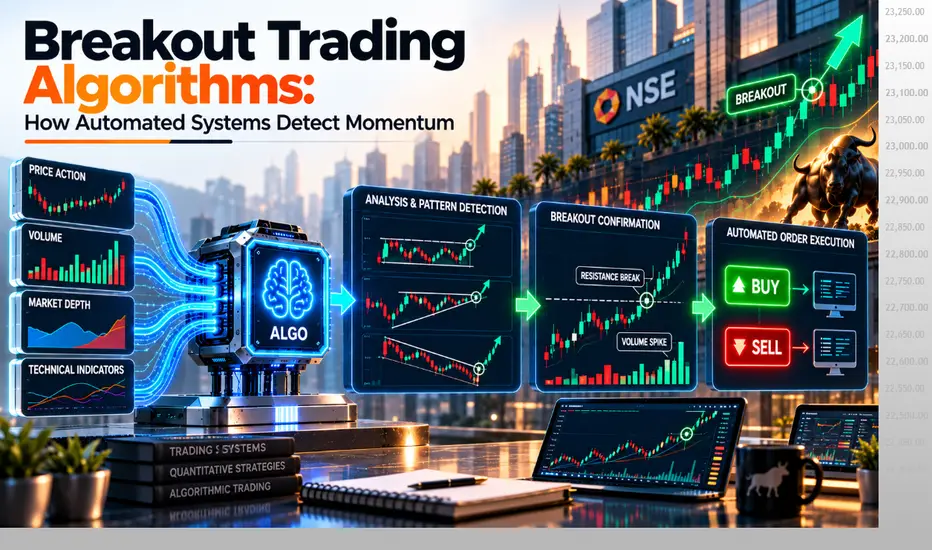
📊 Breakout Trading Algorithms: How Automated Systems Detect Momentum
A breakout algorithm does not simply buy because price moves above resistance.
A better system asks:
**Is this a genuine momentum breakout — or only a temporary spike?**
That is where automation becomes more useful.
---------------------------------
🤖 Step 1: Define the Breakout Level
The algorithm first needs an exact level.
It may use:
• Previous swing high
• Opening range high
• Previous day high
• Consolidation boundary
• Higher-timeframe resistance
For example:
Resistance = Highest High of Previous 20 Candles
Now the computer knows exactly what it is monitoring.
---------------------------------
📈 Step 2: Look for Price Acceptance
Price touching above resistance is not enough.
A stronger breakout may require:
✅ Candle close above resistance
✅ Strong candle body
✅ Close near the candle high
✅ Limited upper wick
✅ Follow-through after breakout
This helps separate:
**Breakout Acceptance**
from:
**Temporary Price Penetration**
---------------------------------
📊 Step 3: Confirm Participation
Momentum becomes more meaningful when volume expands.
A system may require:
**Current Volume > Recent Average Volume**
Why?
Because a breakout with weak participation can fail quickly.
Volume helps the algo determine whether real market interest is supporting the move.
---------------------------------
⚡ Step 4: Detect Momentum Expansion
A strong breakout system may also check:
• Candle range expanding
• ATR increasing
• Price above VWAP
• Higher lows forming
• Relative strength improving
This helps identify the shift from:
**Compression → Expansion**
rather than trading every random breakout candle.
---------------------------------
🎯 Step 5: Check Entry Location
A breakout can be correct...
but the entry can still be poor.
If resistance breaks at 500 and price is already at 515, the move may be too extended.
A good algo can reject trades when:
• Price is too far from breakout
• Stop becomes too wide
• R:R becomes unattractive
Correct direction does not automatically mean good execution.
---------------------------------
🔄 Breakout + Retest Algorithms
Some systems wait for:
**Breakout → Pullback → Retest Hold → Entry**
This can improve:
• Entry location
• False-breakout filtering
• Stop placement
• Risk-to-reward
The algorithm enters only after old resistance begins acting as support.
---------------------------------
⚠️ False Breakout Filters
A breakout may be rejected when:
❌ Large upper wick appears
❌ Price closes back inside the range
❌ Volume remains weak
❌ VWAP fails immediately
❌ Follow-through disappears
The goal is not to trade every breakout.
It is to trade the breakouts showing genuine acceptance.
---------------------------------
📊 For Option Traders
For NIFTY or stock options, the underlying should usually create the directional signal first.
Example:
Underlying:
✅ Resistance breaks
✅ Price above VWAP
✅ Momentum confirms
Then the option engine checks:
• CE / PE selection
• Strike liquidity
• Premium VWAP
• Premium swing breakout
• Spread and volume
**Underlying generates direction.**
**Option premium confirms execution.**
---------------------------------
🛡️ Risk Still Comes Before the Order
Even after a valid signal, the algorithm should check:
• Structural stop
• Position size
• Daily loss limit
• Maximum exposure
• R:R
A breakout signal without risk management is not a complete trading system.
---------------------------------
📊 Simple Formula
Breakout Level + Price Acceptance + Volume Expansion + Momentum + Trend Alignment + Defined Risk
= Higher-Quality Breakout Setup
But:
Level Break + Weak Volume + Rejection + Poor Entry Location
= Possible False Breakout
---------------------------------
📊 Finally, the important point to note is:
A breakout algorithm should not ask only:
“Did price cross resistance?”
It should ask:
**“Did the breakout show enough momentum, participation and structure to deserve capital?”**
That is the real difference between a simple breakout alert and a professional automated momentum system.
---------------------------------
Educational Purpose Only.

⭐For Live Trading Courses And Trading Community 📈
Contact ⬇️
📱wa.me/919322295961
📱t.me/+UgF9lES_XxA0MTk9
⭐Advanced courses
⭐Fully Automated Algo Trading
⭐Daily F&O Trade tips
📱 t.me/+UgF9lES_XxA0MTk9
Contact ⬇️
📱wa.me/919322295961
📱t.me/+UgF9lES_XxA0MTk9
⭐Advanced courses
⭐Fully Automated Algo Trading
⭐Daily F&O Trade tips
📱 t.me/+UgF9lES_XxA0MTk9
פרסומים קשורים
כתב ויתור
המידע והפרסומים אינם מיועדים להיות, ואינם מהווים, ייעוץ או המלצה פיננסית, השקעתית, מסחרית או מכל סוג אחר המסופקת או מאושרת על ידי TradingView. קרא עוד ב־תנאי השימוש.