
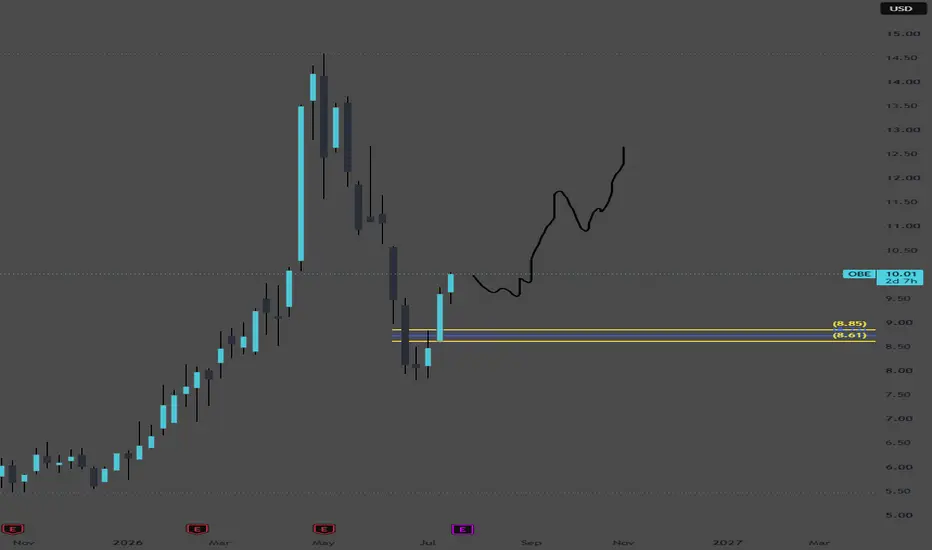
Bull Case
1. High operating leverage to oil prices
Every sustained increase in WTI oil prices significantly boosts cash flow.
Most operating costs are relatively fixed, so higher realized prices largely flow to the bottom line.
2. Attractive valuation
OBE has historically traded at lower EV/EBITDA and cash flow multiples than many North American E&P peers.
The market still discounts the company because of its past as Penn West Petroleum, despite a much healthier balance sheet today.
3. Improved balance sheet
Management has focused on debt reduction over the last several years.
Lower leverage reduces financial risk and gives flexibility for acquisitions or shareholder returns.
4. Production growth
Recent acquisitions, including the Belly River transaction, are expected to increase production and extend drilling inventory. Management has also increased production guidance following the acquisition.
5. Capital discipline
Unlike previous commodity cycles, management emphasizes:
returns on invested capital,
free cash flow generation,
disciplined capital spending,
maintaining financial flexibility.
Potential Catalysts
Higher oil prices.
Strong quarterly earnings.
Continued debt reduction.
Share buybacks.
Additional accretive acquisitions.
Reserve upgrades.
Improved analyst sentiment following successful integration of recent assets.
Key Risks
Oil price declines remain the largest risk.
Canadian pipeline constraints and differentials.
Cost inflation.
Integration risk from acquisitions.
Environmental and regulatory changes.
A global recession reducing energy demand.
Valuation Scenario
If WTI remains in the $70–80/bbl range:
Free cash flow could remain robust.
Debt can continue declining.
Investors may award a higher valuation multiple.
If WTI moves above $85/bbl, upside could be substantial due to operating leverage.
Conversely, if WTI falls below $60/bbl for an extended period, earnings and cash flow would likely compress significantly.
Overall View
The investment thesis rests on three pillars:
A stronger company than its historical reputation suggests.
An inexpensive valuation relative to cash-generating capability.
Significant upside from disciplined capital allocation and favorable commodity prices.
The primary downside is that OBE remains fundamentally an oil producer, making returns highly sensitive to crude prices. For investors who are constructive on medium-term oil fundamentals, OBE offers a relatively high-beta way to express that view.
1. High operating leverage to oil prices
Every sustained increase in WTI oil prices significantly boosts cash flow.
Most operating costs are relatively fixed, so higher realized prices largely flow to the bottom line.
2. Attractive valuation
OBE has historically traded at lower EV/EBITDA and cash flow multiples than many North American E&P peers.
The market still discounts the company because of its past as Penn West Petroleum, despite a much healthier balance sheet today.
3. Improved balance sheet
Management has focused on debt reduction over the last several years.
Lower leverage reduces financial risk and gives flexibility for acquisitions or shareholder returns.
4. Production growth
Recent acquisitions, including the Belly River transaction, are expected to increase production and extend drilling inventory. Management has also increased production guidance following the acquisition.
5. Capital discipline
Unlike previous commodity cycles, management emphasizes:
returns on invested capital,
free cash flow generation,
disciplined capital spending,
maintaining financial flexibility.
Potential Catalysts
Higher oil prices.
Strong quarterly earnings.
Continued debt reduction.
Share buybacks.
Additional accretive acquisitions.
Reserve upgrades.
Improved analyst sentiment following successful integration of recent assets.
Key Risks
Oil price declines remain the largest risk.
Canadian pipeline constraints and differentials.
Cost inflation.
Integration risk from acquisitions.
Environmental and regulatory changes.
A global recession reducing energy demand.
Valuation Scenario
If WTI remains in the $70–80/bbl range:
Free cash flow could remain robust.
Debt can continue declining.
Investors may award a higher valuation multiple.
If WTI moves above $85/bbl, upside could be substantial due to operating leverage.
Conversely, if WTI falls below $60/bbl for an extended period, earnings and cash flow would likely compress significantly.
Overall View
The investment thesis rests on three pillars:
A stronger company than its historical reputation suggests.
An inexpensive valuation relative to cash-generating capability.
Significant upside from disciplined capital allocation and favorable commodity prices.
The primary downside is that OBE remains fundamentally an oil producer, making returns highly sensitive to crude prices. For investors who are constructive on medium-term oil fundamentals, OBE offers a relatively high-beta way to express that view.
העסקה בוטלה באופן ידני
took risk off. leaving a small runner.

כתב ויתור
המידע והפרסומים אינם מיועדים להיות, ואינם מהווים, ייעוץ או המלצה פיננסית, השקעתית, מסחרית או מכל סוג אחר המסופקת או מאושרת על ידי TradingView. קרא עוד ב־תנאי השימוש.
כתב ויתור
המידע והפרסומים אינם מיועדים להיות, ואינם מהווים, ייעוץ או המלצה פיננסית, השקעתית, מסחרית או מכל סוג אחר המסופקת או מאושרת על ידי TradingView. קרא עוד ב־תנאי השימוש.