
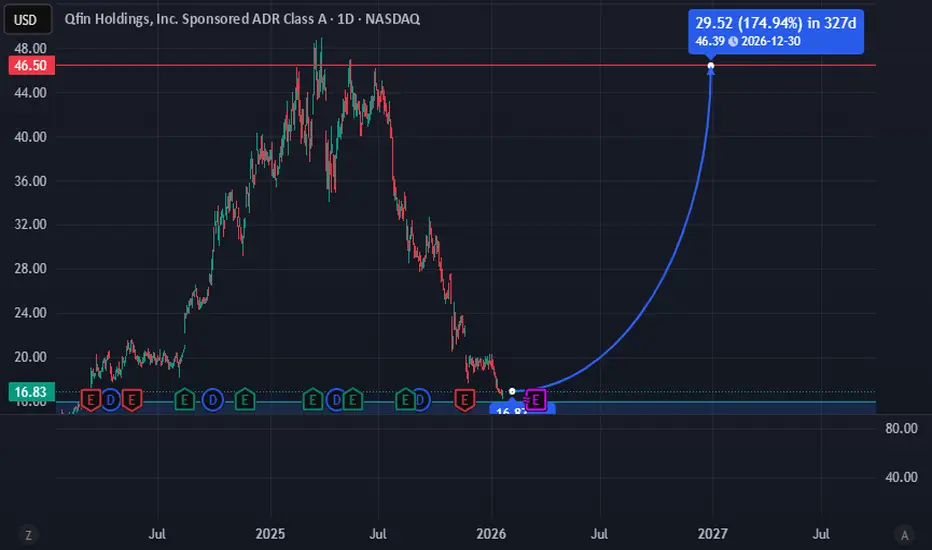
Qfin Holdings, Inc. (NASDAQ: QFIN) – Fundamental Stock Evaluation
Company Overview
Qfin Holdings, Inc. is a China-based fintech company specializing in AI-driven credit technology solutions. The company operates a digital platform that connects borrowers with financial institutions, providing credit assessment, loan facilitation, and risk management services. QFIN primarily serves the consumer finance market in China and leverages proprietary data analytics and artificial intelligence to enhance underwriting efficiency.
Financial Performance & Profitability
QFIN demonstrates strong underlying profitability despite market volatility:
Revenue (TTM): Approximately $2.7–2.8 billion
Net Income (TTM): Approximately $950+ million
Diluted EPS (TTM): ~$6.8–7.0
Return on Equity (ROE): ~29%
The company maintains high margins and strong earnings generation, indicating an efficient and scalable business model. Profitability remains solid even under regulatory pressure, highlighting operational resilience.
Valuation Metrics
QFIN currently trades at extremely discounted valuation levels relative to its fundamentals:
P/E Ratio: ~2.4x
Price-to-Sales (P/S): < 1
Price-to-Book (P/B): Significantly below sector averages
These multiples suggest the stock is deeply undervalued, with the market pricing in elevated regulatory and macroeconomic risks.
Balance Sheet & Financial Strength
QFIN maintains a strong balance sheet:
Cash & Equivalents: ~$1.5 billion
Total Debt: ~$1.0 billion
Net Cash Position: Positive
Debt-to-Equity Ratio: ~0.28
Current Ratio: ~2.9
The company has sufficient liquidity to meet short-term obligations and sustain operations without financial stress.
Dividend & Shareholder Returns
Dividend Yield: ~9%
QFIN consistently returns capital to shareholders, making it attractive to income-focused investors.
Dividend sustainability is supported by strong free cash flow generation.
Institutional & Market Perception
While institutional ownership exists, investor sentiment remains cautious due to:
Regulatory uncertainty in China’s fintech sector
Macroeconomic slowdown concerns
Despite this, analyst consensus indicates significant upside potential, with some target prices implying 100%+ upside from current levels.
Key Risks
Regulatory Risk: Ongoing government oversight of fintech and consumer lending in China
Market Volatility: High price fluctuations
Macroeconomic Exposure: Slower credit demand during economic downturns
These risks largely explain the valuation discount.
Investment Thesis
QFIN represents a high-risk, high-reward value opportunity:
✔ Strong profitability and cash flow
✔ Attractive dividend yield
✔ Solid balance sheet
❗ Significant regulatory and geopolitical risk
Conclusion:
QFIN appears fundamentally undervalued, but it is best suited for investors with a long-term horizon and high risk tolerance, particularly those seeking value and income opportunities in emerging markets.

כתב ויתור
המידע והפרסומים אינם מיועדים להיות, ואינם מהווים, ייעוץ או המלצה פיננסית, השקעתית, מסחרית או מכל סוג אחר המסופקת או מאושרת על ידי TradingView. קרא עוד ב־תנאי השימוש.
כתב ויתור
המידע והפרסומים אינם מיועדים להיות, ואינם מהווים, ייעוץ או המלצה פיננסית, השקעתית, מסחרית או מכל סוג אחר המסופקת או מאושרת על ידי TradingView. קרא עוד ב־תנאי השימוש.