
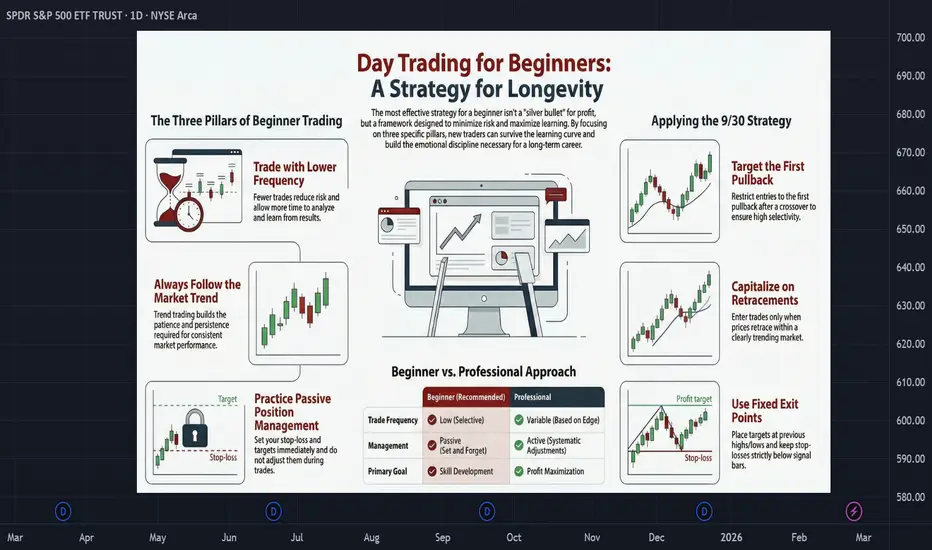
🔥Day Trading for Beginners: A Strategy for Longevity🔥
Most new traders begin with a single objective: profit.
While that is expected and a natural long-term goal, that narrow focus often leads to rushed decisions, oversized risk, and early exits from the market.
Hence, your first strategy should not aim to maximize returns. It should aim to build competence while preserving capital.
📌 REDEFINE THE PURPOSE OF YOUR FIRST SYSTEM
A beginner strategy is a training framework. And its job is to create a controlled environment where you can:
Early profitability is secondary and a excellent bonus.
Our objective is longevity. Skill development determines whether you remain in the market long enough to compound experience.
When growth of process takes priority, account fluctuations carry less emotional weight, leading to a sustainable trading career.
🧭 THE DISCIPLINE OF DOING LESS
Infrequent trading is a risk management tool.
High activity does not equal high productivity, much less high profits. For developing traders, trading frequently often amplifies errors.
Slower time frames and selective participation create space for reflection. They allow you to review decisions rather than react impulsively.
Key advantages of reduced frequency:
Sitting out uncertain market conditions is not a drawback. It is required discipline.
Waiting for alignment builds selectivity and that is a core professional trait.
🎯 TRADE WITH STRUCTURE, NOT EGO
Attempting to call exact tops and bottoms appeals to ego, not probability.
Counter-trend trading demands precision and experience that most beginners have not yet developed. Hence, following the trend is a beginner's best strategy.
A trend-aligned approach simplifies decision-making by:
Two qualities become essential:
Trading along the market structure places you alongside dominant order flow rather than against it.
⚙️ SET RULES, THEN STEP BACK
Once a trade is placed, your role changes from decision-maker to observer.
Active interference is one of the most common sources of performance deterioration for beginners. Without the intuition of an experienced trader, moving stops, closing prematurely, or widening risk parameters usually reflects discomfort rather than strategy.
A structured approach to position management:
Consistency in execution builds reliable trading records that help you improve future strategy. If your execution is inconsistent, then you cannot draw meaningful and helpful conclusions from you records.
🧠 THE “WHAT-IF” JOURNAL METHOD
You can develop and check the effectiveness of discretionary insight without altering live trades.
Maintain a structured journal:
This transforms impulse into measurable evidence.
If your discretionary actions (active management) truly adds value, the data will show it. If not, the journal prevents unnecessary interference.
Development should be evidence-based, not emotionally driven. You should only apply your intuition only after showing that it is superior to a rule-based approach.
📊 SIMPLIFY YOUR STRATEGY DESIGN
Strategies for a new trader minimize complexity to improve consistency.
When structuring a basic trend-following system:
The objective is repeatability.
A simple system executed consistently produces more useful feedback than a complex system executed inconsistently.
The 9/30 Trading Setup shown in the chart below is a good option for a beginner. It looks for a crossover to indicate trend, a pullback to for context, and a break of bar high to time the trade. Clear and simple.

🧪 CONSIDER SIMULATION BEFORE SCALE
Simulation trading can accelerate learning without financial pressure.
It allows you to:
While simulated results differ from live conditions, the structural lessons remain valuable.
Transition to live capital only after you can adhere to your trading plan consistently in simulation.
📌 A REPEATABLE DEVELOPMENT PROCESS
Approach your first year as structured training:
Avoid frequent system changes. Stability enables meaningful evaluation.
📈 FINAL TAKEAWAY
Your first trading strategy is not a revenue engine. It is an apprenticeship.
Prioritize:
If you build structured habits now, profitability becomes a by-product of competence.
If you chase returns first, inconsistency becomes the default.
Decide whether your current approach builds skill or merely seeks profits with process.
Most new traders begin with a single objective: profit.
While that is expected and a natural long-term goal, that narrow focus often leads to rushed decisions, oversized risk, and early exits from the market.
Hence, your first strategy should not aim to maximize returns. It should aim to build competence while preserving capital.
📌 REDEFINE THE PURPOSE OF YOUR FIRST SYSTEM
A beginner strategy is a training framework. And its job is to create a controlled environment where you can:
- Practice execution
- Apply risk management consistently
- Observe your psychological reactions
- Collect meaningful performance data
Early profitability is secondary and a excellent bonus.
Our objective is longevity. Skill development determines whether you remain in the market long enough to compound experience.
When growth of process takes priority, account fluctuations carry less emotional weight, leading to a sustainable trading career.
🧭 THE DISCIPLINE OF DOING LESS
Infrequent trading is a risk management tool.
High activity does not equal high productivity, much less high profits. For developing traders, trading frequently often amplifies errors.
Slower time frames and selective participation create space for reflection. They allow you to review decisions rather than react impulsively.
Key advantages of reduced frequency:
- Improved ability to review trades objectively
- Reduced exposure to emotional cycles
- Lower transaction costs
- Clearer pattern recognition
Sitting out uncertain market conditions is not a drawback. It is required discipline.
Waiting for alignment builds selectivity and that is a core professional trait.
🎯 TRADE WITH STRUCTURE, NOT EGO
Attempting to call exact tops and bottoms appeals to ego, not probability.
Counter-trend trading demands precision and experience that most beginners have not yet developed. Hence, following the trend is a beginner's best strategy.
A trend-aligned approach simplifies decision-making by:
- Waiting for directional clarity
- Trading in the direction of prevailing momentum
- Not predicting turning points without structural confirmation
Two qualities become essential:
- Patience — waiting for established directional bias
- Persistence — holding trades aligned with that bias
Trading along the market structure places you alongside dominant order flow rather than against it.
⚙️ SET RULES, THEN STEP BACK
Once a trade is placed, your role changes from decision-maker to observer.
Active interference is one of the most common sources of performance deterioration for beginners. Without the intuition of an experienced trader, moving stops, closing prematurely, or widening risk parameters usually reflects discomfort rather than strategy.
A structured approach to position management:
- Define stop-loss before entry
- Define target before entry
- Execute according to plan
- Avoid mid-trade adjustments unless rule-based (as in predetermined and not decided on the fly)
Consistency in execution builds reliable trading records that help you improve future strategy. If your execution is inconsistent, then you cannot draw meaningful and helpful conclusions from you records.
🧠 THE “WHAT-IF” JOURNAL METHOD
You can develop and check the effectiveness of discretionary insight without altering live trades.
Maintain a structured journal:
- Record what you would have done differently during the trade (DURING the trade, to avoid hindsight bias.)
- Note alternative exits or adjustments separately
- Collect at least 30 documented trades
- Compare actual results with hypothetical adjustments
This transforms impulse into measurable evidence.
If your discretionary actions (active management) truly adds value, the data will show it. If not, the journal prevents unnecessary interference.
Development should be evidence-based, not emotionally driven. You should only apply your intuition only after showing that it is superior to a rule-based approach.
📊 SIMPLIFY YOUR STRATEGY DESIGN
Strategies for a new trader minimize complexity to improve consistency.
When structuring a basic trend-following system:
- Limit entries to clearly defined pullbacks
- Restrict trades to one direction per trend
- Use fixed stop placement rules
- Use predefined target logic
- Avoid discretionary overrides
The objective is repeatability.
A simple system executed consistently produces more useful feedback than a complex system executed inconsistently.
The 9/30 Trading Setup shown in the chart below is a good option for a beginner. It looks for a crossover to indicate trend, a pullback to for context, and a break of bar high to time the trade. Clear and simple.
🧪 CONSIDER SIMULATION BEFORE SCALE
Simulation trading can accelerate learning without financial pressure.
It allows you to:
- Test execution mechanics
- Refine order placement
- Build statistical samples
- Observe emotional tendencies in controlled conditions
While simulated results differ from live conditions, the structural lessons remain valuable.
Transition to live capital only after you can adhere to your trading plan consistently in simulation.
📌 A REPEATABLE DEVELOPMENT PROCESS
Approach your first year as structured training:
- Select one simple strategy
- Trade it on a consistent time frame
- Risk a small, fixed percentage per trade
- Journal every entry and exit
- Review performance monthly, not daily
- Adjust only after sufficient data is collected
Avoid frequent system changes. Stability enables meaningful evaluation.
📈 FINAL TAKEAWAY
Your first trading strategy is not a revenue engine. It is an apprenticeship.
Prioritize:
- Process over profit
- Discipline over excitement
- Data over impulse
- Consistency over complexity
If you build structured habits now, profitability becomes a by-product of competence.
If you chase returns first, inconsistency becomes the default.
Decide whether your current approach builds skill or merely seeks profits with process.

Price action | Founder of Trading Setups Review | tradingsetupsreview.com/ | Author of Day Trading With Price Action
כתב ויתור
המידע והפרסומים אינם מיועדים להיות, ואינם מהווים, ייעוץ או המלצה פיננסית, השקעתית, מסחרית או מכל סוג אחר המסופקת או מאושרת על ידי TradingView. קרא עוד ב־תנאי השימוש.
Price action | Founder of Trading Setups Review | tradingsetupsreview.com/ | Author of Day Trading With Price Action
כתב ויתור
המידע והפרסומים אינם מיועדים להיות, ואינם מהווים, ייעוץ או המלצה פיננסית, השקעתית, מסחרית או מכל סוג אחר המסופקת או מאושרת על ידי TradingView. קרא עוד ב־תנאי השימוש.