
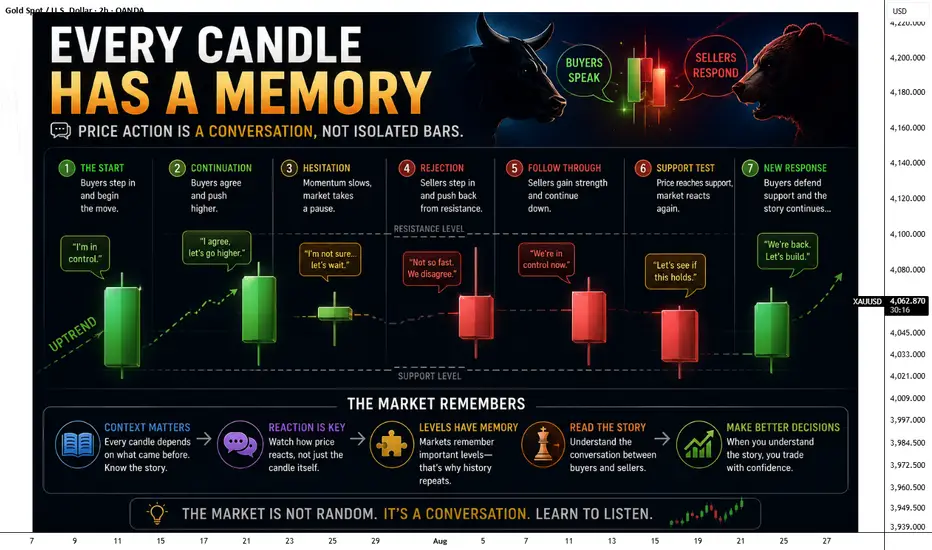
When beginners look at a chart, they often treat every candle as a separate event. A green candle means buyers are strong, and a red candle means sellers are in control. While this is partly true, it misses something much more important. **No candle is born in isolation. Every candle is influenced by the candles that came before it. Just like every sentence in a conversation depends on the previous one, every candle continues the story that the market has already been telling.
Imagine walking into a room where two people are arguing. If you hear only the last sentence, you will probably misunderstand the situation. But if you listen from the beginning, every word starts making sense. Price action works the same way. A single candle rarely tells the complete story. It only makes sense when viewed in the context of the candles surrounding it.
The First Candle Starts the Conversation
Every move in the market begins with a reason. It could be buyers becoming more aggressive, sellers taking profits, or important news changing market sentiment. The first candle simply starts the conversation. It asks a question, but it does not always provide the answer.
A large bullish candle, for example, shows that buyers were in control during that period. However, it does not tell us whether buyers will remain strong or whether sellers are waiting at the next resistance level. The next few candles will continue that story.
The Next Candle Responds:
Every new candle reacts to what happened before it.
Suppose a strong bullish candle appears. The following candle now has a decision to make. It can continue moving higher, showing that buyers still have confidence. It can become small, suggesting hesitation. Or it can reverse completely, showing that sellers have entered the market with greater strength.
The second candle is not creating a new story. It is responding to the previous one.
Trends Are Conversations:
A trend is not created by one candle. It is created by hundreds of candles agreeing with each other.
An uptrend is like a group of people repeating the same opinion. Buyers continue making higher highs and higher lows because each candle supports the previous one.
A downtrend works the same way. Every bearish candle reinforces the message that sellers remain in control.
The moment candles stop agreeing with each other, the conversation begins to change.
Rejection Is a Different Opinion:
Sometimes the market suddenly changes its tone.
Imagine a strong bullish candle reaching resistance, followed by a candle with a long upper wick. That wick tells us something important. Buyers tried to push price higher, but sellers refused to accept those prices and forced the market back down before the candle closed.
That single wick becomes a reply in the conversation. It tells us that someone disagreed with the previous move.
This is why experienced traders pay attention to how candles react to one another instead of memorizing individual candlestick patterns.
Memory Creates Context:
Markets remember important levels because traders remember them.
If price was rejected from a certain level yesterday, many traders will watch that same level today. If a breakout failed last week, traders will be cautious the next time price reaches that area.
Although candles do not literally have memory, the people trading the market do. Their decisions are influenced by what happened before, and those decisions shape the next candle.
This is why history often seems to repeat itself.
The Story Is More Important Than the Shape
Many beginners spend months memorizing candlestick patterns like Doji, Hammer, or Engulfing candles. While these patterns can be useful, they become much more meaningful when you understand the story behind them.
A bullish engulfing candle appearing after a long downtrend tells a completely different story than the same pattern appearing in the middle of a sideways market.
The shape of the candle matters, but its location and the conversation leading up to it matter even more.
My Thoughts:
Every candle is a response to what happened before it. Every trend is a conversation between buyers and sellers. Every wick represents an argument, every breakout is a statement, and every reversal is a change in opinion.
The next time you open a chart, don't look at candles as individual bars. Read them like sentences in a story. Because the market is not writing random candles.
By BrightRally_Research on TradingView
Imagine walking into a room where two people are arguing. If you hear only the last sentence, you will probably misunderstand the situation. But if you listen from the beginning, every word starts making sense. Price action works the same way. A single candle rarely tells the complete story. It only makes sense when viewed in the context of the candles surrounding it.
The First Candle Starts the Conversation
Every move in the market begins with a reason. It could be buyers becoming more aggressive, sellers taking profits, or important news changing market sentiment. The first candle simply starts the conversation. It asks a question, but it does not always provide the answer.
A large bullish candle, for example, shows that buyers were in control during that period. However, it does not tell us whether buyers will remain strong or whether sellers are waiting at the next resistance level. The next few candles will continue that story.
The Next Candle Responds:
Every new candle reacts to what happened before it.
Suppose a strong bullish candle appears. The following candle now has a decision to make. It can continue moving higher, showing that buyers still have confidence. It can become small, suggesting hesitation. Or it can reverse completely, showing that sellers have entered the market with greater strength.
The second candle is not creating a new story. It is responding to the previous one.
Trends Are Conversations:
A trend is not created by one candle. It is created by hundreds of candles agreeing with each other.
An uptrend is like a group of people repeating the same opinion. Buyers continue making higher highs and higher lows because each candle supports the previous one.
A downtrend works the same way. Every bearish candle reinforces the message that sellers remain in control.
The moment candles stop agreeing with each other, the conversation begins to change.
Rejection Is a Different Opinion:
Sometimes the market suddenly changes its tone.
Imagine a strong bullish candle reaching resistance, followed by a candle with a long upper wick. That wick tells us something important. Buyers tried to push price higher, but sellers refused to accept those prices and forced the market back down before the candle closed.
That single wick becomes a reply in the conversation. It tells us that someone disagreed with the previous move.
This is why experienced traders pay attention to how candles react to one another instead of memorizing individual candlestick patterns.
Memory Creates Context:
Markets remember important levels because traders remember them.
If price was rejected from a certain level yesterday, many traders will watch that same level today. If a breakout failed last week, traders will be cautious the next time price reaches that area.
Although candles do not literally have memory, the people trading the market do. Their decisions are influenced by what happened before, and those decisions shape the next candle.
This is why history often seems to repeat itself.
The Story Is More Important Than the Shape
Many beginners spend months memorizing candlestick patterns like Doji, Hammer, or Engulfing candles. While these patterns can be useful, they become much more meaningful when you understand the story behind them.
A bullish engulfing candle appearing after a long downtrend tells a completely different story than the same pattern appearing in the middle of a sideways market.
The shape of the candle matters, but its location and the conversation leading up to it matter even more.
My Thoughts:
Every candle is a response to what happened before it. Every trend is a conversation between buyers and sellers. Every wick represents an argument, every breakout is a statement, and every reversal is a change in opinion.
The next time you open a chart, don't look at candles as individual bars. Read them like sentences in a story. Because the market is not writing random candles.
By BrightRally_Research on TradingView

פרסומים קשורים
כתב ויתור
המידע והפרסומים אינם מיועדים להיות, ואינם מהווים, ייעוץ או המלצה פיננסית, השקעתית, מסחרית או מכל סוג אחר המסופקת או מאושרת על ידי TradingView. קרא עוד ב־תנאי השימוש.
פרסומים קשורים
כתב ויתור
המידע והפרסומים אינם מיועדים להיות, ואינם מהווים, ייעוץ או המלצה פיננסית, השקעתית, מסחרית או מכל סוג אחר המסופקת או מאושרת על ידי TradingView. קרא עוד ב־תנאי השימוש.