
⚠️ Disclaimer: This post is for educational and informational purposes
If you’ve spent any time in DeFi, you’ve probably heard the term Liquidity Pool.
But what exactly is it?
Why do people put their crypto into these pools?
How do traders use them?
And where does the liquidity provider actually make money?
Let’s break it down step by step. 👇
🔹 What Is a Liquidity Pool?
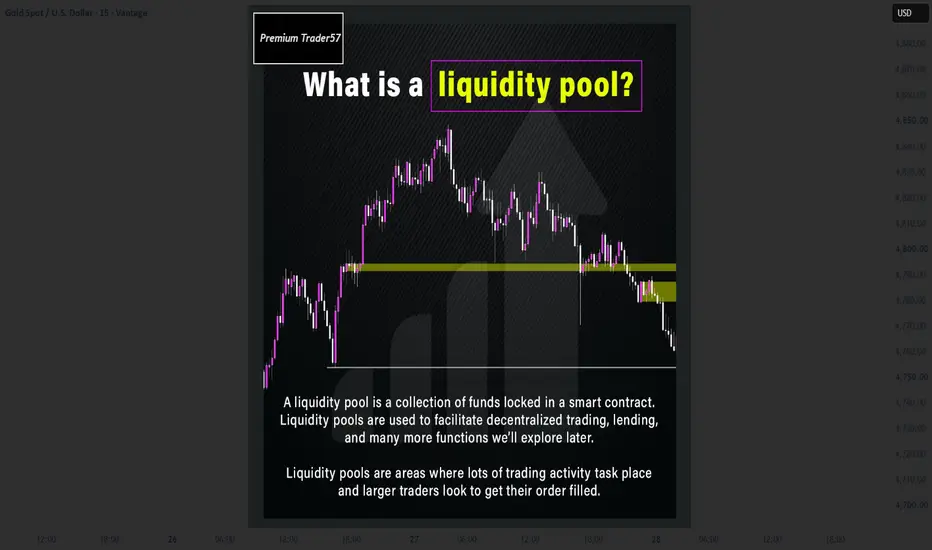
A liquidity pool is a smart-contract-based pool containing two or more crypto assets that are deposited by users.
These assets provide the liquidity needed for decentralized trading.
For example, imagine an ETH/USDC liquidity pool.
The pool might contain:
500 ETH
1,000,000 USDC
Users can trade ETH for USDC — or USDC for ETH — directly against the pool without needing a traditional buyer and seller to match their orders.
The people who deposit these assets are called Liquidity Providers (LPs).
🔹 Why Do Liquidity Pools Exist?
Traditional exchanges usually rely on an order book.
An order book matches:
Buyer → Seller
But decentralized exchanges (DEXs) can use a different model called an Automated Market Maker (AMM).
Instead of waiting for another person to place the opposite trade, users trade against the liquidity held inside the pool.
So the basic structure looks like this:
Liquidity Providers → Liquidity Pool → Traders
LPs provide the capital.
Traders use that liquidity.
The protocol's smart contract manages the trades according to its rules.
🔹 How Does an AMM Determine the Price?
One of the classic AMM models uses the formula:
x × y = k
Where:
x = amount of Token A
y = amount of Token B
k = a constant
Suppose a pool contains:
10 ETH × 20,000 USDC = 200,000
If someone buys ETH from the pool, the amount of ETH decreases.
To maintain the relationship defined by the AMM, the amount of USDC in the pool increases.
This means the price changes as trades happen.
Bigger trade → Bigger price impact
This is one reason liquidity depth matters.
A large pool can generally handle larger trades with less price impact than a very small pool, all else equal.
🔹 Where Does the Liquidity Come From?
The liquidity comes from users.
Imagine you provide:
$5,000 worth of ETH
and
$5,000 worth of USDC
to an ETH/USDC pool.
You have supplied $10,000 of liquidity.
In return, the protocol records your share of the pool.
Depending on the protocol, you may receive LP tokens or another form of position representation.
Your share allows you to participate in the pool's economics and, subject to the protocol's rules, withdraw your portion later.
🔹 How Do Liquidity Providers Earn?
The main source is usually trading fees.
Suppose traders continuously swap ETH and USDC through the pool.
Every trade may generate a fee.
A portion of those fees can be distributed to liquidity providers according to the protocol's rules.
For example:
Trader swaps:
$100,000
If the applicable trading fee is 0.30%, the fee would be:
$300
That fee doesn't automatically mean every LP receives $300.
The distribution depends on the protocol, pool design, incentives, and your share of the relevant liquidity.
So:
More trading volume + sufficient liquidity + attractive fee structure
can potentially create more fee revenue for LPs.
But this does not mean LPs are guaranteed to make money.
🔹 The Big Risk: Impermanent Loss
This is probably the most important concept to understand before providing liquidity.
Let's say you deposit:
ETH + USDC
Then ETH's market price changes significantly.
The AMM's mechanism causes the pool's asset composition to change as traders arbitrage the pool toward the market price.
You may end up holding:
Less ETH + More USDC
than you would have if you had simply held the original assets in your wallet.
The difference is commonly referred to as impermanent loss.
Why "impermanent"?
Because if the relative prices return to the appropriate original relationship before you withdraw, the difference can disappear.
But once you withdraw, the loss relative to simply holding the assets can become realized.
And if trading fees and other rewards don't compensate for that difference, providing liquidity may underperform simply holding the assets.
🔹 Simple Example
Imagine you deposit:
$5,000 ETH + $5,000 USDC
Total:
$10,000
Now imagine ETH's price increases dramatically.
Arbitrage traders interact with the pool, changing its ETH/USDC ratio.
When you later withdraw, you might receive something like:
$7,000 ETH + $7,500 USDC
Total:
$14,500
Sounds great, right?
But here's the important comparison:
If you had simply held your original ETH and USDC instead of providing liquidity, your portfolio might have been worth $15,500.
The difference is the economic effect commonly described as impermanent loss, before considering the fees and rewards you earned.
So you shouldn't look only at:
"How much money is inside my LP position?"
You should compare it against:
"What would I have if I had simply held the same assets?"
🔹 Other Risks You Need to Understand
Liquidity pools aren't simply a way to earn passive income.
There are several risks.
1️⃣ Impermanent Loss
Changes in the relative prices of the assets can reduce your performance compared with holding the assets separately.
2️⃣ Smart Contract Risk
Your funds interact with code.
If the underlying smart contract has a vulnerability, exploit, or design flaw, funds can potentially be lost.
3️⃣ Token Risk
Providing liquidity for a highly volatile or low-quality token can expose you to significant losses.
A token can lose most or all of its value.
4️⃣ Stablecoin Risk
Even stablecoins aren't completely risk-free.
They can experience depegging, liquidity issues, or other risks.
5️⃣ Low Liquidity
Small pools can experience significant price impact.
This can also make exiting a position more difficult or costly.
6️⃣ Protocol Risk
A protocol may have economic, governance, oracle, or implementation risks beyond the basic AMM mechanism.
7️⃣ Incentive Risk
Some pools offer additional token rewards.
But those rewards can decrease in value or disappear entirely.
A high advertised APY doesn't automatically mean high profit.
🔹 What Is APY in Liquidity Pools?
You may see something like:
APY: 25%
or
APR: 80%
Don't immediately interpret this as guaranteed return.
These numbers can depend on:
Trading volume
Pool liquidity
Token prices
Fee distribution
Incentive emissions
Reward-token price
Compounding
Protocol changes
An APY displayed today can be very different tomorrow.
🔹 Why Do Traders Need Liquidity?
Imagine you want to swap:
$100,000 USDC → ETH
You need someone or something willing to sell you that ETH.
In a DEX using an AMM, the liquidity pool provides the assets needed for the swap.
Without sufficient liquidity:
Large trade → High price impact → Worse execution
With deeper liquidity:
Large trade → Lower price impact → Better execution
This is why liquidity is one of the fundamental building blocks of DeFi.
🔹 The Liquidity Provider's Trade-Off
Providing liquidity is essentially a trade-off.
You are giving the market access to your capital.
In return, you may receive:
💰 Trading fees
🎁 Incentive rewards
📈 Potential additional yield
But you're also accepting:
⚠️ Impermanent loss
⚠️ Smart-contract risk
⚠️ Token price risk
⚠️ Stablecoin/depeg risk
⚠️ Protocol risk
So the correct question isn't:
"What is the APY?"
A better question is:
"Is the expected fee/reward income sufficient to compensate me for the risks I'm taking?"
🔹 Liquidity Pools in One Simple Picture
Think of a liquidity pool like a shared inventory warehouse.
LPs put assets into the warehouse.
Traders come and exchange assets from that inventory.
The warehouse charges a fee for facilitating those trades.
LPs can receive a portion of the economics generated by the activity.
But the inventory composition changes as people trade.
And the value of what you eventually withdraw may be different from what you originally deposited.
That's the core idea behind liquidity pools.
🧠 The Takeaway
A liquidity pool allows users to deposit crypto assets into a smart contract so traders can swap those assets through a decentralized exchange.
LPs provide liquidity → Traders use liquidity → Trades generate fees → LPs may receive a share of those fees.
But liquidity providing isn't "free money."
The biggest concepts to understand are:
AMMs + Trading Fees + Price Impact + Impermanent Loss + Smart Contract Risk + Token Risk
If you understand those six concepts, you'll have a much stronger foundation for understanding DeFi liquidity pools.
Always do your own research (DYOR), understand the specific protocol and pool mechanics, and never deposit money you cannot afford to lose.
⚠️ Disclaimer: This post is for educational and informational purposes only and should not be considered financial, investment, trading, tax, or legal advice. Cryptocurrency and DeFi involve substantial risks, including the possible loss of some or all of your funds. Always conduct your own research and consider consulting a qualified professional before making financial decisions.

Gold Free Signals 🔔
t.me/+UamB2uCTUtkzMmQ0
Account Management?
Contact now 👉 t.me/Aashuanalyst
BACKUP CHANNELS
t.me/goldoperator57
t.me/+UMb_CTTFmOg1NDk0
t.me/katefx57
t.me/Xausniperelite
t.me/+UamB2uCTUtkzMmQ0
Account Management?
Contact now 👉 t.me/Aashuanalyst
BACKUP CHANNELS
t.me/goldoperator57
t.me/+UMb_CTTFmOg1NDk0
t.me/katefx57
t.me/Xausniperelite
כתב ויתור
המידע והפרסומים אינם מיועדים להיות, ואינם מהווים, ייעוץ או המלצה פיננסית, השקעתית, מסחרית או מכל סוג אחר המסופקת או מאושרת על ידי TradingView. קרא עוד ב־תנאי השימוש.