מעודכן
Acceptance Breakout Planner [AGPro Series]
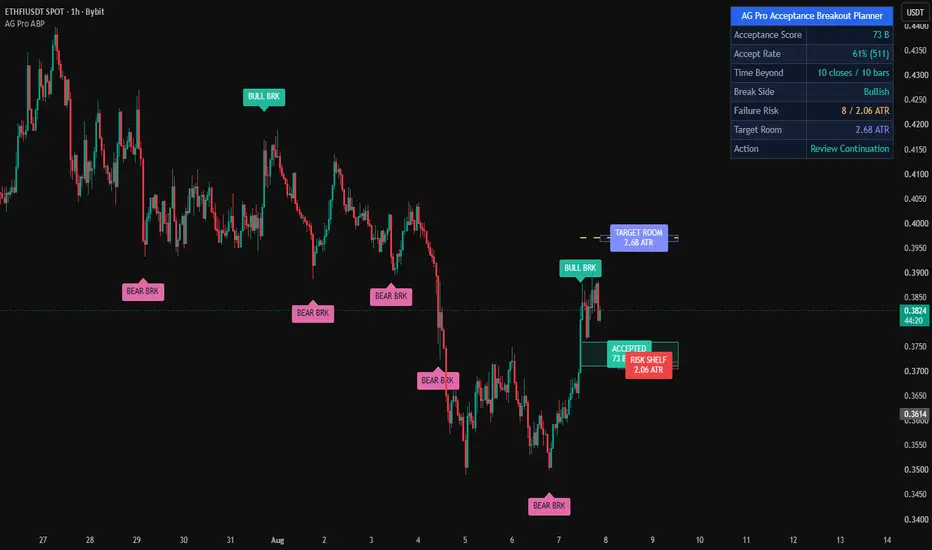
Acceptance Breakout Planner [AGPro Series]
🧠 Core Idea
Did price truly accept beyond the breakout level, or did it only tag the level and fail to hold?
📌 Overview / What it does
Acceptance Breakout Planner [AGPro Series] is a chart-first breakout decision tool designed to evaluate what happens after price moves beyond a key rolling reference edge.
Instead of treating every breakout as meaningful, the script measures close persistence, time beyond the level, retest-hold behavior, range distance, candle quality, volume support, and failure shelf risk. It converts that evidence into a 0-100 Acceptance Score and a clear next-action state.
The script produces an acceptance band, a failure shelf, a target-room guide, controlled chart labels, alerts, and a clean AGPro planning panel. It does not predict price movement, automate execution, or claim that acceptance will continue.
🎯 Purpose & Design Philosophy
This script was built to fill the gap between a simple breakout marker and a full trade-management system.
Many traders can see when price crosses a level. The harder question is whether price is spending enough time beyond that level to deserve attention, or whether the break is only a low-commitment tag.
The design supports a planner mindset: observe the break, measure acceptance, watch the failure shelf, and review the next state with structure instead of reacting to a single candle.
⚡ Why This Script Is Different
Most breakout tools focus on the moment price crosses a level.
This script does NOT function as a generic breakout signal, volume-spike detector, consolidation breakout box, Donchian channel tool, or broad break-retest scanner.
Instead, it focuses on post-break acceptance quality. The key question is not simply "did price break?" The key question is "did price remain accepted beyond the broken reference long enough to reduce tag-only risk?"
This keeps the script separate from Breakout Volume Quality, Consolidation Breakout Quality, Break-Retest Quality, Price Acceptance Profile, and reference-specific breakout tools in the AGPro catalog.
⚙️ Methodology
1. Context Detection
The script maps rolling upper and lower reference edges from prior bars. These references are used only as breakout acceptance anchors.
2. Reference Mapping
When price closes beyond a reference edge by an ATR-adjusted buffer, the planner starts an active acceptance sequence.
3. Reaction Evaluation
The active sequence is scored through close persistence, time beyond the level, acceptance-band retests, candle quality, relative volume support, and distance from the failure shelf.
4. Visual Output
The chart shows an acceptance band, a failure shelf, a target-room guide, compact state labels, and a panel that summarizes acceptance score, time beyond, break side, failure risk, and action.
🗺️ How to Read the Chart
Acceptance Band = the zone around the broken level where price should hold if acceptance is developing.
Failure Shelf = the invalidation context behind the broken level. A close through this shelf means the breakout acceptance sequence needs review.
Target Room = a projected planning guide based on the prior reference range. It is not a forecast or promised target.
Labels = compact event markers such as BULL BRK, BEAR BRK, WATCH, HOLD, ACCEPT, TAG, RISK, and REJECT.
Colors = teal supports constructive acceptance, pink marks rejection or failure pressure, yellow marks caution, and indigo marks active watch states.
Panel = a compact decision view showing Acceptance Score, Time Beyond, Break Side, Failure Risk, and Action.
🚦 Signals & States
• BULL BRK → price closed beyond the upper reference and started an acceptance review.
• BEAR BRK → price closed beyond the lower reference and started an acceptance review.
• WATCH → acceptance evidence is improving but is not mature yet.
• HOLD → price revisited the acceptance band and held beyond the broken reference.
• ACCEPT → close persistence, score quality, and time beyond the level reached the accepted state.
• TAG → the sequence is active, but close persistence is still weak after the review window.
• RISK → acceptance is not mature and the failure shelf is becoming more relevant.
• REJECT → price closed through the failure shelf after the breakout sequence.
🔔 Alerts Logic
Alerts trigger when a new acceptance break starts, when accepted state appears, when a retest hold is detected, when failure risk rises, or when price rejects through the failure shelf.
Alerts are attention markers. They are not trade instructions, automation commands, or certainty statements.
🧩 Confluence Logic
The strongest acceptance context appears when several conditions align:
• price closes beyond the broken reference more than once
• the acceptance band holds during a retest
• candle structure remains directional
• failure shelf distance remains healthy
• volume support is present without being the only reason for the score
When these elements align, the Acceptance Score rises and the state becomes easier to interpret.
📊 When to Use
• Breakout review after price crosses a visible range edge
• Markets where one-bar breakout tags are common
• Trend continuation attempts that need acceptance confirmation
• Range expansion moves where the trader wants to separate holding behavior from weak level pokes
• Chart review workflows that need a clear post-break next-action state
⚠️ When NOT to Use
• Extremely low-liquidity markets with unreliable candles
• Very noisy symbols where reference edges are constantly pierced
• News-driven volatility where ATR buffers may become unstable
• Situations where the user expects automatic trade entries
• Markets where volume data is missing and volume support is treated as less useful
🎛️ Key Inputs
• Break Side → controls whether the planner evaluates bullish breaks, bearish breaks, or both.
• Reference Lookback → defines the prior-bar range used to map breakout reference edges.
• Close Beyond Level ATR → controls how far beyond the level price must close before a sequence starts.
• Acceptance Band ATR → controls the retest-hold zone around the broken level.
• Failure Shelf ATR → controls the invalidation context behind the broken level.
• Minimum Beyond Closes → controls how much close persistence is required before acceptance can mature.
• ACCEPTED Threshold → sets the minimum 0-100 score for accepted state.
• Label / Panel Controls → adjust visual density, placement, theme, and font size.
🖥️ Interface & Visual Design
The interface is designed to stay chart-first. The acceptance band and failure shelf show the current structure, while labels mark only meaningful state changes.
The panel uses the AGPro standard: a single blue merged header row, compact rows, clear state colors, adjustable location, adjustable theme, and normal font size by default.
The visual hierarchy is intentionally restrained so the chart looks active without becoming crowded.
🧪 Practical Usage Workflow
1. Read the panel to see the current Acceptance Score and action state.
2. Check whether price is holding beyond the broken reference or drifting back into the band.
3. Watch the failure shelf to understand whether the breakout is losing acceptance.
4. Review labels only as context markers, not as standalone decisions.
5. Confirm the broader market context before acting on any chart interpretation.
🔍 Interpretation Guidelines
Think of the script as a post-break acceptance reviewer.
A higher Acceptance Score means the breakout has stronger evidence of persistence according to the script model. A lower score means the move may still be early, weak, or vulnerable to failure.
The most useful reading is the relationship between time beyond the level, retest behavior, and failure shelf distance.
🚫 What This Script Is NOT
• Not a prediction engine
• Not financial advice
• Not an auto-trading system
• Not guaranteed signals
• Not a generic support/resistance map
• Not a consolidation breakout box tool
• Not a pure volume breakout detector
• Not a full break-retest scanner
⚠️ Limitations & Transparency
Breakout acceptance is sensitive to timeframe, volatility, liquidity, and symbol behavior.
The reference edges are rolling and can change as older bars leave the lookback window.
ATR-based buffers can expand or contract during volatile market conditions.
Relative volume may be less useful on symbols with limited or inconsistent volume data.
🧠 Market Context Notes
Acceptance after a breakout is often more useful than the initial break itself.
A level tag shows that price reached a reference. Acceptance shows whether price can keep spending time beyond that reference.
This distinction is the core purpose of the planner.
🧾 Use Case Examples
When price closes above a reference edge and then holds the acceptance band on a later retest, the script may shift from watch context toward stronger acceptance.
When price breaks a reference but quickly returns through the failure shelf, the script marks rejection context instead of treating the break as mature.
When price remains beyond the level but does not build enough persistence, the script can show TAG ONLY or FAILURE RISK.
🧱 System Philosophy
Acceptance Breakout Planner follows the AGPro decision-engine approach:
It does not ask users to react to a raw signal.
It organizes the chart into quality, state, risk, target-room context, and next-action review.
🔐 Non-Promise Statement
No script can remove uncertainty from markets.
No state, score, label, band, shelf, or alert guarantees future price behavior.
📉 Risk Disclosure
Trading involves risk.
This script is for educational and analytical use only.
It does not provide financial advice, investment advice, trade instructions, or guaranteed outcomes.
Users remain responsible for their own decisions, risk management, and market evaluation.
📚 Educational Note
Use the script to study the difference between a breakout tag and breakout acceptance.
The strongest value comes from comparing the planner state with broader structure, volatility, liquidity, and personal execution rules.
הערות שחרור
UPDATE NOTES - V1.4This update focuses on final lower-zone readability, shelf-text cleanup, and cleaner compact acceptance-band presentation.
The core purpose of the script remains unchanged.
This release removes competing text from the failure shelf when it sits close to the active acceptance band.
This script continues to function as an analytical and visualization tool.
It does not attempt to predict price direction or provide guaranteed outcomes.
------------------------
What Changed
------------------------
* Removed failure-shelf box text
The shelf zone no longer prints an additional SHELF label inside the lower visual area, reducing overlap with the acceptance-band text and live price line.
* Preserved the shelf visual
The failure shelf remains visible as a subtle planning zone, but it no longer competes with the main acceptance-band message.
* Preserved core behavior
Acceptance scoring, retest logic, failure shelf calculation, target-room corridor, panel output, and alerts remain unchanged.
------------------------
Visual Improvements
------------------------
* Improved readability in compact lower-zone situations
* Reduced superposition between shelf text, acceptance-band text, and the live price line
* Kept the acceptance-band message as the primary chart text in the active zone
* Preserved the cleaner target-room corridor from prior updates
------------------------
Interface & Usability
------------------------
* No input workflow changes were required
* Existing panel controls, visual controls, label controls, and alert controls remain available
* Failure shelf information remains available through the visual shelf and panel risk context
------------------------
Behavior Notes
------------------------
This update does not change the core analytical logic of the script.
The goal is to improve clarity and usability, not to introduce predictive behavior.
Users should interpret outputs the same way as before, but with cleaner lower-zone text handling.
------------------------
Limitations Reminder
------------------------
The script remains a rule-based analytical tool.
Very compressed price structures and chart price lines can still occupy the same visual area, but competing shelf text has been removed.
Outputs should always be interpreted within broader market context.
------------------------
Risk Reminder
------------------------
This script is for educational and analytical purposes only.
It does not provide financial advice or guaranteed trading outcomes.
Users remain responsible for their own decisions.
הערות שחרור
🔧 UPDATE NOTES - 1.5This update focuses on zone readability, premium badge structure, panel stability, and publication-ready visual clarity.
The core purpose of the script remains unchanged.
This release improves how the existing acceptance breakout logic is presented, organized, and interpreted on the chart.
This script continues to function as an analytical and visualization tool.
It does not attempt to predict price direction or provide guaranteed outcomes.
------------------------
What Changed
------------------------
• Added separate premium zone badges
Acceptance band, failure shelf, and target-room context now use dedicated centered badges instead of relying on transparent box text.
• Restored failure-shelf explanation without clutter
The failure shelf is no longer visually silent. It now carries a compact Risk Shelf badge while keeping the underlying shelf clean.
• Improved target-room presentation
The target-room corridor now uses a separate centered badge for clearer first-glance interpretation.
• Improved panel rebuild behavior
Panel location and theme changes now rebuild the panel cleanly while preserving the merged blue header row.
• Improved score formatting
Panel score and risk values now use compact score-grade formatting for better readability.
------------------------
Visual Improvements
------------------------
• Eliminated unlabeled active-zone behavior by adding contrast-safe centered badges
• Reduced dependence on box text that can become hard to read in compact price ranges
• Improved dark and light chart readability with contrast-aware event label text
• Refined visual hierarchy so acceptance, risk, and target zones each explain their role
------------------------
Interface & Usability
------------------------
• Preserved all existing inputs and visual controls
• Preserved panel show/hide, theme, location, and font-size controls
• Preserved chart label font-size control across event labels and zone badges
• Improved first-glance publication quality without changing the model behavior
------------------------
Behavior Notes
------------------------
This update does not change the core analytical logic of the script.
The reference-edge model, acceptance score, retest hold logic, failure shelf, target-room guide, alerts, and state logic remain intact.
Users should interpret outputs the same way as before, but with improved visual structure.
------------------------
Limitations Reminder
------------------------
The script remains a rule-based analytical tool.
Market conditions such as volatility, liquidity, and timeframe differences may affect how signals appear.
Outputs should always be interpreted within broader market context.
------------------------
Risk Reminder
------------------------
This script is for educational and analytical purposes only.
It does not provide financial advice or guaranteed trading outcomes.
Users remain responsible for their own decisions.
הערות שחרור
🔧 UPDATE NOTES - v1.7This update adds an accept-rate proof and cleans up the Failure Risk reading.
The core purpose of the script remains unchanged.
This release keeps the same acceptance model, failure shelf and target-room logic, and improves
how the planner reports its track record and risk.
This script continues to function as an analytical and visualization tool.
It does not attempt to predict price direction or provide guaranteed outcomes.
------------------------
What Changed
------------------------
- Accept Rate proof layer
The panel now reports how often a breakout sequence reached the accepted state before it was
rejected or expired, shown with the sample count for transparency.
- Per-sequence counting
Each breakout sequence is counted once, so the rate is an honest measure of how often breaks
on this market and timeframe genuinely get accepted rather than only tagging the level.
- Clearer Failure Risk reading
Failure Risk now shows a clean numeric value with the shelf distance, instead of a quality
grade, so a high risk reading is no longer presented as if it were a high quality grade.
------------------------
Visual Improvements
------------------------
- Kept the acceptance band, failure shelf and target-room badges unchanged
- Preserved the contrast-safe centered zone badges and planning guides
- Maintained the selective, candle-clear event labels
- Left the clean publication layout intact
------------------------
Interface & Usability
------------------------
- Added an Accept Rate row for an at-a-glance acceptance track record
- Made the Failure Risk row easier to read at a glance
- Kept the existing score, time, side, target and action hierarchy
- Enhanced overall user experience without changing the core scoring logic
------------------------
Behavior Notes
------------------------
This update does not change the core analytical logic of the script.
The acceptance score, states and failure model are unchanged. The Accept Rate and the Failure
Risk display are track-record and presentation layers only.
------------------------
Limitations Reminder
------------------------
The script remains a rule-based analytical tool.
Market conditions such as volatility, liquidity, and timeframe differences may affect how
breakouts, acceptance and the rate appear.
Outputs should always be interpreted within broader market context.
------------------------
Risk Reminder
------------------------
This script is for educational and analytical purposes only.
It does not provide financial advice or guaranteed trading outcomes.
Users remain responsible for their own decisions.
הערות שחרור
Version 1.8 – Labeled Reference Map and Separated Planning LanesThis update improves chart clarity by replacing accumulated historical reference traces with a current labeled map and by separating active planning annotations into distinct visual lanes. Core breakout detection, acceptance scoring, failure-risk calculation, proof statistics, and alert behavior remain unchanged.
• Replaced persistent rolling reference plots with two bounded current-reference lines labeled Upper Ref and Lower Ref, including their live price values.
• Removed historical reference-line accumulation after breakout activation, preventing old unexplained line fragments from remaining on publication charts.
• Moved the Failure Shelf into its own forward corridor while keeping its badge centered inside the displayed zone, reducing overlap with the Acceptance badge.
• Added a mandatory Break Ref identity tag whenever the acceptance band is hidden but its planning guide remains visible.
• Added a mandatory Target identity tag whenever the target-room corridor is hidden but its target guide remains visible.
• Preserved centered labels for every displayed Acceptance, Failure Shelf, and Target Room zone and retained the existing premium color hierarchy.
• Preserved the panel structure, accept-rate proof layer, five alert conditions, and all analytical thresholds.

כתב ויתור
המידע והפרסומים אינם מיועדים להיות, ואינם מהווים, ייעוץ או המלצה פיננסית, השקעתית, מסחרית או מכל סוג אחר המסופקת או מאושרת על ידי TradingView. קרא עוד ב־תנאי השימוש.
כתב ויתור
המידע והפרסומים אינם מיועדים להיות, ואינם מהווים, ייעוץ או המלצה פיננסית, השקעתית, מסחרית או מכל סוג אחר המסופקת או מאושרת על ידי TradingView. קרא עוד ב־תנאי השימוש.