OPEN-SOURCE SCRIPT
Auction Pressure Phase Portrait [Pineify]
Overview
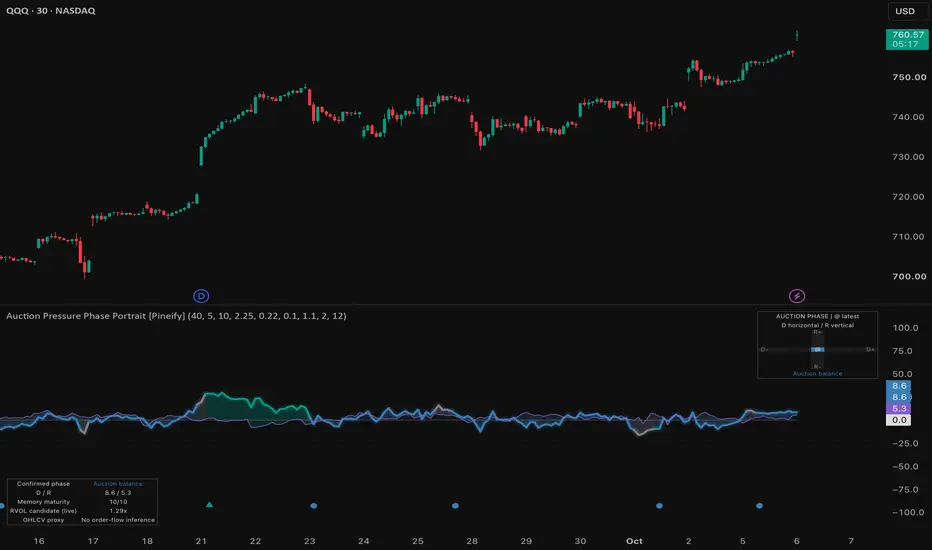
This auction pressure indicator retains two OHLCV coordinates: direction D and wick rejection R. A ribbon tracks their separation, while a phase portrait shows the latest confirmed trajectory. It describes candle behavior beyond isolated patterns.
Problem Definition
A bullish body, a lower wick and a busy volume bar answer different questions. The body records open-to-close displacement; the wick records an excursion that did not survive the close. A single candle label cannot distinguish repeated displacement from a one-bar rejection. Adding both into one score can also hide opposing evidence. The design keeps direction and rejection visible separately and asks whether either has persisted enough to define a phase.
Design Rationale
The larger of current true range and prior average true range bounds excursions and restrains tiny candles. Prior median volume prevents the current spike from setting its own baseline. Capped square-root weighting reduces thin-volume evidence and limits spike influence. Separate half-life memories replace immediate pattern votes. Entry/release hysteresis and consecutive candidate closes reduce phase chatter, at the cost of delayed recognition. This retains disagreement that one blended oscillator would erase.
Key Features
How It Works
The prior window requires valid OHLC and positive volume. Its mean true range and median volume exclude the current bar. D blends 65% of close minus open with 35% of twice close minus high minus low; R is lower wick minus upper wick. Both divide by the range scale and receive the square root of the ratio of capped RVOL to the full-weight multiple. Zero-seeded memories blend old and new samples using the half-life. Display waits for memory maturity.
On confirmed closes, both small coordinates propose balance. Strong R meeting the dominance ratio proposes rejection first; otherwise strong D with supportive D+R proposes accumulation. Existing phases may hold above the release level; other cases propose mixed pressure. Consecutive candidates confirm a phase. A rejection flip must oppose the last accumulation since balance or a previous flip. Invalid data reset memory, phase and trail.
How Multiple Indicators Work Together
Range scaling makes candle geometry comparable; volume weighting controls evidence entering both memories. Decay retains the path, and phase rules compare the coordinates. Removing R hides rejection dominance; blending D and R hides disagreement; removing coverage lets stale pressure survive missing participation. Volume weights evidence without assigning direction.
Trading Ideas and Insights
Accumulation invites checking whether price accepts levels in that direction. A rejection takeover calls for inspecting the level and subsequent closes before considering a reversal. Ribbon width measures coordinate separation, not momentum strength. Balance means small remembered candle pressures; it establishes neither fair value nor a price range.
Unique Aspects
Compared with static candle patterns or one blended pressure oscillator, the contribution is the retained two-coordinate path and its context-aware transitions. Rejection alone is distinguished from a flip against remembered accumulation. Data failure breaks that context. The portrait exposes agreement, opposition and return toward the origin without treating quadrant location as a probability.
How to Use
Start with standard candles on liquid stocks, futures or crypto, typically 5m-1D, and wait for baseline and memory maturity. Read the D line and D-to-R ribbon before consulting the inset: D runs left/right and R up/down; @ is latest and fading dots are older confirmed points. Grid cells are quantized in 25-point steps and overlapping points keep the newest mark. Tables show the latest state, not the historical bar under the cursor.
Customization
The baseline controls range and volume context; half-life controls memory decay, and maturity controls the startup gate. The full-weight volume multiple sets saturation. Entry, lower release, rejection dominance and candidate-close count tune phase persistence; release must remain below entry. Defaults are starting choices, not universal optima. Hide the rejection line, halo, background, markers, portrait or summary as needed; the core ribbon retains both coordinates.
Assumptions and Limitations
D and R are related candle proxies, not independent measurements or true buyer/seller order flow. Gaps enlarge true range but receive no separate directional vote. Missing or zero volume require a complete new baseline and memory warm-up. Smoothing and confirmation lag; settings and loaded history affect the path. Confirmed curves and phases hold intrabar, while live RVOL diagnostics can change. Feed revisions can alter historical results. Wick rejection may precede continuation. No execution, profitability, forecast accuracy or immunity to repainting is established.
Conclusion
Auction Pressure Phase Portrait separates remembered displacement from rejection. Read its confirmed phases as candle-context evidence, then assess price structure and risk before considering a trade.
This auction pressure indicator retains two OHLCV coordinates: direction D and wick rejection R. A ribbon tracks their separation, while a phase portrait shows the latest confirmed trajectory. It describes candle behavior beyond isolated patterns.
Problem Definition
A bullish body, a lower wick and a busy volume bar answer different questions. The body records open-to-close displacement; the wick records an excursion that did not survive the close. A single candle label cannot distinguish repeated displacement from a one-bar rejection. Adding both into one score can also hide opposing evidence. The design keeps direction and rejection visible separately and asks whether either has persisted enough to define a phase.
Design Rationale
The larger of current true range and prior average true range bounds excursions and restrains tiny candles. Prior median volume prevents the current spike from setting its own baseline. Capped square-root weighting reduces thin-volume evidence and limits spike influence. Separate half-life memories replace immediate pattern votes. Entry/release hysteresis and consecutive candidate closes reduce phase chatter, at the cost of delayed recognition. This retains disagreement that one blended oscillator would erase.
Key Features
- Bounded D and R memories on a -100 to +100 scale.
- Accumulation, rejection, mixed pressure and balance phases with confirmed transitions.
- Recent phase trail, live participation diagnostics and data-interruption alerts.
How It Works
The prior window requires valid OHLC and positive volume. Its mean true range and median volume exclude the current bar. D blends 65% of close minus open with 35% of twice close minus high minus low; R is lower wick minus upper wick. Both divide by the range scale and receive the square root of the ratio of capped RVOL to the full-weight multiple. Zero-seeded memories blend old and new samples using the half-life. Display waits for memory maturity.
On confirmed closes, both small coordinates propose balance. Strong R meeting the dominance ratio proposes rejection first; otherwise strong D with supportive D+R proposes accumulation. Existing phases may hold above the release level; other cases propose mixed pressure. Consecutive candidates confirm a phase. A rejection flip must oppose the last accumulation since balance or a previous flip. Invalid data reset memory, phase and trail.
How Multiple Indicators Work Together
Range scaling makes candle geometry comparable; volume weighting controls evidence entering both memories. Decay retains the path, and phase rules compare the coordinates. Removing R hides rejection dominance; blending D and R hides disagreement; removing coverage lets stale pressure survive missing participation. Volume weights evidence without assigning direction.
Trading Ideas and Insights
Accumulation invites checking whether price accepts levels in that direction. A rejection takeover calls for inspecting the level and subsequent closes before considering a reversal. Ribbon width measures coordinate separation, not momentum strength. Balance means small remembered candle pressures; it establishes neither fair value nor a price range.
Unique Aspects
Compared with static candle patterns or one blended pressure oscillator, the contribution is the retained two-coordinate path and its context-aware transitions. Rejection alone is distinguished from a flip against remembered accumulation. Data failure breaks that context. The portrait exposes agreement, opposition and return toward the origin without treating quadrant location as a probability.
How to Use
Start with standard candles on liquid stocks, futures or crypto, typically 5m-1D, and wait for baseline and memory maturity. Read the D line and D-to-R ribbon before consulting the inset: D runs left/right and R up/down; @ is latest and fading dots are older confirmed points. Grid cells are quantized in 25-point steps and overlapping points keep the newest mark. Tables show the latest state, not the historical bar under the cursor.
Customization
The baseline controls range and volume context; half-life controls memory decay, and maturity controls the startup gate. The full-weight volume multiple sets saturation. Entry, lower release, rejection dominance and candidate-close count tune phase persistence; release must remain below entry. Defaults are starting choices, not universal optima. Hide the rejection line, halo, background, markers, portrait or summary as needed; the core ribbon retains both coordinates.
Assumptions and Limitations
D and R are related candle proxies, not independent measurements or true buyer/seller order flow. Gaps enlarge true range but receive no separate directional vote. Missing or zero volume require a complete new baseline and memory warm-up. Smoothing and confirmation lag; settings and loaded history affect the path. Confirmed curves and phases hold intrabar, while live RVOL diagnostics can change. Feed revisions can alter historical results. Wick rejection may precede continuation. No execution, profitability, forecast accuracy or immunity to repainting is established.
Conclusion
Auction Pressure Phase Portrait separates remembered displacement from rejection. Read its confirmed phases as candle-context evidence, then assess price structure and risk before considering a trade.
סקריפט קוד פתוח
ברוח האמיתית של TradingView, יוצר הסקריפט הזה הפך אותו לקוד פתוח, כך שסוחרים יוכלו לעיין בו ולאמת את פעולתו. כל הכבוד למחבר! אמנם ניתן להשתמש בו בחינם, אך זכור כי פרסום חוזר של הקוד כפוף ל־כללי הבית שלנו.

🚀🚀🚀 Pineify - pineify.app
Essential Toolkit for Every Trader
- AI Pine Script Generator
- Finance AI Agent
- AI Stock Picker
- Pine Script Visual Editor
- Invited indicators
- Strategy Optimizer
- Trading Journal
- Backtest Report
Essential Toolkit for Every Trader
- AI Pine Script Generator
- Finance AI Agent
- AI Stock Picker
- Pine Script Visual Editor
- Invited indicators
- Strategy Optimizer
- Trading Journal
- Backtest Report
כתב ויתור
המידע והפרסומים אינם מיועדים להיות, ואינם מהווים, ייעוץ או המלצה פיננסית, השקעתית, מסחרית או מכל סוג אחר המסופקת או מאושרת על ידי TradingView. קרא עוד ב־תנאי השימוש.
סקריפט קוד פתוח
ברוח האמיתית של TradingView, יוצר הסקריפט הזה הפך אותו לקוד פתוח, כך שסוחרים יוכלו לעיין בו ולאמת את פעולתו. כל הכבוד למחבר! אמנם ניתן להשתמש בו בחינם, אך זכור כי פרסום חוזר של הקוד כפוף ל־כללי הבית שלנו.
🚀🚀🚀 Pineify - pineify.app
Essential Toolkit for Every Trader
- AI Pine Script Generator
- Finance AI Agent
- AI Stock Picker
- Pine Script Visual Editor
- Invited indicators
- Strategy Optimizer
- Trading Journal
- Backtest Report
Essential Toolkit for Every Trader
- AI Pine Script Generator
- Finance AI Agent
- AI Stock Picker
- Pine Script Visual Editor
- Invited indicators
- Strategy Optimizer
- Trading Journal
- Backtest Report
כתב ויתור
המידע והפרסומים אינם מיועדים להיות, ואינם מהווים, ייעוץ או המלצה פיננסית, השקעתית, מסחרית או מכל סוג אחר המסופקת או מאושרת על ידי TradingView. קרא עוד ב־תנאי השימוש.