מעודכן
TL Elliott Wave Pro - Rule Checked 12345 ABC Count + Fibs + FVG
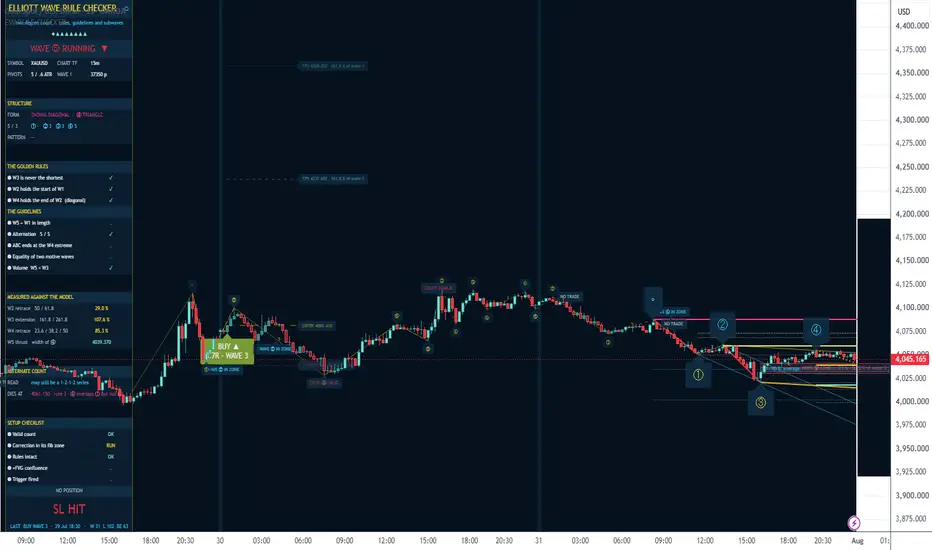
TL ELLIOTT WAVE PRO — the complete Elliott Wave rule set in one indicator: the count, the three golden rules, the three guidelines, all four fibonacci tools and the fair value gap that turns a level into a trade.
Elliott Wave is usually taught as a picture and traded as a feeling. This indicator turns it into something you can actually check: it labels the impulse, it tells you which of the three golden rules currently hold, it measures every wave against the fibonacci relationships the theory is built on, and the moment a rule breaks it says so instead of quietly redrawing the count into something that still looks right.
Everything below comes from the classic rule set. Nothing is invented, nothing is hidden.
━━━ ① THE WAVE COUNT ━━━
A ZigZag builds the alternating pivot sequence, and the engine reads the most recent structure the rules allow:
· ①②③④⑤ — the five wave impulse: three impulses with the trend, two corrections against it
· ⒶⒷⒸ — the correction that follows: an impulse down, a correction up, an impulse down
Impulse legs are drawn SOLID, corrective legs DASHED. That is not decoration — it is the definition the whole model rests on: impulsive waves are larger and move with the trend, corrective waves are smaller and move against it. The wave that has not happened yet is projected as a dotted gold line straight to its first fibonacci target.
Finished counts are frozen in faded gold exactly where they were found, so you can scroll back through the chart and study how the reading developed instead of only seeing today's answer.
━━━ ② THE THREE GOLDEN RULES — a hard validity gate ━━━
❶ Wave 3 must be the longest impulse wave, and it can never be the shortest
❷ Wave 2 must not surpass the start of wave 1
❸ Wave 4 cannot overlap with wave 1's price territory
Each rule gets a live ✓ / ✗ in the panel. If one of them breaks the count is not "weaker" — it is invalid, and the indicator behaves accordingly: the setup is cancelled, a COUNT INVALID tag goes on the chart with the reason, an alert fires, and the next confirmed pivot starts a fresh count. Rule 1 has a strict and a relaxed reading, switchable in the settings.
━━━ ③ THE THREE GUIDELINES — a soft quality score ━━━
❶ When wave 3 extends as the longest impulse wave, wave 5 typically approximates the length of wave 1
❷ Wave 2 and wave 4 alternate between a flat and a sharp correction — the indicator classifies each correction by depth and duration and shows you the pair, e.g. S / F
❸ After a five wave impulse advance, ABC corrections commonly end near the prior extreme of wave 4 — that level is projected as the C target
Guidelines are informational by default, because that is what they are. You can require one, two or all three before a signal is allowed to fire.
━━━ ④ THE FOUR FIBONACCI TOOLS, WITH THEIR CORRECT ANCHORS ━━━
Wave 2 retracement — 0 % at the end of wave 1, 100 % at its start
· typical 50.0 % and 61.8 %, plus the 60 % average line
Wave 3 extension of wave 1 — projected from the wave 2 extreme
· typical 161.8 % and 261.8 %
Wave 4 retracement — 0 % at the end of wave 3, 100 % at its start
· typical 23.6 %, 38.2 % and 50.0 %, plus the 30–40 % average band
Wave 5 — two separate targets
· 100 % of wave 1 projected from the wave 4 extreme
· 161.8 % of wave 4, anchored 0 % at the wave 4 extreme and 100 % at the wave 3 extreme
The level the market actually turned at is highlighted in gold, and the panel prints the measured value next to the expected one, so you can see at a glance whether this count is textbook or stretched.
━━━ ⑤ +FVG — the confluence that makes it a trade ━━━
A fibonacci zone on its own is a level. A fair value gap sitting inside that zone is a reason. The indicator scans for unfilled three-candle gaps inside the wave 2 and the wave 4 retracement zone, draws them as a +FVG box, and marks the signal accordingly. You can leave it as a quality tag or make it mandatory.
━━━ ⑥ THE TRADES — always in the direction of the impulse ━━━
Trading in the direction of the impulse waves is what pays, so that is all this indicator signals:
WAVE 3 ENTRY — buy the wave 2 correction in an uptrend, sell it in a downtrend
· stop behind the wave 2 pivot, or at the rule 2 invalidation
· TP1 161.8 % of wave 1, TP2 261.8 % of wave 1
WAVE 5 ENTRY — buy the wave 4 correction, sell it in a downtrend
· stop behind the wave 4 pivot, or at the rule 3 invalidation
· TP1 wave 5 = wave 1, TP2 161.8 % of wave 4
Three trigger models per trade: momentum close out of the zone, zone tap for limit-style entries, or a break of the last minor swing for the latest and safest fill. Minimum reward/risk filter, ATR stop buffer, break even at a chosen R. The counter-trend ABC entry exists but is OFF by default, on purpose.
━━━ WHY EVERY SIGNAL EXPLAINS ITSELF ━━━
Hover any signal pill and you get the full reasoning: the exact count with its prices, which golden rules hold, how deep the correction actually went against the typical values, which guidelines are satisfied, whether a fair value gap was inside the zone, plus entry, stop, both targets, risk in pips, reward in pips and the R multiple.
Every wave label carries its own tooltip — what that wave is, how far it travelled, which rule it has to respect and whether it does. Every fibonacci line explains its anchoring. Setups that were found and then rejected get a NO TRADE tag with the reason, so you learn the filter instead of wondering why nothing fired. There is a HOW TO READ THIS card and an honest BEFORE YOU TRADE THIS card on the chart.
━━━ COCKPIT PANEL ━━━
Live count stage, symbol, chart timeframe, ZigZag settings and the size of wave 1 · the three golden rules with ✓ / ✗ / pending · the three guidelines with the flat-sharp alternation pair · every wave measured against its expected fibonacci value · a five step setup checklist that fills in as the trade builds · the open position with stop and target · a large status line · a rough win / loss / break-even tracker and the last signal timestamp.
━━━ ALERTS AND AUTOMATION ━━━
Every event fires a clean JSON payload ready for a webhook: entry, stop, both targets, the direction of the count, the measured wave 2 retracement, the wave 3 extension, the wave 4 retracement, which rules held, whether an FVG was present, the R multiple, symbol, exchange, timeframe, volume and an optional account field. Events: ENTRY, TP1, SL, BE, INVALID, IMPULSE_COMPLETE. Six plain-language alertconditions are included as well for anybody who just wants a notification.
━━━ SETTINGS WORTH KNOWING ━━━
· ZigZag pivot strength and a minimum swing size in ATR — this pair decides the degree of the count and therefore everything else
· Every fibonacci percentage is editable
· Rule 1 strict or relaxed, rules 2 and 3 on or off, kill-on-invalidation on or off
· FVG optional or mandatory, minimum gap size in ATR
· Full TL chart theme: navy background, mint / red candles, corrective legs dimmed — or switch it off and keep your own
· Panel, animated 3D logo and the right-hand extension of the lines are all configurable
Tip: if the candles cover the panel, right click the indicator → Visual order → Bring to front. That is a TradingView layer setting, not something Pine can control.
━━━ HONEST NOTES ━━━
Elliott Wave is not a standalone technique, and its subjective nature has put a lot of traders off it. Two competent analysts label the same chart differently. This indicator picks ONE reading — the most recent one the three golden rules allow — and tells you the moment that reading dies. It does not pretend the ambiguity is gone.
The count re-reads itself on every new pivot. A label that moves is not a bug; it is the engine refusing to defend a count the market has stopped supporting.
The ZigZag pivot strength decides everything. Too small and you count noise, too large and you only see the count after the move is over. Change it and watch the whole picture change — that is the honest lesson of Elliott Wave, and no indicator can take it away from you.
The percentages are averages, not laws. Corrections come in slightly smaller and slightly larger than the textbook numbers all the time.
The win / loss counter in the panel is a rough on-chart tracker. It assumes a fill at the marked price and resolves target before stop inside the same bar. It is not a backtest and it is not a performance claim.
This indicator is a study tool. It is not financial advice.
━━━ CREDIT ━━━
The rule set is classic Elliott Wave Theory as it is taught publicly. The wave engine, the rule and guideline checks, the fibonacci anchoring, the FVG confluence, the panel and the design are original work.
Open source — read it, change it, learn from it.
הערות שחרור
Removed all external links and promotional elements from the indicator: the YouTube / website / community buttons in the panel, the three link inputs and every mention of an external site. Nothing about the wave engine, the rules, the fibonacci tools or the signals has changed.הערות שחרור
House Rules compliance pass. Removed the pixel monogram and every brand and company reference from the code and the panel, on top of the external links removed in the previous update. The wave engine, the three golden rules, the guidelines, the fibonacci anchoring and the signal logic are unchanged.הערות שחרור
Replaced the preview chart: the previous snapshot accidentally showed several indicators stacked on one chart. This one shows the indicaVersion note added. The preview chart has also been replaced: the earlier snapshot accidentally showed several indicators stacked on one chart, this one shows the indicator on its own.tor on its own. No code change.הערות שחרור
House Rules cleanup: the brand abbreviation has been removed from the input labels and from the default webhook id.הערות שחרור
Version 4 - the two-degree engine.The first release counted a plain five-wave impulse against three rules and three guidelines. This update adds the parts of the model that decide whether a count is even the right KIND of count.
SECOND DEGREE - a finer ZigZag now runs underneath the main one and counts the swings inside every leg. Five means motive, three means corrective, and the verdict is written on the leg itself. That single test is what separates a real impulse from a correction that only looks like one. The subwave skeleton can be drawn so you see exactly what is being counted.
DIAGONALS - the only five-wave structure in the trend direction whose wave 4 is allowed to overlap wave 1. The engine tests the overlap and the converging wedge, names leading or ending, swaps rule 3 for its diagonal wording instead of reporting a break, and projects the retracement back to where the diagonal began.
TRUNCATED FIFTH, WAVE-4 TRIANGLE, FIFTH-WAVE EXTENSION - detected, tagged and alerted. When wave 4 is a contracting triangle, the standard wave 5 target is replaced by the post-triangle thrust.
CORRECTIVE PATTERNS BY NAME - zigzag, regular / expanded / running flat, contracting triangle and double three, classified from the subwave verdict and adjustable B-retracement thresholds.
RULE 1 IS NOW CORRECT BY DEFAULT - "wave 3 is never the shortest" is the rule; "wave 3 is the longest" is a guideline. The first release defaulted to the guideline. Both readings are available, measured in points or in percent.
TWO MORE GUIDELINES - equality of two motive waves, and volume. Volume in wave 5 matching or exceeding wave 3 is the signature of a fifth-wave extension and is flagged.
DEPTH OF CORRECTIVE WAVES - the engine locates the fourth wave of one lesser degree inside wave 3 and prints it as the wave 4 target.
TREND CHANNEL - built in the three stages the classic literature describes, including the steep-wave-3 variant and a throw-over flag.
MORE WAVE 5 MATHS - 0.382 / 0.618 / 1.618 of the net distance of waves 1 through 3, plus the golden-section targets.
ALTERNATE COUNT - the strongest competing reading in the panel with the exact price that kills the primary one, and the full reasoning in the cell tooltips.
NINE WAVE DEGREES - the labels can now read as any degree from Subminuette to Grand Supercycle.
The panel gained a STRUCTURE block and an ALTERNATE COUNT block. The webhook payload gained the detected form, the truncation and triangle flags, the 5/3 subdivision string, the corrective pattern and the alternate invalidation price. Four new alertconditions: diagonal detected, truncated fifth, wave 4 triangle, fifth-wave extension warning.
Also fixed: the theme margin box no longer drags the price scale when future bars are visible.

כתב ויתור
המידע והפרסומים אינם מיועדים להיות, ואינם מהווים, ייעוץ או המלצה פיננסית, השקעתית, מסחרית או מכל סוג אחר המסופקת או מאושרת על ידי TradingView. קרא עוד ב־תנאי השימוש.
כתב ויתור
המידע והפרסומים אינם מיועדים להיות, ואינם מהווים, ייעוץ או המלצה פיננסית, השקעתית, מסחרית או מכל סוג אחר המסופקת או מאושרת על ידי TradingView. קרא עוד ב־תנאי השימוש.