מעודכן
Candle Range Theory - Quantified [Pickmytrade]
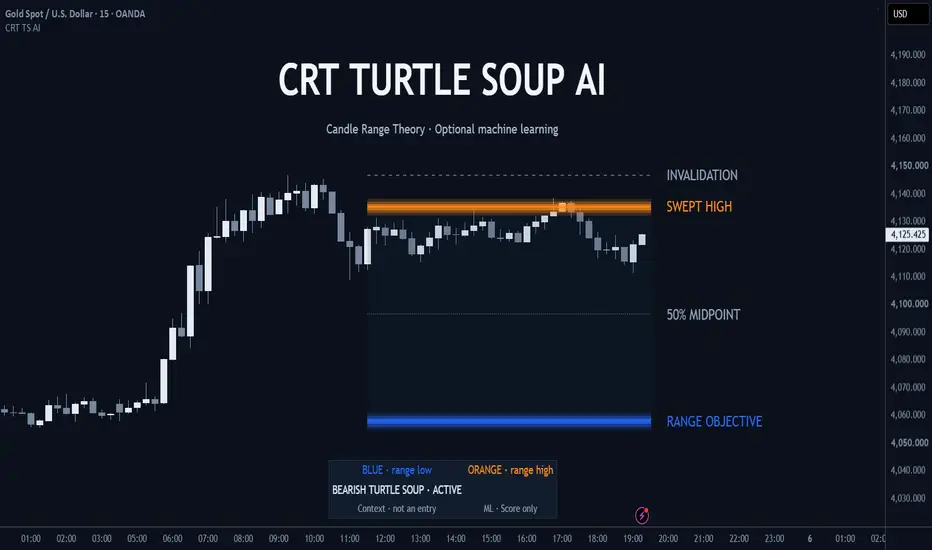
Candle Range Theory - Quantified [Pickmytrade] follows one completed higher-timeframe candle range through a raid, confirmation and optional reference plan. It separates a range being swept from a complete setup: the selected objective must still be available when confirmation arrives.
The default workflow is CRT context → market structure shift (MSS) → fair value gap (FVG) or opposing-candle zone → later retest. A separate mode uses a subsequent higher-timeframe close beyond the raid candle's other extreme. Both routes use explicit closed-candle rules, one attempt per context, fixed protection and visible workflow states.
“Quantified” refers to the defined geometry, tick thresholds, confirmation timing and reference-plan accounting. The rules can be inspected and tested. The name does not imply a proven trading advantage or a universally correct interpretation of discretionary CRT.
🔷 THE FIXED RANGE
🔸 C1 is the earlier completed higher-timeframe candle. C2 is the next completed candle. The script uses the native higher-timeframe candles from the chart's own symbol and feed.
🔸 A long context requires C2 to trade at least one minimum tick below C1's low and then close strictly inside C1's high–low range. A short context reverses those conditions. C2 cannot sweep both C1 edges; a dual sweep is rejected.
🔸 C1 and C2 must be full-length, consecutive candles. Missing or shortened context candles are excluded. During an eligible context, the C1 range, midpoint and swept edge remain fixed.
🔸 C2 must finish before the lower-timeframe workflow begins. An MSS that happened while C2 was still forming is not entered retrospectively. This is a delayed, confirmed-context interpretation of CRT and Turtle Soup concepts.
🔷 DEFAULT MODE — CRT + TURTLE SOUP
🔸 Confirmed structure. At C2's close, the script freezes the latest eligible opposing swing formed inside C2: a swing high for a long context or a swing low for a short context. It must already be confirmed, unbroken by a later close and ahead of C2's closing price. Without that anchor, the context produces no MSS setup.
🔸 Swing timing. Default strength 1 means a strict three-candle swing: the centre high exceeds both neighbouring highs, or its low is below both neighbouring lows. Equal-price ties fail. A pivot becomes available only after its right-hand confirmation candle closes. Strength 1–5 is configurable; the trigger is never backdated to the pivot candle.
🔸 MSS. A future directional-body candle must close through the frozen swing by at least one minimum tick. This one-tick break is the script's mechanical displacement proxy. There is no additional ATR/body-size, volume, trend or session filter.
🔸 Entry zone. After the next contiguous chart candle closes, the script checks the three-candle FVG with the MSS candle in the middle. For a long, the third candle's low must be at least one tick above the first candle's high; for a short, its high must be at least one tick below the first candle's low. Those two prices define the gap.
🔸 Fallback. If that FVG does not exist, the script uses the full high–low range of the last opposing-body chart candle before the MSS, beginning no earlier than C2's start. This is an explicit order-block proxy. It does not claim to identify institutional orders. FVG takes precedence; the chosen zone is frozen once. Without either candidate, there is no setup.
🔸 Retest. The first strictly later candle overlapping the frozen zone confirms at its close. The formation candle cannot also count as the retest. The script then creates one BUY SETUP or SELL SETUP. No extra outside-body trap or immediate-reclaim sequence is required.
🔷 ALTERNATIVE — CRT HTF CONFIRMATION
This route waits for a subsequent native higher-timeframe candle to close beyond the original C2 high by one tick for a long, or below C2's low by one tick for a short. It requires agreement between the chart close and the native higher-timeframe close at the aligned closing boundary.
It can confirm in C3 or a later candle while the context remains valid. It does not stack the MSS/FVG/OB route on top. The intervening chart candles still check invalidation and whether the objective has already traded.
🔷 ONE ATTEMPT AND FIXED PROTECTION
🔸 Before confirmation, missing/partial chart observations, a touched stop or a failed range reclaim invalidate the attempt. A selected target touched before setup marks the objective consumed. The script does not subsequently count that earlier move as a target hit from a later entry.
🔸 A new eligible context can replace an unfilled waiting context. It cannot replace a pending or active reference plan. There is one global reference plan per indicator instance, with no repeated entry from the same context.
🔸 The stop is fixed beyond C2's sweep extreme. The default buffer is one minimum tick; it is configurable and is not a universal allowance for spread, volatility or execution costs.
🔸 The default single target is the opposite C1 edge. The optional 50% midpoint target is a separate choice. There are no automatic partial exits, break-even moves or trailing stops. A target is not switched after observing a favourable outcome.
🔸 There is no mandatory C3 expiry or C3 time exit. An unfilled context can persist until it is invalidated, consumed or superseded. An active reference plan continues to its fixed stop/target or an unknown-data outcome.
🔷 SETUP CLOSE AND REFERENCE ENTRY
The setup is known at the confirmation candle's CLOSE. The reference engine uses the NEXT AVAILABLE observed candle's OPEN, committed when that candle closes. It does not invent a historical limit fill at the edge of an FVG or order block.
Known opening crossings are checked before intrabar high/low touches. An opening gap through a stop or target uses the opening reference price. If an inside-open candle touches both boundaries and their order is unknown, the model assumes stop first. Missing observations after entry produce UNKNOWN/censored status; they do not establish an exit or a zero result.
All labels and alerts are closed-candle observations. A displayed reference entry, stop or target is not an acknowledged broker fill or a working protective order. A reference can stop out; the visual range does not imply that its target was reached.
🔷 CHART PRESENTATION
🔸 Thin, layered rectangles highlight the exact fixed reference levels. Orange marks the upper range edge and blue the lower edge. The faint full-range box remains visible behind price. These are level highlights, not added entry conditions.
🔸 The edge-band half-width is a decorative 2.5% of the reference range, with a two-tick minimum; its inner layer is half as wide. The midpoint, structure trigger and stop can have narrower highlights. These widths are never used as tolerances in the model's comparisons or as substitutes for actual FVG/OB zone bounds.
🔸 Upper/lower colours describe range location, including a neutral closed-candle observation range. BUY SETUP and SELL SETUP text retain their separate blue-long/orange-short meaning. A coloured level band alone is not a trade signal.
🔸 Current captions identify the swept C1 edge, structure/HTF trigger, C2-based stop and selected target. The genuine FVG/OB entry zone remains a separate labelled box while its workflow is in progress. Reference-exit text is optional and defaults off.
🔸 Level highlight bands can be disabled without changing signals. This display adds no moving-average filter, price-following flow ribbon, volume estimate, confidence score or learning model.
🔸 Cover presentation shows a centred heading and compact state key. Disable “Lower heading and compact key” to see the detailed workflow panel. Waiting, invalid, consumed, reference-closed and unknown states are part of the explanation.
🔷 STARTING SETTINGS
Higher timeframe: 4 hours by default; 1 hour and 2 hours are available.
Confirmation: CRT + Turtle Soup by default; CRT HTF confirmation is the alternative.
Swing strength / stop buffer: 1 / 1 tick.
Target: opposite range edge; optional 50% midpoint.
Muted past windows: 2. Level highlight bands: on. Dynamic alert delivery: Off. Receiver messages: disarmed.
Use standard minute-based candles with an integer higher-timeframe/chart ratio of at least three. The intended lower-timeframe examples are 1m, 3m and 5m; the publication's chart interval is an example, not a proven optimum. Synthetic chart types are blocked. No volume feed is required by this price-based model. Full candle duration, continuity and source availability still matter.
🔷 TIMING, ALERTS AND AUTOMATION
🔸 Completed C1/C2 values are requested with historical offsets. The alternative route uses the current native higher-timeframe close only at its actual closing boundary. Pivots wait for their right-side confirmation; a zone waits for its third candle; a retest must occur later. No developing higher-timeframe close supplies an early historical signal.
🔸 Loaded-history changes rebuild the state and available pivots from the new starting point. Feed revisions or missing data can also change observations. The closed-bar sequencing does not guarantee identical results under a different dataset.
🔸 Four informational alert conditions cover BUY SETUP, SELL SETUP, reference exit observed and reference outcome UNKNOWN. Choose Once Per Bar Close. These choices remain separate from the dynamic delivery input.
🔸 Dynamic delivery defaults Off. “Observations” sends an events array for analysis. That wrapper is not an order payload. “Receiver JSON” is an optional, separately armed route using private account-generated BUY, SELL and close-only templates, explicit instrument mapping and fixed quantity.
🔸 A receiver entry message is a setup-close request. The reference engine's later next-open record is not the order message. Actual order type, fill, protection and account behaviour depend on the receiver and broker configuration. Fixed bracket protection, deduplication and strategy ownership need separate demo verification.
🔸 Verified broker-side brackets are required for intrabar protection. Reference stop/target observations do not send a second close order. The optional close-only template is reserved for reconciliation of an owned realtime entry intent whose reference path becomes invalid or unknown. Sending it does not prove that a broker position was flattened.
🔸 The indicator does not recover broker positions or observe acknowledgements, rejected/partial fills, manual orders or independent broker exits. Reconcile actual positions after a reload or unknown outcome. Recreate TradingView alerts after source or input changes; existing alerts retain their saved script/settings snapshot.
🔷 VERIFICATION AND LIMITATIONS
The separately frozen Python implementation passed 31 synthetic rule tests. Twelve continuous 15m/1h market-and-mode streams covered archived NQ, GC and BTC data. Their 129 closed reference plans matched the execution adapter and an independent OHLC/cost oracle; 13 active-gap outcomes were censored. Prefix and changed-future checks also passed.
A separate current-feed Gold 3m/4h check compared 401 closed bars and found no differences in the checked setup/reference fields. It included two eligible contexts and one closed reference plan. This default-mode pilot is bounded: the native engine had calculated history before the exported window. It is not validation across other markets, long histories or all inputs.
These are software-mechanics checks, not a profitability study. The archived sample was previously exposed and inherited source-availability/OHLC-quality screening. No archived 1m, 3m or 5m inputs were available for that pilot. Its results do not validate the intended 3m example, establish signal accuracy or demonstrate a predictive edge. Broader native/Python event-ledger parity and live receiver acceptance have not been established.
This model does not encode every discretionary higher-timeframe bias, support/resistance choice, liquidity objective, consolidation reading or session condition used by individual CRT/ICT traders. The exact pivots, tick thresholds, zone bounds and closed-retest entry are disclosed implementation choices.
🔷 CONCEPT CREDITS AND IMPLEMENTATION
The range-raid/reclaim and structure/retest interpretation was informed by independent CRT education and Ayub Rana's explanation of the ICT Turtle Soup pattern. These references informed the mechanical specification; they do not constitute official approval of this script.
Michael J. Huddleston's ICT teaching supplies the MSS/FVG/liquidity terminology used in this context. Turtle Soup also has an earlier published lineage in Larry Connors and Linda Raschke's Street Smarts. The original daily 20-day Turtle Soup rules are a distinct setup from this indicator's intraday, higher-timeframe-candle interpretation. CRT is also taught by Romeotpt; this publication makes no sole-inventor claim.
The contribution is an explicit Pine workflow: a frozen context and structure anchor, delayed zone formation, a strictly later retest, target-consumption checks and one persistent reference-plan lifecycle. Established price-action concepts remain established concepts. There is no AI classifier, probability estimate or external learning service in this indicator.
Built in Pine Script v6. Open source — Mozilla Public License 2.0.
הערות שחרור
Candle Range Strategy AI — CRT + Turtle Soup v2This update adds an independently implemented confirmed Turtle Soup range map and optional CRT-specific machine learning to the original quantified workflow. This remains an indicator, not a strategy() order backtest.
🔷 CHART PRESENTATION
🔸 Larger neutral candles, a lower title, clearer level labels and a restrained blue/orange range map make the workflow easier to read. Range shading and thin edge highlights are decorative; they do not change thresholds, entries or model scores. The cover uses a 15-minute chart with the default 4-hour context for readability, not as a recommended or optimized trading interval.
🔷 CRT + TURTLE SOUP
🔸 The default map shows the completed higher-timeframe range, sweep/reclaim, midpoint, opposite-edge objective and C2-buffered invalidation. C2 must leave the opposite objective untouched. Both boundaries touched on one bar are marked as order unknown.
🔸 Optional internal Turtle Soup marks later aligned chart-timeframe traps fully inside the active parent range. These are context observations, not extra buy/sell entry instructions.
🔸 Execution detail retains the stricter confirmed MSS → zone formation → later retest workflow and its fixed reference plan. The map can show a newer context while an older entry plan is still being tracked; their states are separate.
🔷 OPTIONAL MACHINE LEARNING
🔸 A k-nearest-neighbour classifier compares six normalized CRT features with prior resolved reference cases using logarithmic (Lorentzian-style) distance. The features measure sweep depth, reclaim distance, range relative to ATR, planned reward/risk, directional candle body and confirmation delay. Target/stop reference outcomes supply the labels; unknown outcomes do not train. Default k=9, recent memory=200, warmup=40 with both labels required.
🔸 Score only is the default and does not filter entries. To disable ML scoring and filtering: Settings → Inputs → 06 · CRT machine learning → ML mode → Off. Baseline CRT entries remain available; the chart shows ML OFF. Reference outcomes still record in the background.
🔸 Filter setups is optional. It requires a ready score of at least 60 by default and blocks entries during warmup. Rejected candidates retain shadow reference observations, preserving the baseline schedule without issuing accepted entry alerts.
🔸 The historical vote is not a calibrated probability. Native comparisons across six Gold chart timeframes found no demonstrated advantage over the non-ML baseline. The score is experimental.
🔷 ALERTS AND LIMITS
🔸 New context alerts cover bullish/bearish Turtle Soup, objective touch, invalidation/both touched, and internal Turtle Soup. They do not route orders or require an ML score. Existing entry/reference alerts remain separate. Recreate alerts after a source or settings change.
🔸 Defaults remain delivery Off and receiver disarmed. Context boundaries and reference outcomes are not broker fills or account returns. Gaps censor reference outcomes; real execution costs and live delivery remain unverified.
🔸 All context confirmations use closed candles; no developing range signals are added. Loaded history and settings rebuild the model. The full method and settings are documented in the source and accompanying description.
הערות שחרור
Candle Range Strategy AI — chart presentation refinement🔷 CLEARER RANGE DISPLAY
🔸 A shorter CANDLE RANGE AI cover heading, sentence-case subtitle, compact status key and additional chart spacing improve readability.
🔸 Layered blue/orange bands highlight the exact range edges. Their thickness and shading are decorative, not entry zones, tolerances or confidence levels. Muted past windows retain already-known confirmed Turtle Soup ranges from their first observation bar, with the existing history limit.
🔸 The compact key shows context state and the selected ML mode. Turn off cover presentation to see the detailed workflow, frozen historical vote and case counts.
CRT entries, Turtle Soup detection, reference outcomes, ML calculations and alerts are unchanged. Score only remains the default; ML Off remains available. This is a visual update, not evidence of improved performance.
הערות שחרור
CRT + Turtle Soup AI — naming updateThe script name and cover now explicitly include both CRT and Turtle Soup. CRT means Candle Range Theory. AI refers to the optional historical kNN model; Score only remains the default and ML Off remains available.
The revised range presentation is retained. This update changes naming, cover typography and the informational ML-filter message's branding. Entry conditions, Turtle Soup detection, reference outcomes and machine-learning calculations are unchanged.
הערות שחרור
CRT Turtle Soup AI — name formatThe indicator name and cover heading now use CRT Turtle Soup AI, with no plus sign. CRT means Candle Range Theory. The range styling, settings, entry rules, Turtle Soup detection and optional machine-learning calculations are unchanged.
הערות שחרור
Clarified in the source comments that AI refers to optional machine learning and ML Off retains baseline CRT Turtle Soup. Discovery tags now include AI alongside machine learning, CRT and Turtle Soup. Calculations, settings and chart presentation are unchanged.
Automate TradingView alerts to brokers no coding needed. Trade futures, forex, or crypto, copy trades across unlimited accounts, & control risk with ease.
For Tradovate: bit.ly/4a1KBrY
For all other supported brokers: bit.ly/4qEbU2G
For Tradovate: bit.ly/4a1KBrY
For all other supported brokers: bit.ly/4qEbU2G
כתב ויתור
המידע והפרסומים אינם מיועדים להיות, ואינם מהווים, ייעוץ או המלצה פיננסית, השקעתית, מסחרית או מכל סוג אחר המסופקת או מאושרת על ידי TradingView. קרא עוד ב־תנאי השימוש.