Ha Smooth Scalper
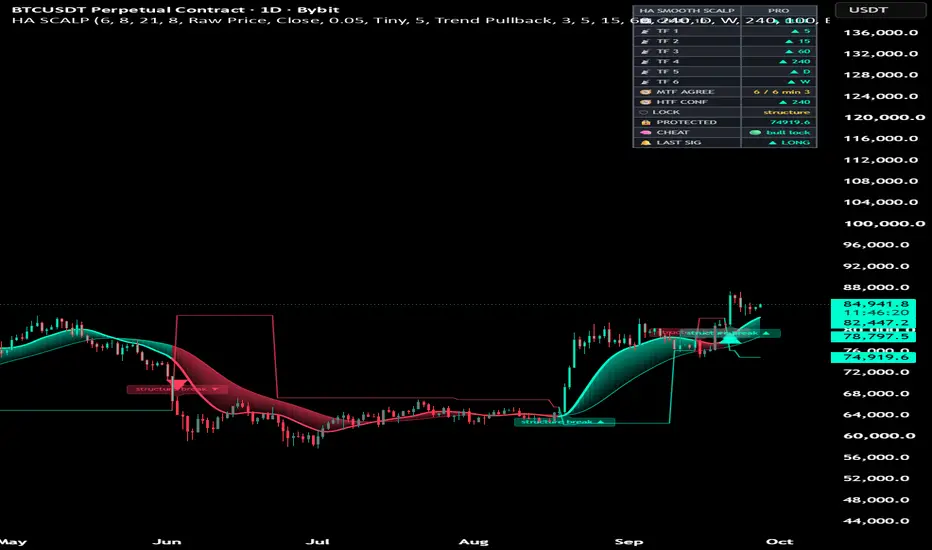
ha smooth scalper is a trend, structure and multi-timeframe scalping tool built around smoothed heikin-ashi price action.
the indicator combines a double-smoothed heikin-ashi engine with confirmed market structure, protected swing levels, multi-timeframe direction, an independent higher-timeframe confirmator and configurable entry filters.
its main purpose is to reduce short-term candle noise while preventing every small heikin-ashi color change from being interpreted as a genuine trend reversal.
the system can maintain the current bullish or bearish state until real market structure is broken, while the multi-timeframe engine measures whether the surrounding timeframes support the same direction.
### ha smooth engine
the core of the indicator is a double-smoothed heikin-ashi calculation.
raw open, high, low and close values are first smoothed before the heikin-ashi calculation is performed. the resulting heikin-ashi values are then smoothed again.
this creates a cleaner representation of directional movement than standard candles.
**pre-smooth length**
controls the first ema smoothing applied to the original ohlc data.
lower values make the engine react faster to price changes.
higher values remove more short-term noise but make the calculation slower to react.
**post-smooth length**
controls the second smoothing stage applied after the heikin-ashi values have been calculated.
increasing this setting creates a smoother directional structure.
reducing it produces a more responsive heikin-ashi engine.
**slow baseline length**
controls the slower ema calculated from the smoothed heikin-ashi close.
the fast and slow baselines are used to visualize trend behavior and to determine slope direction for trend-pullback signals.
### real structure trend lock
the structure lock is designed to prevent the indicator from changing trend direction because of a simple short-term heikin-ashi color flip.
when enabled, the active bullish or bearish state remains locked until a protected market structure level is genuinely broken.
during a bullish structure, the system protects confirmed swing lows.
during a bearish structure, it protects confirmed swing highs.
the trend changes only when price breaks the relevant protected structure according to the selected confirmation method.
**enable real structure trend lock**
activates this structural trend logic.
when disabled, trend direction follows the raw smoothed heikin-ashi direction instead.
**structure pivot strength**
controls how many bars are required to confirm structural swing highs and lows.
lower values create a more responsive structure model with more frequent pivots.
higher values focus on larger and more established swings.
**structure source**
two sources are available:
**raw price**
uses the actual chart highs and lows to identify market structure.
**smoothed ha**
uses the smoothed heikin-ashi highs and lows.
raw price provides a more direct representation of actual traded price structure, while smoothed ha produces a cleaner structural interpretation.
### structure break confirmation
a protected structure can be broken using either a candle close or a wick.
**close**
requires price to close beyond the protected level.
this is the more conservative option because an intrabar wick alone cannot change the structural trend.
**wick**
allows a high or low penetration to confirm the structure break.
this reacts faster but is more sensitive to temporary liquidity sweeps and wick excursions.
### structure break buffer
**structure break buffer × atr** adds an atr-based distance beyond the protected swing before a structure break is accepted.
with a bullish trend, the protected low is adjusted downward by the selected atr buffer.
with a bearish trend, the protected high is adjusted upward.
a larger buffer requires a deeper structural violation.
a smaller buffer makes the lock more sensitive.
this can be useful for filtering small penetrations around obvious swing levels.
### protected structure level
**show protected structure level** displays the price currently controlling the structural trend.
in a bullish structure, this is the protected low.
in a bearish structure, this is the protected high.
this line provides a direct visual reference for the level that must be violated before the structural direction can change.
### structure break labels
**show structure break labels** displays a label when the structural state flips from bearish to bullish or bullish to bearish.
**structure label size** controls the size of these labels.
available sizes are tiny, small and normal.
### cheat smooth candle mode
cheat smooth candle mode is a visual trend-lock system.
instead of allowing every short-term candle fluctuation to change chart color, candles can remain bullish while the active direction remains bullish and bearish while the active direction remains bearish.
when structure direction is selected as the color source, the candle color can remain locked until the real structure engine changes direction.
**enable cheat smooth candle mode**
activates the feature.
**color real chart candles**
applies the active cheat direction directly to the original chart candles.
**plot cheat smooth candles**
draws a separate set of additionally smoothed candles.
**cheat candle extra smooth**
controls the extra ema smoothing applied to these candles.
larger values create cleaner and slower candles.
smaller values remain closer to the underlying smoothed heikin-ashi movement.
**use structure direction for candle color**
when enabled, candle color follows the structure-locked direction.
when disabled, color follows the raw smoothed heikin-ashi direction.
this distinction is important when using the indicator to remain visually aligned with the larger active structure during small countertrend movements.
### scalp signal engine
the indicator contains two entry modes:
**reversal**
allows a signal when the active direction flips and the other enabled confirmation requirements are satisfied.
**trend pullback**
adds the slow baseline slope as an additional trend filter.
for a long signal in trend-pullback mode, the slow baseline must be rising.
for a short signal, the slow baseline must be falling.
this makes trend-pullback mode more selective about taking directional changes against the current baseline slope.
### impulse filter
**impulse filter** requires the current smoothed heikin-ashi candle body to be larger than the previous body.
the filter is intended to require increasing candle displacement when a signal occurs.
when disabled, this expanding-body requirement is removed.
### multi-timeframe confluence
ha smooth scalper can evaluate up to six independent timeframes.
each timeframe can be individually enabled or disabled.
the default configuration includes:
5 minute
15 minute
1 hour
4 hour
daily
weekly
each timeframe is evaluated using the same smoothed heikin-ashi directional engine.
the dashboard then displays whether each enabled timeframe is bullish or bearish.
### minimum timeframes agreeing
**min timeframes agreeing** defines how many enabled timeframes must agree with the signal direction.
the value can range from 0 to 6.
for example, if six timeframes are enabled and the minimum is set to three, at least three must be bullish for a qualifying long signal or bearish for a qualifying short signal.
the effective requirement automatically adapts to the number of enabled timeframes.
this means that disabling timeframes does not leave an impossible confirmation requirement.
setting the value to zero removes the minimum agreement requirement.
### confirmed mtf candles
**use confirmed mtf candles** determines whether multi-timeframe direction is based on confirmed higher-timeframe information or the currently developing higher-timeframe candle.
confirmed mode uses the previous confirmed directional state from each requested timeframe.
this is useful when stable multi-timeframe confirmation is preferred over faster intrabar changes.
live mode reacts more quickly but can change while the higher-timeframe candle is still developing.
### extra htf confirmator
the indicator includes a separate higher-timeframe confirmation layer in addition to the six-timeframe confluence system.
when enabled, this confirmator can block a long or short signal if its selected higher timeframe does not agree with the proposed direction.
**confirmator timeframe**
selects the timeframe used for this additional filter.
**confirmator ema length**
sets the ema period when the ema-based confirmation method is selected.
### confirmator modes
two methods are available:
**ema slope + price**
a bullish confirmation requires price to be above the higher-timeframe ema while the ema is flat-to-rising.
a bearish confirmation requires price below the ema while the ema is flat-to-falling.
if neither condition is satisfied, the confirmator remains neutral and does not approve either direction.
**ha direction**
uses the smoothed heikin-ashi direction from the selected higher timeframe instead.
### confirmed htf candle
**use confirmed htf candle** determines whether the extra higher-timeframe confirmator uses confirmed information or the current developing higher-timeframe state.
confirmed mode is more stable.
live mode is more responsive but can change before the higher-timeframe candle closes.
### how a long signal is built
a long signal begins when the active direction changes from bearish to bullish.
the signal must then pass the enabled filters.
depending on the configuration, this can include:
a bullish structural flip
the required number of bullish mtf directions
bullish approval from the extra htf confirmator
a rising slow baseline in trend-pullback mode
an expanding smoothed candle body when the impulse filter is enabled
only when the required conditions agree does the indicator generate the long signal.
### how a short signal is built
a short signal follows the opposite process.
the active direction must change from bullish to bearish.
the required number of enabled timeframes must support the bearish direction.
the extra htf confirmator must approve the bearish side when enabled.
trend-pullback mode requires a falling slow baseline.
the impulse filter can additionally require expanding candle displacement.
### full confluence stars
a gold star represents stronger timeframe alignment than a normal signal.
a bullish star requires a valid long signal while every enabled mtf direction is bullish.
a bearish star requires a valid short signal while every enabled mtf direction is bearish.
this makes the star a visual marker for complete agreement across all selected mtf filters at the moment of the signal.
it does not guarantee that the trade will continue in that direction.
### trend cloud
**trend cloud** displays the area between the fast smoothed heikin-ashi baseline and the slower baseline.
the cloud automatically follows the active bullish or bearish direction.
**gradient fill**
changes the visual density of the cloud and creates a stronger gradient between its boundaries.
the cloud can be used as a quick visual reference for trend direction, baseline separation and changes in directional structure.
### glow baseline
**glow baseline** adds several transparent layers around the fast baseline.
this option is purely visual and can make the active directional baseline easier to identify.
**baseline width** controls the width of the primary fast baseline.
### smoothed ha candles
**plot smoothed ha candles** displays the main double-smoothed heikin-ashi candles directly on the price chart.
this is separate from cheat smooth candles.
the standard smoothed ha candles represent the underlying ha engine, while cheat candles add another smoothing stage and can use the locked structure direction for their color.
### confluence background tint
**confluence background tint** adds a subtle background color based on the active trend direction.
the strength of the tint changes according to the number of timeframes agreeing with the current direction.
this provides a fast visual representation of mtf alignment without requiring constant attention to the dashboard.
### buy and sell signals
**show buy / sell signals** controls the long and short markers displayed on the chart.
bullish signals are shown below price.
bearish signals are shown above price.
disabling this option hides the markers without changing the underlying signal calculations.
### pro dashboard
the dashboard provides a compact summary of the entire system.
it displays:
current chart direction
tf 1 direction
tf 2 direction
tf 3 direction
tf 4 direction
tf 5 direction
tf 6 direction
current mtf agreement count
minimum mtf agreement required
extra htf confirmator direction
current trend-lock method
current protected structure price
cheat candle lock direction
last generated signal
each disabled timeframe is clearly marked as off.
### dashboard position
the dashboard can be placed in nine locations:
top right
top center
top left
middle right
middle center
middle left
bottom right
bottom center
bottom left
### dashboard appearance
**panel text size** provides tiny, small and normal display modes.
**panel emojis** enables or removes the dashboard icons.
**show dashboard** completely enables or disables the panel.
### alerts
the indicator includes dedicated alerts for:
long scalp signals
short scalp signals
full bullish confluence
full bearish confluence
bullish structure breaks
bearish structure breaks
this allows the system to be monitored without requiring every chart to remain continuously visible.
### quick start
start with the default settings and observe the main chart direction.
green represents the active bullish state.
red represents the active bearish state.
with structure lock enabled, do not interpret every temporary countertrend candle as a trend reversal.
instead, watch the protected structure level.
during a bullish structure, the protected low represents the level controlling the current bullish state.
during a bearish structure, the protected high controls the bearish state.
a valid break of this level can flip the structural direction.
next, check the dashboard.
look at how many of the enabled timeframes agree with the current chart direction.
for example, if the dashboard shows four bullish timeframes out of six and the minimum requirement is three, the mtf filter currently satisfies the bullish agreement requirement.
then check the extra htf confirmator.
if it points in the opposite direction, new signals on the conflicting side can be blocked.
when a buy or sell marker appears, the indicator has detected a directional flip that also satisfies the active signal filters.
a gold star means the signal occurred while every enabled mtf direction agreed with it.
### a simple scalping workflow
use a lower chart timeframe for execution while keeping several larger timeframes enabled for context.
keep structure lock enabled to reduce unnecessary directional changes.
use **close** confirmation when you want structure to survive temporary wick sweeps.
use **trend pullback** mode when you want signals to agree with the slow baseline slope.
set the minimum mtf agreement according to how selective you want the signal engine to be.
use the extra htf confirmator as a final directional filter.
when a signal appears, check:
the protected structure
the current chart direction
mtf agreement
extra htf direction
baseline slope
whether full confluence is present
then use your own entry, invalidation and risk-management rules before taking a position.
### faster configuration
for a more responsive setup:
reduce pre-smooth length
reduce post-smooth length
reduce structure pivot strength
reduce the structure break buffer
use live mtf candles
use live extra htf confirmation
reduce the minimum number of agreeing timeframes
these changes increase responsiveness but can also increase sensitivity to market noise.
### more selective configuration
for a slower and more filtered setup:
increase pre-smooth and post-smooth lengths
increase structure pivot strength
use close-based structure confirmation
increase the atr structure buffer moderately
enable confirmed mtf candles
enable confirmed htf candles
increase the minimum timeframe agreement
keep the extra htf confirmator enabled
use trend-pullback mode
keep the impulse filter enabled
this configuration requires more conditions to agree before signals are accepted.
### understanding structure lock
structure lock is one of the central features of the indicator.
standard trend systems can rapidly alternate between bullish and bearish states during sideways movement.
this script can instead separate short-term heikin-ashi movement from actual structural invalidation.
a bullish state can therefore remain bullish during a temporary bearish pullback as long as the protected bullish structure has not been broken.
the same principle applies to bearish structure.
this is also why cheat candle coloring can remain consistently bullish or bearish through smaller countertrend movements.
### using raw price vs smoothed ha structure
**raw price** is useful when the protected levels should correspond directly to actual market highs and lows.
**smoothed ha** removes part of the underlying price noise before structural pivots are detected.
raw price generally produces levels that are easier to compare with conventional support, resistance and swing analysis.
smoothed ha can create a cleaner structural model when the underlying chart is particularly noisy.
### using close vs wick confirmation
**close** confirmation can be useful when the market frequently trades through obvious swing levels before recovering.
a wick through the protected level does not immediately change the trend.
**wick** confirmation reacts as soon as the structural boundary is exceeded.
it can therefore detect changes sooner, but it is also more vulnerable to liquidity sweeps and temporary price spikes.
### how ha smooth scalper can help
ha smooth scalper can help with:
reducing short-term candle noise
maintaining a cleaner visual trend state
separating temporary heikin-ashi flips from structural trend changes
tracking protected swing highs and lows
identifying confirmed bullish and bearish structure breaks
comparing direction across as many as six configurable timeframes
requiring a minimum level of mtf agreement before signals
filtering entries with an independent higher-timeframe trend condition
distinguishing live higher-timeframe information from confirmed higher-timeframe states
finding directional flips with optional momentum expansion
filtering trend-pullback entries using baseline slope
highlighting complete multi-timeframe alignment
keeping chart candle colors aligned with the active structural direction
monitoring the entire setup through a compact dashboard
creating alerts for signals, full confluence and structure changes
the indicator can be particularly useful on lower timeframes where raw candle direction changes frequently and a trader wants to preserve broader structural context.
it can also help separate three different pieces of information that are often mixed together: immediate smoothed price direction, actual protected market structure and higher-timeframe directional agreement.
ha smooth scalper should be used as a market structure and confirmation framework rather than as an automatic trading system. a long or short marker indicates that the conditions configured inside the indicator have aligned; it does not define position size, stop placement, profit targets or the probability that the next trade will be profitable.

Light the candle that sleeps within you.
כתב ויתור
המידע והפרסומים אינם מיועדים להיות, ואינם מהווים, ייעוץ או המלצה פיננסית, השקעתית, מסחרית או מכל סוג אחר המסופקת או מאושרת על ידי TradingView. קרא עוד ב־תנאי השימוש.
Light the candle that sleeps within you.
כתב ויתור
המידע והפרסומים אינם מיועדים להיות, ואינם מהווים, ייעוץ או המלצה פיננסית, השקעתית, מסחרית או מכל סוג אחר המסופקת או מאושרת על ידי TradingView. קרא עוד ב־תנאי השימוש.