TEProfile PeaksShelvesVisits SessionFold
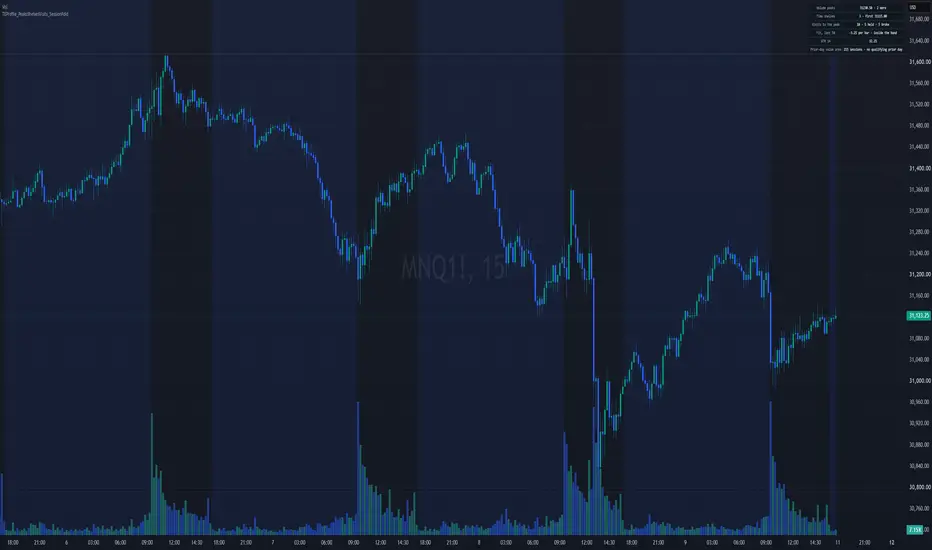
Library "TEProfile_PeaksShelvesVisits_SessionFold"
Market-profile and fitting maths for Pine arrays: a volume profile's point of control and high-volume rows, time-at-price shelves, visits to a price band and how each ended, an ordinary least-squares fit with a band side and a fit-window picker, a Wilder ATR over arrays, a CME Globex session fold with the prior trading day's value area, a log(1 + k) table and small array helpers. No trading rules.
pushTagged(cP, cT, cL, price, ty, lb)
appends one tagged price to three parallel arrays: the price, its type code and its label code. Nothing is appended when the price is na.
Parameters:
cP (array<float>): output: the price is pushed here
cT (array<int>): output: the type code is pushed here
cL (array<int>): output: the label code is pushed here
price (float): the price (na appends nothing)
ty (int): the type code
lb (int): the label code
Returns: true
weightsOrDefault(w, dflt)
a copy of a weight array in which every na or zero weight is replaced by a default
Parameters:
w (array<float>): the weights
dflt (float): the value written in place of an na or zero weight
Returns: a new array, the same length as w
ringPushPair(ps, bs, p, b, keep)
pushes one value onto each of two parallel rings and, when the first ring is longer than keep, shifts the oldest value off both. Keep the two rings the same length: only the first one's size is checked.
Parameters:
ps (array<float>): the first ring (oldest first), updated in place
bs (array<int>): the second ring, updated in place in lockstep
p (float): the value pushed onto ps
b (int): the value pushed onto bs
keep (int): the most values a ring holds
Returns: the size of ps after the push
log1pTable()
ln(1 + k) for k = 0 … 79 as the 80 IEEE-754 doubles JavaScript's Math.log1p returns; math.log(1 + k) differs from them at k = 13 in the last bit, so a script that must match a JavaScript reference bit for bit reads this table
Returns: a new array of 80 floats, index k holding ln(1 + k)
profilePeaksInto(h, l, v, bins, cP, cT, cL, tick, pocTy, pocLb, hvnTy, hvnLb)
writes a volume profile's point of control and its high-volume rows into three parallel output arrays. Rows are max(1, ceil((highest high − lowest low) / bins / tick)) ticks tall, filled by TE Math's profileRows (each bar's volume spread per tick of its range). The point of control (the first row holding the most volume) is written first, then every other inner row whose volume is at least both neighbours' and at least 0.55 × the point of control's, each at its row's centre. The row height uses the whole of h and l (their highest high and lowest low), even where v is shorter. Nothing is written for fewer than 10 bars, fewer than 3 bins or 3 rows, no volume, or tick ≤ 0.
Parameters:
h (array<float>): highs
l (array<float>): lows
v (array<float>): volumes (the profile covers the shortest of the three)
bins (int): the number of rows the range is divided into, before rounding the row height up to whole ticks
cP (array<float>): output: prices are pushed here
cT (array<int>): output: type codes are pushed here
cL (array<int>): output: label codes are pushed here
tick (float): the tick size the rows are built on (nothing is written when tick ≤ 0)
pocTy (int): the type code written with the point of control
pocLb (int): the label code written with the point of control
hvnTy (int): the type code written with each high-volume row
hvnLb (int): the label code written with each high-volume row
Returns: true
shelvesInto(h, l, bins, minShare, cP, cT, cL, ty, lb)
writes time-at-price shelves into three parallel output arrays. The range from the lowest low to the highest high is split into `bins` equal bins; each bar adds 1, spread evenly over the bins its low-to-high range touches. Each inner bin (not the first or the last) whose count is at least minShare of the total and at least both neighbours' counts is written at its centre. Nothing is written for fewer than 20 bars, fewer than 3 bins or a flat range.
Parameters:
h (array<float>): highs
l (array<float>): lows (the count covers the shorter of h and l)
bins (int): the number of bins
minShare (float): the smallest share of the total count a bin must hold (0 to 1)
cP (array<float>): output: prices are pushed here
cT (array<int>): output: type codes are pushed here
cL (array<int>): output: label codes are pushed here
ty (int): the type code written with each shelf
lb (int): the label code written with each shelf
Returns: true
visitCounts(h, l, c, ts, price, tol, orient, from)
counts the visits of a bar series to a price band and how each ended. A visit is a run of bars whose range reaches price ± tol; it counts when its first bar starts at or after `from`. A counted visit is judged once, when it ends (the next bar lies wholly outside the band): a close on the holding side is held, otherwise broke. The holding side is orient when it is not 0 (+1: a close above the band holds, −1: a close below it holds), else the side the visit came from (the last close outside the band before it; unknown: neither). A visit still open at the last bar is counted but not judged.
Parameters:
h (array<float>): highs, oldest first
l (array<float>): lows, oldest first
c (array<float>): closes, oldest first
ts (array<int>): each bar's start time, oldest first (the walk covers the shortest of the four arrays)
price (float): the price at the centre of the band
tol (float): the band half-width
orient (int): +1, −1, or 0 for the side the visit came from
from (int): the earliest start time a counted visit may begin at
Returns: a tuple [visits counted, held, broke]
linearFit(c, fromI, toI)
ordinary least squares of c on x = i over the indexes fromI … toI, so the fitted value at index i is a + b × i; sigma is the root of the mean squared residual. All three are na unless 0 ≤ fromI, toI < size(c) and the window holds at least 3 values.
Parameters:
c (array<float>): the values
fromI (int): the first index of the window
toI (int): the last index of the window (inclusive)
Returns: a tuple [a, b, sigma]
bandSide(lastC, center, sigma, dev)
which side of a band around a centre a value lies on: +1 above centre + dev × sigma, −1 below centre − dev × sigma, 0 between them or when any input is na
Parameters:
lastC (float): the value to place (for example the last close)
center (float): the band centre
sigma (float): the band unit (for example a residual standard deviation)
dev (float): the band half-width in units of sigma
Returns: +1, −1 or 0
windowFromLastPivot(nowBar, hiBars, loBars, minLen, maxLen)
the first index of a window ending at nowBar that starts at the newest pivot index at or before nowBar (taken from either array; na entries are ignored), or nowBar − maxLen + 1 when there is none, then clamped so the window is at least minLen and at most maxLen values long
Parameters:
nowBar (int): the last index of the window
hiBars (array<int>): the indexes of the pivot highs
loBars (array<int>): the indexes of the pivot lows
minLen (int): the shortest window
maxLen (int): the longest window
Returns: the first index of the window
atrOrZero(h, l, c, period)
Wilder's average true range of `period` (TE Math's Atr) folded over three arrays, oldest first; 0.0 while it is still na (fewer than `period` true ranges)
Parameters:
h (array<float>): highs, oldest first
l (array<float>): lows, oldest first
c (array<float>): closes, oldest first (the fold covers the shortest of the three)
period (int): the ATR length
Returns: the ATR, or 0.0
sessionFoldNew(atrLen)
a new, empty session fold: no session yet, a Wilder ATR of atrLen for the finished sessions, and empty bar and daily-row arrays
Parameters:
atrLen (int): the length of the sessions' ATR (sAtr)
Returns: a SessionFold
sessionFoldStep(d, t, h, l, c, v, tick)
folds one COMPLETED bar into the CME Globex session that holds it (TE Math's trade date and its 17:00 New York close). When a new trade date starts it closes the previous one: appends it to sesK / sesH / sesL as a daily row (high and low, or na when fewer than 1,242 bars were folded) unless its date is at or before seedK, folds its high − low into sAtr, and sets pvOk, poc, vah and val to its 70% value area (TE Math, rows of 0.02 × sAtr) when it is the trading day before the new one and was folded from within 30 minutes of its 18:00 open to within 30 minutes of its close for at least 90% of its minutes, with sAtr warm. Call it once per bar, oldest first.
Parameters:
d (SessionFold): the fold state, updated in place
t (int): the bar's time
h (float): the bar's high
l (float): the bar's low
c (float): the bar's close
v (float): the bar's volume
tick (float): the tick size the value area rows are built on
Returns: the session's bar count after this bar (the fold itself is in d)
SessionFold
the state of a CME session fold. Create it with sessionFoldNew and step it with sessionFoldStep.
Fields:
key (series int): the trade date (yyyymmdd) being folded; na before the first bar
kEnd (series int): the close time of the session being folded
kNow (series int): the trade date of the latest bar
first (series int): the time of the first bar folded into this session
lastT (series int): the time of the last bar folded into this session
n (series int): how many bars this session has folded
sH (series float): this session's high so far
sL (series float): this session's low so far
sAtr (Atr type from TradersEdgeUSA/TEMath_WilderSuperTrend_TickGridValueArea/1): the Wilder ATR of the finished sessions' high − low (sessionFoldNew sets its length)
pH (array<float>): this session's bar highs
pL (array<float>): this session's bar lows
pC (array<float>): this session's bar closes
pV (array<float>): this session's bar volumes
pvOk (series bool): whether poc, vah and val describe the session that finished last
poc (series float): its point of control
vah (series float): its value area high
val (series float): its value area low
sesK (array<int>): the daily rows' trade dates
seedK (series int): the last trade date the caller appended to the daily rows itself; a finished session at or before it is not appended (na for none)
sesH (array<float>): the daily rows' highs, na for a session folded for fewer than 1,242 bars
sesL (array<float>): the daily rows' lows, na alongside sesH
Market-profile and fitting maths for Pine arrays: a volume profile's point of control and high-volume rows, time-at-price shelves, visits to a price band and how each ended, an ordinary least-squares fit with a band side and a fit-window picker, a Wilder ATR over arrays, a CME Globex session fold with the prior trading day's value area, a log(1 + k) table and small array helpers. No trading rules.
pushTagged(cP, cT, cL, price, ty, lb)
appends one tagged price to three parallel arrays: the price, its type code and its label code. Nothing is appended when the price is na.
Parameters:
cP (array<float>): output: the price is pushed here
cT (array<int>): output: the type code is pushed here
cL (array<int>): output: the label code is pushed here
price (float): the price (na appends nothing)
ty (int): the type code
lb (int): the label code
Returns: true
weightsOrDefault(w, dflt)
a copy of a weight array in which every na or zero weight is replaced by a default
Parameters:
w (array<float>): the weights
dflt (float): the value written in place of an na or zero weight
Returns: a new array, the same length as w
ringPushPair(ps, bs, p, b, keep)
pushes one value onto each of two parallel rings and, when the first ring is longer than keep, shifts the oldest value off both. Keep the two rings the same length: only the first one's size is checked.
Parameters:
ps (array<float>): the first ring (oldest first), updated in place
bs (array<int>): the second ring, updated in place in lockstep
p (float): the value pushed onto ps
b (int): the value pushed onto bs
keep (int): the most values a ring holds
Returns: the size of ps after the push
log1pTable()
ln(1 + k) for k = 0 … 79 as the 80 IEEE-754 doubles JavaScript's Math.log1p returns; math.log(1 + k) differs from them at k = 13 in the last bit, so a script that must match a JavaScript reference bit for bit reads this table
Returns: a new array of 80 floats, index k holding ln(1 + k)
profilePeaksInto(h, l, v, bins, cP, cT, cL, tick, pocTy, pocLb, hvnTy, hvnLb)
writes a volume profile's point of control and its high-volume rows into three parallel output arrays. Rows are max(1, ceil((highest high − lowest low) / bins / tick)) ticks tall, filled by TE Math's profileRows (each bar's volume spread per tick of its range). The point of control (the first row holding the most volume) is written first, then every other inner row whose volume is at least both neighbours' and at least 0.55 × the point of control's, each at its row's centre. The row height uses the whole of h and l (their highest high and lowest low), even where v is shorter. Nothing is written for fewer than 10 bars, fewer than 3 bins or 3 rows, no volume, or tick ≤ 0.
Parameters:
h (array<float>): highs
l (array<float>): lows
v (array<float>): volumes (the profile covers the shortest of the three)
bins (int): the number of rows the range is divided into, before rounding the row height up to whole ticks
cP (array<float>): output: prices are pushed here
cT (array<int>): output: type codes are pushed here
cL (array<int>): output: label codes are pushed here
tick (float): the tick size the rows are built on (nothing is written when tick ≤ 0)
pocTy (int): the type code written with the point of control
pocLb (int): the label code written with the point of control
hvnTy (int): the type code written with each high-volume row
hvnLb (int): the label code written with each high-volume row
Returns: true
shelvesInto(h, l, bins, minShare, cP, cT, cL, ty, lb)
writes time-at-price shelves into three parallel output arrays. The range from the lowest low to the highest high is split into `bins` equal bins; each bar adds 1, spread evenly over the bins its low-to-high range touches. Each inner bin (not the first or the last) whose count is at least minShare of the total and at least both neighbours' counts is written at its centre. Nothing is written for fewer than 20 bars, fewer than 3 bins or a flat range.
Parameters:
h (array<float>): highs
l (array<float>): lows (the count covers the shorter of h and l)
bins (int): the number of bins
minShare (float): the smallest share of the total count a bin must hold (0 to 1)
cP (array<float>): output: prices are pushed here
cT (array<int>): output: type codes are pushed here
cL (array<int>): output: label codes are pushed here
ty (int): the type code written with each shelf
lb (int): the label code written with each shelf
Returns: true
visitCounts(h, l, c, ts, price, tol, orient, from)
counts the visits of a bar series to a price band and how each ended. A visit is a run of bars whose range reaches price ± tol; it counts when its first bar starts at or after `from`. A counted visit is judged once, when it ends (the next bar lies wholly outside the band): a close on the holding side is held, otherwise broke. The holding side is orient when it is not 0 (+1: a close above the band holds, −1: a close below it holds), else the side the visit came from (the last close outside the band before it; unknown: neither). A visit still open at the last bar is counted but not judged.
Parameters:
h (array<float>): highs, oldest first
l (array<float>): lows, oldest first
c (array<float>): closes, oldest first
ts (array<int>): each bar's start time, oldest first (the walk covers the shortest of the four arrays)
price (float): the price at the centre of the band
tol (float): the band half-width
orient (int): +1, −1, or 0 for the side the visit came from
from (int): the earliest start time a counted visit may begin at
Returns: a tuple [visits counted, held, broke]
linearFit(c, fromI, toI)
ordinary least squares of c on x = i over the indexes fromI … toI, so the fitted value at index i is a + b × i; sigma is the root of the mean squared residual. All three are na unless 0 ≤ fromI, toI < size(c) and the window holds at least 3 values.
Parameters:
c (array<float>): the values
fromI (int): the first index of the window
toI (int): the last index of the window (inclusive)
Returns: a tuple [a, b, sigma]
bandSide(lastC, center, sigma, dev)
which side of a band around a centre a value lies on: +1 above centre + dev × sigma, −1 below centre − dev × sigma, 0 between them or when any input is na
Parameters:
lastC (float): the value to place (for example the last close)
center (float): the band centre
sigma (float): the band unit (for example a residual standard deviation)
dev (float): the band half-width in units of sigma
Returns: +1, −1 or 0
windowFromLastPivot(nowBar, hiBars, loBars, minLen, maxLen)
the first index of a window ending at nowBar that starts at the newest pivot index at or before nowBar (taken from either array; na entries are ignored), or nowBar − maxLen + 1 when there is none, then clamped so the window is at least minLen and at most maxLen values long
Parameters:
nowBar (int): the last index of the window
hiBars (array<int>): the indexes of the pivot highs
loBars (array<int>): the indexes of the pivot lows
minLen (int): the shortest window
maxLen (int): the longest window
Returns: the first index of the window
atrOrZero(h, l, c, period)
Wilder's average true range of `period` (TE Math's Atr) folded over three arrays, oldest first; 0.0 while it is still na (fewer than `period` true ranges)
Parameters:
h (array<float>): highs, oldest first
l (array<float>): lows, oldest first
c (array<float>): closes, oldest first (the fold covers the shortest of the three)
period (int): the ATR length
Returns: the ATR, or 0.0
sessionFoldNew(atrLen)
a new, empty session fold: no session yet, a Wilder ATR of atrLen for the finished sessions, and empty bar and daily-row arrays
Parameters:
atrLen (int): the length of the sessions' ATR (sAtr)
Returns: a SessionFold
sessionFoldStep(d, t, h, l, c, v, tick)
folds one COMPLETED bar into the CME Globex session that holds it (TE Math's trade date and its 17:00 New York close). When a new trade date starts it closes the previous one: appends it to sesK / sesH / sesL as a daily row (high and low, or na when fewer than 1,242 bars were folded) unless its date is at or before seedK, folds its high − low into sAtr, and sets pvOk, poc, vah and val to its 70% value area (TE Math, rows of 0.02 × sAtr) when it is the trading day before the new one and was folded from within 30 minutes of its 18:00 open to within 30 minutes of its close for at least 90% of its minutes, with sAtr warm. Call it once per bar, oldest first.
Parameters:
d (SessionFold): the fold state, updated in place
t (int): the bar's time
h (float): the bar's high
l (float): the bar's low
c (float): the bar's close
v (float): the bar's volume
tick (float): the tick size the value area rows are built on
Returns: the session's bar count after this bar (the fold itself is in d)
SessionFold
the state of a CME session fold. Create it with sessionFoldNew and step it with sessionFoldStep.
Fields:
key (series int): the trade date (yyyymmdd) being folded; na before the first bar
kEnd (series int): the close time of the session being folded
kNow (series int): the trade date of the latest bar
first (series int): the time of the first bar folded into this session
lastT (series int): the time of the last bar folded into this session
n (series int): how many bars this session has folded
sH (series float): this session's high so far
sL (series float): this session's low so far
sAtr (Atr type from TradersEdgeUSA/TEMath_WilderSuperTrend_TickGridValueArea/1): the Wilder ATR of the finished sessions' high − low (sessionFoldNew sets its length)
pH (array<float>): this session's bar highs
pL (array<float>): this session's bar lows
pC (array<float>): this session's bar closes
pV (array<float>): this session's bar volumes
pvOk (series bool): whether poc, vah and val describe the session that finished last
poc (series float): its point of control
vah (series float): its value area high
val (series float): its value area low
sesK (array<int>): the daily rows' trade dates
seedK (series int): the last trade date the caller appended to the daily rows itself; a finished session at or before it is not appended (na for none)
sesH (array<float>): the daily rows' highs, na for a session folded for fewer than 1,242 bars
sesL (array<float>): the daily rows' lows, na alongside sesH

כתב ויתור
המידע והפרסומים אינם מיועדים להיות, ואינם מהווים, ייעוץ או המלצה פיננסית, השקעתית, מסחרית או מכל סוג אחר המסופקת או מאושרת על ידי TradingView. קרא עוד ב־תנאי השימוש.
כתב ויתור
המידע והפרסומים אינם מיועדים להיות, ואינם מהווים, ייעוץ או המלצה פיננסית, השקעתית, מסחרית או מכל סוג אחר המסופקת או מאושרת על ידי TradingView. קרא עוד ב־תנאי השימוש.