
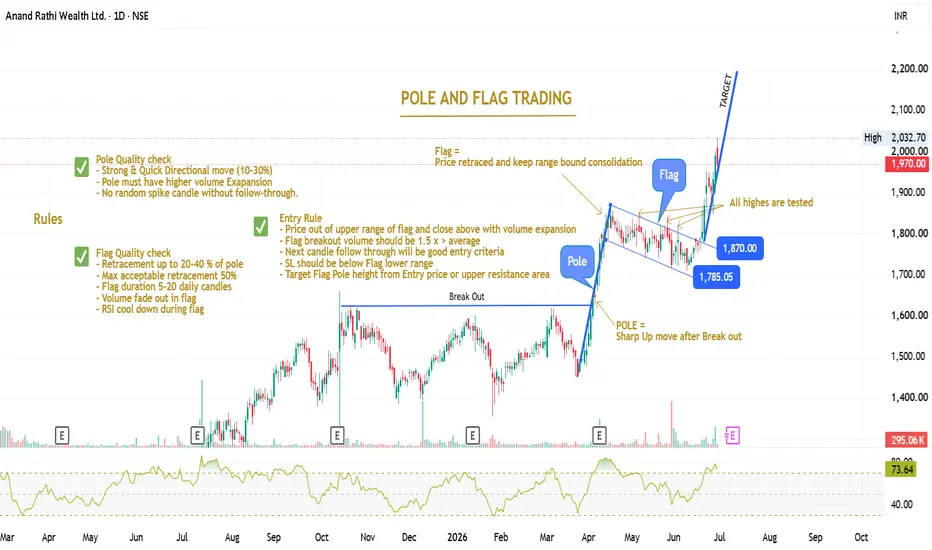
Pole & Flag Pattern :
Markets move in phases: impulse, consolidation, and continuation. The Pole & Flag pattern represents this natural rhythm of price action.
A pole is the strong directional move where buyers or sellers aggressively take control. This phase is usually supported by increasing volume, showing strong participation and momentum.
After a sharp move, the market often pauses. This creates the flag, a short consolidation phase where early participants book profits and new participants enter. A healthy flag is usually smaller than the pole, with controlled retracement and decreasing volatility.
The real opportunity comes when price breaks out of the flag structure.
✅ A quality Pole & Flag setup usually has:
• Strong impulsive pole
• Controlled retracement (not a deep reversal)
• Tight consolidation
• Volume expansion on breakout
• Price closing above the flag boundary
For a bullish setup:
Pole = buyers gaining control
Flag = temporary pause / absorption
Breakout = continuation of demand
Target projection is commonly measured using the pole height from the breakout point.
However, remember:
A pattern is not a guarantee. The context matters:
• Overall market trend
• Volume behavior
• Support and resistance zones
• Risk-to-reward before entry
The pattern is not about drawing two lines — it is about understanding the market psychology behind accumulation, hesitation, and renewed momentum.
📈 Price tells the story. Volume reveals participation.
Few other examples:
 IOLCP

 MOTILALOFS

 AEROENTER

==============================================================================
Disclaimer:
This post is purely for educational and technical analysis purposes. I am not a SEBI registered analyst. This is not a recommendation to buy, sell, or hold any security. Markets involve risk; always do your own research and follow proper risk management.
Markets move in phases: impulse, consolidation, and continuation. The Pole & Flag pattern represents this natural rhythm of price action.
A pole is the strong directional move where buyers or sellers aggressively take control. This phase is usually supported by increasing volume, showing strong participation and momentum.
After a sharp move, the market often pauses. This creates the flag, a short consolidation phase where early participants book profits and new participants enter. A healthy flag is usually smaller than the pole, with controlled retracement and decreasing volatility.
The real opportunity comes when price breaks out of the flag structure.
✅ A quality Pole & Flag setup usually has:
• Strong impulsive pole
• Controlled retracement (not a deep reversal)
• Tight consolidation
• Volume expansion on breakout
• Price closing above the flag boundary
For a bullish setup:
Pole = buyers gaining control
Flag = temporary pause / absorption
Breakout = continuation of demand
Target projection is commonly measured using the pole height from the breakout point.
However, remember:
A pattern is not a guarantee. The context matters:
• Overall market trend
• Volume behavior
• Support and resistance zones
• Risk-to-reward before entry
The pattern is not about drawing two lines — it is about understanding the market psychology behind accumulation, hesitation, and renewed momentum.
📈 Price tells the story. Volume reveals participation.
Few other examples:
IOLCP MOTILALOFS AEROENTER ==============================================================================
Disclaimer:
This post is purely for educational and technical analysis purposes. I am not a SEBI registered analyst. This is not a recommendation to buy, sell, or hold any security. Markets involve risk; always do your own research and follow proper risk management.

Disclaimer
The information and publications are not meant to be, and do not constitute, financial, investment, trading, or other types of advice or recommendations supplied or endorsed by TradingView. Read more in the Terms of Use.
Disclaimer
The information and publications are not meant to be, and do not constitute, financial, investment, trading, or other types of advice or recommendations supplied or endorsed by TradingView. Read more in the Terms of Use.