
Disclaimer:
This analysis is for educational purposes only.
I am not a SEBI-registered advisor.
This is not financial advice.
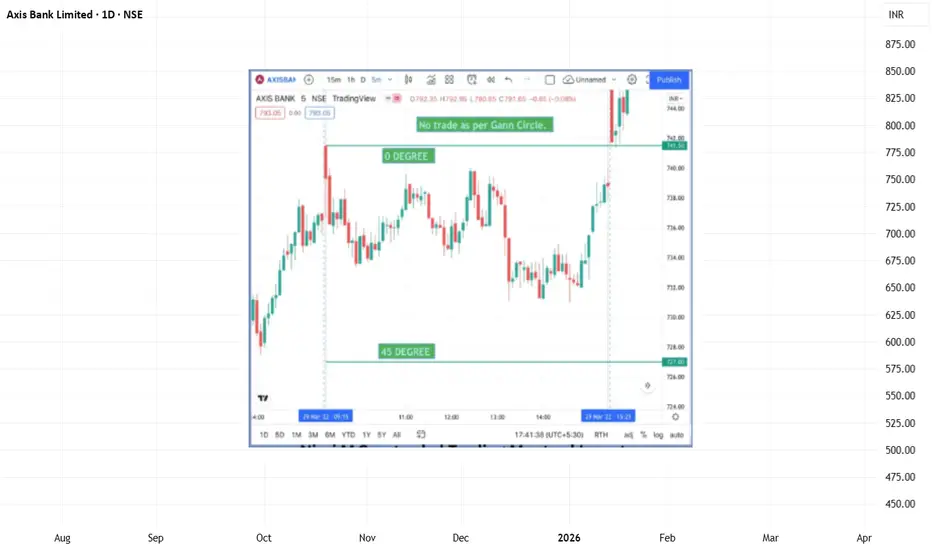
This case study explains how Gann Numbers and degree levels can help identify when market conditions may not form a valid structural setup, highlighting the importance of discipline and observation in price–time analysis.
The focus of this example is educational — to demonstrate how predefined mathematical levels can assist in filtering low-probability conditions and improving structured chart reading.
📊 Pre-Calculated Gann Degree Reference Levels
📈 Observed Market Behavior
🧠 Educational Insight
This analysis is for educational purposes only.
I am not a SEBI-registered advisor.
This is not financial advice.
This case study explains how Gann Numbers and degree levels can help identify when market conditions may not form a valid structural setup, highlighting the importance of discipline and observation in price–time analysis.
The focus of this example is educational — to demonstrate how predefined mathematical levels can assist in filtering low-probability conditions and improving structured chart reading.
📊 Pre-Calculated Gann Degree Reference Levels
- Using Gann Square of 9 price-degree conversion, the following levels were derived in advance:
- Reference level near 741.50
- Next degree level near 727
- Lower degree levels near 714, 701, and 688
- These levels represented potential observation zones, where price could show reaction, stabilization, or continuation depending on time and structure.
📈 Observed Market Behavior
- Price moved downward from the reference level during the session
- However, price movement slowed before reaching the next calculated degree level
- The expected degree completion was not observed within the normal observation window
- Price remained between calculated zones without forming a clear structural confirmation
- This behavior demonstrated a session where price remained in transition between Gann reference zones.
🧠 Educational Insight
- This example highlights an important principle of Gann methodology:
- Gann numbers help define objective observation zones
- Not every session produces a clear structural alignment
- Absence of degree completion can indicate balance or low directional clarity
- Such conditions provide valuable information about market structure
- The purpose of Gann analysis is to study price-time relationships objectively
- Understanding these situations helps traders avoid forcing interpretations and instead focus on structured observation.

Related publications
Disclaimer
The information and publications are not meant to be, and do not constitute, financial, investment, trading, or other types of advice or recommendations supplied or endorsed by TradingView. Read more in the Terms of Use.
Related publications
Disclaimer
The information and publications are not meant to be, and do not constitute, financial, investment, trading, or other types of advice or recommendations supplied or endorsed by TradingView. Read more in the Terms of Use.