
The Performance Trader · 04: How to review a session so the next one starts sharper
Most traders spend hours picking entries and about ninety seconds thinking about a session once it's over. I was worse than that. Good day or bad, I'd shut the screen the moment I was done and never look back. Then I'd sit down the next morning and lose to the same mistake I made the day before, just wearing a different ticker. The chart kept changing. I didn't.
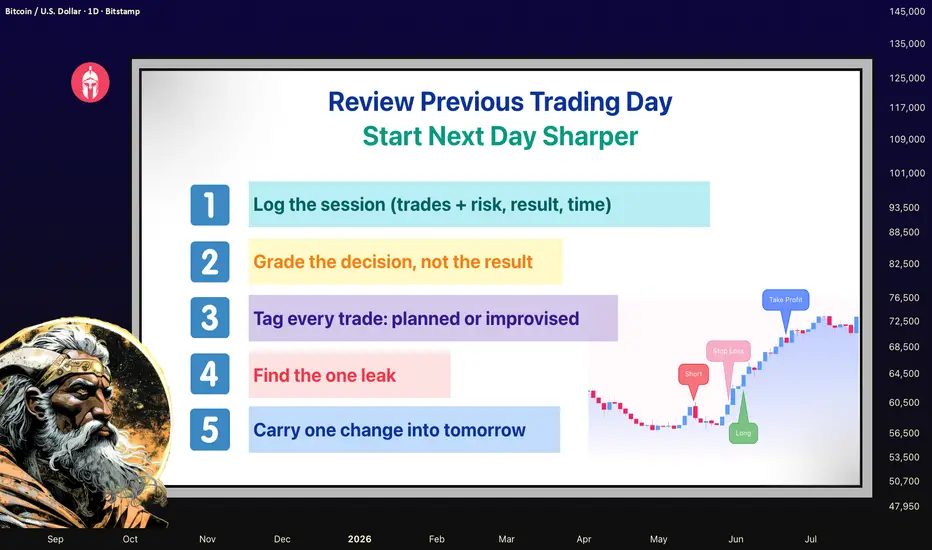
The review is what turns screen time into skill. Fifteen quiet minutes after the close, run the same way every day. Here's the one I use.
📸 Log it while it's still warm
Before the details fade, write the session down. Every trade you took, a screenshot with your entry and exit marked, and three numbers beside each one: what you risked, what it made or lost, and the time of day. Ten minutes, tops. Do it right away, because memory is a liar by dinner, and by tomorrow you'll remember the one clean trade and quietly lose the two dumb ones. The screenshots don't let you round yourself up.
⚖️ Grade the decision, not the result
Here's the mistake that cost me the most, and it took me a long time to even see it. I graded every trade by one thing: did it make money or lose it. That scoreboard is broken.
A trade can lose and still be a good trade. Say you followed your plan, sized it right, and it hit your stop, the price you'd set in advance to get out and cap the loss, anyway. Good decision, bad result, and you'd make the same call again tomorrow. Now turn it around. You double your size on a whim, break your own rule, and the market happens to bail you out. Bad decision, good result.
Score by the money and you'll pat yourself on the back for that second trade and run it again next week, right up until the week it doesn't bail you out. So I grade the decision I made with what I knew at the time. Get the decisions right often enough and the money sorts itself out.
🏷️ Tag every trade: planned or improvised
Then I put one of two labels on each trade. Planned means it was a setup I'd decided to take before the session started; improvised means I made it up on the spot. Then I count the improvised ones. Six trades with four improvised, and it barely matters that I finished green, because that count is the honest story of my day. My best sessions were almost never the ones where I caught more trades. They were the ones where nearly every trade had a label I'd written down before the open.
🔎 Find the one leak
Now the whole point of logging any of it. Out of everything on the page, find the single mistake that shows up the most or costs the most. A leak is a repeated error that quietly bleeds an account, the same wrong move made again and again.
Just one. Not a list of ten things to fix, because you can't hold ten new rules in your head at 10am with money live on the screen, and ten fixes end up doing the work of zero. Mine, for the longest stretch, was dragging my stop wider whenever I wasn't ready to be wrong yet. I only believed it once I saw it stacked up in the log. Same leak, week after week, in my own handwriting.
✍️ Carry one change into tomorrow
Last step is one sentence. Write a single rule for the next session aimed straight at that leak, small enough that you'll actually keep it in the morning. "No trade that isn't one of my two setups." Or, "Once my stop is set, it only moves toward profit." One line, somewhere you'll see it before the open.

That's the whole difference the review makes. Tomorrow starts with one concrete change instead of the same foggy promise to do better.
And a losing day you review honestly buys you something real, the price of a lesson you'll actually keep. Skip it and the same day is just money gone, with the bill landing again the next time you make the move you never bothered to name.
Part 5 lands next Thursday: percent return versus dollar profit, and which one actually tells you whether you're improving.
Most traders spend hours picking entries and about ninety seconds thinking about a session once it's over. I was worse than that. Good day or bad, I'd shut the screen the moment I was done and never look back. Then I'd sit down the next morning and lose to the same mistake I made the day before, just wearing a different ticker. The chart kept changing. I didn't.
The review is what turns screen time into skill. Fifteen quiet minutes after the close, run the same way every day. Here's the one I use.
📸 Log it while it's still warm
Before the details fade, write the session down. Every trade you took, a screenshot with your entry and exit marked, and three numbers beside each one: what you risked, what it made or lost, and the time of day. Ten minutes, tops. Do it right away, because memory is a liar by dinner, and by tomorrow you'll remember the one clean trade and quietly lose the two dumb ones. The screenshots don't let you round yourself up.
⚖️ Grade the decision, not the result
Here's the mistake that cost me the most, and it took me a long time to even see it. I graded every trade by one thing: did it make money or lose it. That scoreboard is broken.
A trade can lose and still be a good trade. Say you followed your plan, sized it right, and it hit your stop, the price you'd set in advance to get out and cap the loss, anyway. Good decision, bad result, and you'd make the same call again tomorrow. Now turn it around. You double your size on a whim, break your own rule, and the market happens to bail you out. Bad decision, good result.
Score by the money and you'll pat yourself on the back for that second trade and run it again next week, right up until the week it doesn't bail you out. So I grade the decision I made with what I knew at the time. Get the decisions right often enough and the money sorts itself out.
🏷️ Tag every trade: planned or improvised
Then I put one of two labels on each trade. Planned means it was a setup I'd decided to take before the session started; improvised means I made it up on the spot. Then I count the improvised ones. Six trades with four improvised, and it barely matters that I finished green, because that count is the honest story of my day. My best sessions were almost never the ones where I caught more trades. They were the ones where nearly every trade had a label I'd written down before the open.
🔎 Find the one leak
Now the whole point of logging any of it. Out of everything on the page, find the single mistake that shows up the most or costs the most. A leak is a repeated error that quietly bleeds an account, the same wrong move made again and again.
Just one. Not a list of ten things to fix, because you can't hold ten new rules in your head at 10am with money live on the screen, and ten fixes end up doing the work of zero. Mine, for the longest stretch, was dragging my stop wider whenever I wasn't ready to be wrong yet. I only believed it once I saw it stacked up in the log. Same leak, week after week, in my own handwriting.
✍️ Carry one change into tomorrow
Last step is one sentence. Write a single rule for the next session aimed straight at that leak, small enough that you'll actually keep it in the morning. "No trade that isn't one of my two setups." Or, "Once my stop is set, it only moves toward profit." One line, somewhere you'll see it before the open.
That's the whole difference the review makes. Tomorrow starts with one concrete change instead of the same foggy promise to do better.
And a losing day you review honestly buys you something real, the price of a lesson you'll actually keep. Skip it and the same day is just money gone, with the bill landing again the next time you make the move you never bothered to name.
Part 5 lands next Thursday: percent return versus dollar profit, and which one actually tells you whether you're improving.
Do you review your sessions, or just move straight on to the next one? And if you do review, what's the one leak yours keeps surfacing?

SkillTrade · skill-based trading contests, launching soon.
Same start. Same market. Sharpest trader wins.
👉 New lessons every Monday and Thursday.
TG: t.me/+7cYXQ5wuoodmZmMy
Same start. Same market. Sharpest trader wins.
👉 New lessons every Monday and Thursday.
TG: t.me/+7cYXQ5wuoodmZmMy
Disclaimer
The information and publications are not meant to be, and do not constitute, financial, investment, trading, or other types of advice or recommendations supplied or endorsed by TradingView. Read more in the Terms of Use.