
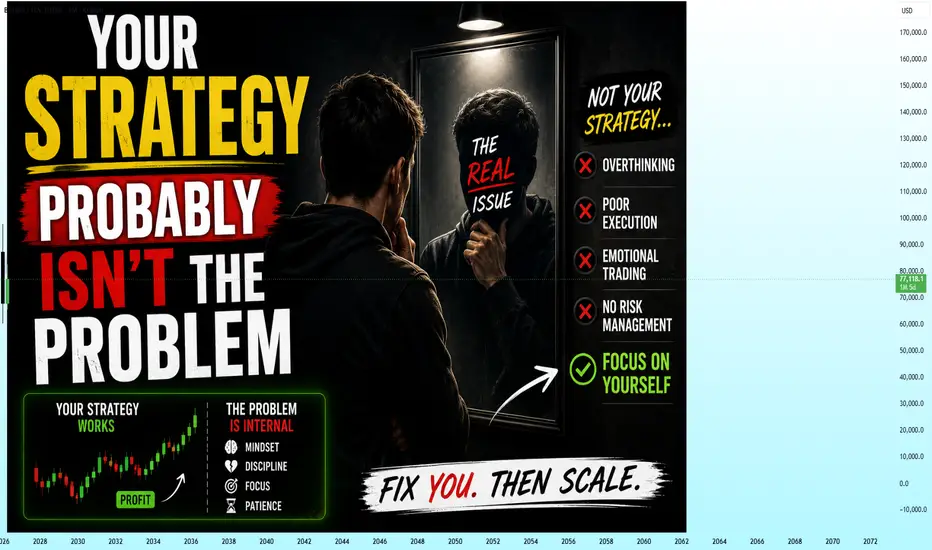
There are periods in trading where everything externally looks wrong even when internally everything is correct.
That is the phase most traders never survive.
Not because the system stopped working.
Not because probability disappeared.
Not because the market suddenly became impossible.
They fail because they emotionally reinterpret a normal statistical event as evidence that something is broken.
And once that happens, the destruction usually begins quietly.
A trader changes one rule.
Then another.
Then position sizing changes.
Then execution quality changes.
Then sample consistency disappears.
Eventually the trader is no longer testing a system.
They are reacting emotionally to short-term outcomes while convincing themselves they are “adapting.”
This is one of the most expensive misunderstandings in trading.
A rule-based loss inside a tested system does not mean the trade was wrong.
A losing streak inside a tested system does not mean the edge disappeared.
A flat month does not mean the strategy stopped working.
And a small sample skew does not override the law of large numbers.
Most traders intellectually understand these statements.
Very few can emotionally tolerate them in live execution.
That difference separates statistical operators from emotional gamblers.
The Core Problem: Humans Naturally Think in Small Samples
Human psychology evolved for immediate survival, not probabilistic reasoning.
If an early human ate a poisonous berry once, avoiding that berry immediately increased survival odds.
The brain became optimized for fast emotional adaptation from limited data.
Trading punishes this instinct.
Because markets operate through distributions, not isolated events.
A profitable system can lose repeatedly in the short term.
An unprofitable system can win repeatedly in the short term.
Short-term outcomes alone do not reveal edge quality.
This is mathematically unavoidable.
Suppose a trader has a strategy with:
45% win rate
1:2.5 risk-to-reward
1% risk per trade
The expectancy becomes:
Expected value = (0.45 × 2.5R) − (0.55 × 1R)
= 1.125R − 0.55R
= +0.575R per trade
This is a highly profitable system over large samples.
Yet despite positive expectancy, this strategy can still experience long losing streaks.
The probability of four consecutive losses becomes:
0.55 × 0.55 × 0.55 × 0.55
= 0.0915
= 9.15%
That means approximately once every 11 sequences, four losses in a row are statistically normal.
Nothing abnormal occurred.
But emotionally, many traders begin behaving as if the market has personally turned against them.
The trader suddenly starts thinking:
“Maybe market conditions changed.”
“Maybe this setup no longer works.”
“Maybe I should reduce risk.”
“Maybe I should wait for more confirmation.”
“This week feels different.”
The dangerous part is that these thoughts often sound intelligent.
But in reality, they are frequently emotional discomfort translated into analytical language.
The Difference Between Evidence and Noise
Professional trading requires distinguishing between meaningful evidence and normal variance.
This is where most people fail.
A small sample is extremely noisy.
Suppose you flip a coin with a genuine 55% probability of landing heads.
Over:
10 flips, randomness dominates.
50 flips, randomness still heavily influences results.
1,000 flips, probability begins stabilizing.
10,000 flips, distribution approaches theoretical expectancy.
Trading behaves similarly.
A trader cannot judge a system accurately after:
5 trades
20 trades
1 losing week
1 flat month
Yet this is exactly what most people do.
They continuously evaluate a long-term probabilistic system using short-term emotional reactions.
That is equivalent to judging the fairness of a casino after watching six blackjack hands.
The sample is too small.
The conclusions become distorted.
This creates one of the most destructive cycles in trading:
Trader experiences normal variance.
Trader interprets variance emotionally.
Trader changes execution.
Statistical consistency breaks.
Performance deteriorates.
Trader believes the original system failed.
In reality, the system often never failed.
The trader interrupted the probability distribution before the edge could materialize.
Why Probability Feels Emotionally Wrong
Probability rarely feels comfortable in real time.
That is because humans experience outcomes sequentially, not statistically.
A trader does not emotionally feel “500 trades.”
They feel:
this loss
this missed move
this drawdown
this frustration
this fear
The brain zooms into the present moment.
Probability only becomes visible across distributions.
Imagine a casino owner emotionally reacting after every roulette spin:
“Black came five times. Something is wrong.”
That would sound absurd.
Yet traders do this constantly.
They experience:
three losses
one flat week
a missed move
two stop-outs
and immediately begin questioning the system.
Professional traders understand something critical:
Short-term randomness can temporarily overpower expectancy.
This is not evidence against probability.
This is how probability behaves.
The Law of Large Numbers Is Not Motivation
Many traders treat the law of large numbers like a motivational phrase.
It is not motivation.
It is mathematics.
The law of large numbers states that as sample size increases, actual outcomes begin converging toward expected outcomes.
This principle is foundational in:
insurance
casinos
quantitative finance
actuarial science
statistical modeling
A casino may lose money over:
50 spins
200 hands
one evening
But over millions of events, the mathematical edge dominates.
Trading systems work similarly.
Suppose two traders use the exact same profitable strategy.
Trader A
Executes 1,000 trades consistently.
Maintains fixed risk.
Follows all rules.
Accepts variance.
Trader B
Changes rules after losses.
Skips setups emotionally.
Reduces size during drawdowns.
Adds confirmation randomly.
Even with identical systems, outcomes diverge dramatically.
Why?
Because expectancy only manifests through consistent repetition.
Trader B continuously interrupts the statistical process.
The edge never receives enough clean samples to express itself fully.
This is one reason why discipline in trading is not merely psychological.
It is mathematical.
The Hidden Damage of Emotional Adaptation
Most traders believe they are adapting intelligently during drawdowns.
Often they are simply reacting emotionally.
There is a critical distinction between:
evidence-based system evolution
emotional rule mutation
Real system development occurs through:
structured testing
large datasets
repeatable observation
statistical review
Emotional adaptation occurs through discomfort.
After several losses, the trader suddenly:
tightens stops
exits early
skips entries
seeks more confirmation
changes targets
trades smaller
trades larger
avoids valid setups
These adjustments may feel reasonable.
But mathematically they often damage expectancy.
Suppose a strategy originally produces:
40% win rate
1:3 reward-to-risk
Expected value:
= (0.40 × 3R) − (0.60 × 1R)
= 1.2R − 0.6R
= +0.6R
Now imagine emotional fear causes premature exits.
Average reward shrinks from 3R to 1.8R.
New expectancy:
= (0.40 × 1.8R) − (0.60 × 1R)
= 0.72R − 0.6R
= +0.12R
The edge nearly disappears.
The market did not destroy the system.
Emotional discomfort destroyed execution quality.
Flat Periods Are Structurally Normal
One of the least understood concepts in trading is that profitable systems are not supposed to produce perfectly smooth equity curves.
Even elite hedge funds experience:
stagnation periods
drawdowns
volatility compression
flat quarters
A positive expectancy model does not guarantee immediate profit.
It guarantees probabilistic advantage across sufficiently large samples.
Suppose a system generates:
+0.4R expectancy per trade
300 trades annually
The theoretical expected annual return becomes:
300 × 0.4R
= 120R
However, the path toward that expectancy may include:
12 consecutive losses
3 flat months
severe equity fluctuations
temporary underperformance
Most traders are emotionally unprepared for this reality.
They expect profitable systems to produce constant reinforcement.
Markets rarely behave that way.
Variance Is Built Into Every System
Variance is not a flaw in trading.
Variance is part of probability itself.
Even a strategy with strong edge experiences outcome dispersion.
Suppose a strategy has:
60% win rate
1:1.5 reward-to-risk
This is statistically powerful.
Yet the probability of six consecutive losses becomes:
0.40^6
= 0.004096
= 0.4096%
That seems small.
But across thousands of trades, such sequences eventually occur.
Professionals understand this.
Amateurs interpret it emotionally.
Professionals think:
“This is inside expected distribution.”
Amateurs think:
“The system stopped working.”
Then the emotional destruction begins.
Why Most Traders Never Reach Statistical Maturity
Statistical maturity means emotionally accepting that short-term outcomes are unreliable indicators of long-term edge quality.
Very few traders reach this stage.
Because emotional pain increases during variance.
And humans instinctively seek immediate relief.
The easiest emotional relief is changing something.
Adding an indicator feels productive.
Avoiding trades feels safer.
Searching for new systems creates hope.
But this often prevents the trader from ever collecting enough clean data to understand whether the original system actually worked.
This creates an endless loop:
system hopping
emotional optimization
inconsistent execution
fragmented samples
unstable expectancy
Many traders spend years searching for a “better strategy” when the real issue is inability to survive normal variance long enough for expectancy to emerge.
Drawdowns Are Not Optional
Every serious probabilistic system experiences drawdowns.
This includes:
hedge funds
quantitative firms
market makers
professional prop traders
casinos
No edge eliminates temporary adverse sequences.
A trader who cannot psychologically survive drawdowns cannot operate probabilistically.
Suppose a strategy risks 1% per trade and experiences a statistically normal 10-trade losing streak.
The drawdown becomes approximately:
1 − (0.99^10)
≈ 9.56%
Nothing abnormal occurred.
Yet many traders emotionally collapse during perfectly normal drawdowns because they never truly accepted variance beforehand.
Preparation matters because preparation creates statistical understanding before emotional exposure begins.
Why Preparation Changes Emotional Stability
Preparation is not merely technical.
It is psychological inoculation against variance.
When traders deeply test systems themselves, they begin understanding:
expected drawdowns
expected losing streaks
expected skew
expected volatility
expected stagnation periods
This transforms emotional reactions.
Instead of saying:
“Something is wrong.”
The trader thinks:
“This is statistically possible within system behavior.”
That shift is enormous.
Because calm execution requires contextual understanding of probability.
Without preparation, every drawdown feels personal.
With preparation, drawdowns become measurable statistical events.
The Market Does Not Owe Emotional Comfort
One of the hardest truths in trading is that profitable execution often feels uncomfortable.
Especially during variance.
A trader may execute perfectly for weeks while producing little profit.
That does not invalidate the process.
Professional trading is not about emotional satisfaction per trade.
It is about extracting edge across distributions.
The market does not reward:
impatience
emotional certainty
constant reassurance seeking
short-term emotional interpretation
It rewards statistical consistency.
This is why elite execution often appears boring from the outside.
The trader simply:
follows rules
accepts losses
repeats the process
avoids emotional contamination
trusts large samples
There is very little drama in professional execution.
The drama usually exists inside undisciplined thinking.
The Danger of Treating Small Samples as Truth
Humans naturally overreact to recent experiences.
This is called recency bias.
If a trader experiences:
three losses
one strong win
one volatile week
the brain begins treating recent outcomes as predictive evidence.
But mathematically, small samples contain enormous randomness.
Suppose a system has:
52% win rate
1:2 reward-to-risk
Over 20 trades, outcomes may vary wildly.
The trader may experience:
8 wins and 12 losses
14 wins and 6 losses
long streaks
unusual clustering
None of this necessarily disproves the edge.
Random distributions naturally create temporary distortions.
This is why emotional interpretation based on recent outcomes becomes dangerous.
The trader starts modifying behavior based on noise rather than evidence.
Real Confidence Comes From Testing
Most traders try to build confidence emotionally.
Real confidence comes from data.
When a trader personally tests:
500 trades
1,000 trades
multiple market conditions
historical drawdowns
expectancy models
confidence becomes grounded in statistical understanding rather than hope.
This changes live execution dramatically.
The trader no longer needs constant reassurance because the system has already been studied deeply.
Execution becomes calmer.
Cleaner.
Less reactive.
The trader understands that any single trade means very little relative to the larger distribution.
The Real Objective of Trading
Most traders unconsciously try to win individual trades.
Professionals try to execute probability distributions correctly.
That difference changes everything.
A professional understands:
“I do not need this trade to win.”
“I need this process to remain statistically consistent.”
That mindset removes enormous emotional pressure.
Because the trader stops attaching identity to isolated outcomes.
Instead, focus shifts toward:
execution quality
sample consistency
expectancy preservation
emotional neutrality
This is where long-term stability begins.
Conclusion
There will always be periods where you are doing the right thing and still not making money.
That is not necessarily evidence of failure.
Often it is simply probability behaving normally across a small sample.
A rule-based loss inside a tested system does not mean the trade was wrong.
A losing streak inside a tested system does not mean the edge disappeared.
A flat period inside a tested system does not mean you are wasting time.
And short-term skew inside a small sample does not mean probability stopped working.
Variance is not the enemy.
Emotional misinterpretation of variance is the enemy.
This is why preparation matters so deeply.
Preparation is what allows traders to recognize the difference between:
normal statistical fluctuation
and
genuine system deterioration.
Without preparation, every drawdown feels catastrophic.
With preparation, drawdowns become measurable components of probabilistic execution.
The market will always produce randomness in the short term.
That is its nature.
Nothing is wrong.
The real challenge is whether the trader can continue executing correctly while randomness temporarily hides the edge.
Because long-term profitability is rarely destroyed by probability itself.
It is usually destroyed by traders abandoning statistically valid behavior before the law of large numbers has enough time to work in their favor.
That is the phase most traders never survive.
Not because the system stopped working.
Not because probability disappeared.
Not because the market suddenly became impossible.
They fail because they emotionally reinterpret a normal statistical event as evidence that something is broken.
And once that happens, the destruction usually begins quietly.
A trader changes one rule.
Then another.
Then position sizing changes.
Then execution quality changes.
Then sample consistency disappears.
Eventually the trader is no longer testing a system.
They are reacting emotionally to short-term outcomes while convincing themselves they are “adapting.”
This is one of the most expensive misunderstandings in trading.
A rule-based loss inside a tested system does not mean the trade was wrong.
A losing streak inside a tested system does not mean the edge disappeared.
A flat month does not mean the strategy stopped working.
And a small sample skew does not override the law of large numbers.
Most traders intellectually understand these statements.
Very few can emotionally tolerate them in live execution.
That difference separates statistical operators from emotional gamblers.
The Core Problem: Humans Naturally Think in Small Samples
Human psychology evolved for immediate survival, not probabilistic reasoning.
If an early human ate a poisonous berry once, avoiding that berry immediately increased survival odds.
The brain became optimized for fast emotional adaptation from limited data.
Trading punishes this instinct.
Because markets operate through distributions, not isolated events.
A profitable system can lose repeatedly in the short term.
An unprofitable system can win repeatedly in the short term.
Short-term outcomes alone do not reveal edge quality.
This is mathematically unavoidable.
Suppose a trader has a strategy with:
45% win rate
1:2.5 risk-to-reward
1% risk per trade
The expectancy becomes:
Expected value = (0.45 × 2.5R) − (0.55 × 1R)
= 1.125R − 0.55R
= +0.575R per trade
This is a highly profitable system over large samples.
Yet despite positive expectancy, this strategy can still experience long losing streaks.
The probability of four consecutive losses becomes:
0.55 × 0.55 × 0.55 × 0.55
= 0.0915
= 9.15%
That means approximately once every 11 sequences, four losses in a row are statistically normal.
Nothing abnormal occurred.
But emotionally, many traders begin behaving as if the market has personally turned against them.
The trader suddenly starts thinking:
“Maybe market conditions changed.”
“Maybe this setup no longer works.”
“Maybe I should reduce risk.”
“Maybe I should wait for more confirmation.”
“This week feels different.”
The dangerous part is that these thoughts often sound intelligent.
But in reality, they are frequently emotional discomfort translated into analytical language.
The Difference Between Evidence and Noise
Professional trading requires distinguishing between meaningful evidence and normal variance.
This is where most people fail.
A small sample is extremely noisy.
Suppose you flip a coin with a genuine 55% probability of landing heads.
Over:
10 flips, randomness dominates.
50 flips, randomness still heavily influences results.
1,000 flips, probability begins stabilizing.
10,000 flips, distribution approaches theoretical expectancy.
Trading behaves similarly.
A trader cannot judge a system accurately after:
5 trades
20 trades
1 losing week
1 flat month
Yet this is exactly what most people do.
They continuously evaluate a long-term probabilistic system using short-term emotional reactions.
That is equivalent to judging the fairness of a casino after watching six blackjack hands.
The sample is too small.
The conclusions become distorted.
This creates one of the most destructive cycles in trading:
Trader experiences normal variance.
Trader interprets variance emotionally.
Trader changes execution.
Statistical consistency breaks.
Performance deteriorates.
Trader believes the original system failed.
In reality, the system often never failed.
The trader interrupted the probability distribution before the edge could materialize.
Why Probability Feels Emotionally Wrong
Probability rarely feels comfortable in real time.
That is because humans experience outcomes sequentially, not statistically.
A trader does not emotionally feel “500 trades.”
They feel:
this loss
this missed move
this drawdown
this frustration
this fear
The brain zooms into the present moment.
Probability only becomes visible across distributions.
Imagine a casino owner emotionally reacting after every roulette spin:
“Black came five times. Something is wrong.”
That would sound absurd.
Yet traders do this constantly.
They experience:
three losses
one flat week
a missed move
two stop-outs
and immediately begin questioning the system.
Professional traders understand something critical:
Short-term randomness can temporarily overpower expectancy.
This is not evidence against probability.
This is how probability behaves.
The Law of Large Numbers Is Not Motivation
Many traders treat the law of large numbers like a motivational phrase.
It is not motivation.
It is mathematics.
The law of large numbers states that as sample size increases, actual outcomes begin converging toward expected outcomes.
This principle is foundational in:
insurance
casinos
quantitative finance
actuarial science
statistical modeling
A casino may lose money over:
50 spins
200 hands
one evening
But over millions of events, the mathematical edge dominates.
Trading systems work similarly.
Suppose two traders use the exact same profitable strategy.
Trader A
Executes 1,000 trades consistently.
Maintains fixed risk.
Follows all rules.
Accepts variance.
Trader B
Changes rules after losses.
Skips setups emotionally.
Reduces size during drawdowns.
Adds confirmation randomly.
Even with identical systems, outcomes diverge dramatically.
Why?
Because expectancy only manifests through consistent repetition.
Trader B continuously interrupts the statistical process.
The edge never receives enough clean samples to express itself fully.
This is one reason why discipline in trading is not merely psychological.
It is mathematical.
The Hidden Damage of Emotional Adaptation
Most traders believe they are adapting intelligently during drawdowns.
Often they are simply reacting emotionally.
There is a critical distinction between:
evidence-based system evolution
emotional rule mutation
Real system development occurs through:
structured testing
large datasets
repeatable observation
statistical review
Emotional adaptation occurs through discomfort.
After several losses, the trader suddenly:
tightens stops
exits early
skips entries
seeks more confirmation
changes targets
trades smaller
trades larger
avoids valid setups
These adjustments may feel reasonable.
But mathematically they often damage expectancy.
Suppose a strategy originally produces:
40% win rate
1:3 reward-to-risk
Expected value:
= (0.40 × 3R) − (0.60 × 1R)
= 1.2R − 0.6R
= +0.6R
Now imagine emotional fear causes premature exits.
Average reward shrinks from 3R to 1.8R.
New expectancy:
= (0.40 × 1.8R) − (0.60 × 1R)
= 0.72R − 0.6R
= +0.12R
The edge nearly disappears.
The market did not destroy the system.
Emotional discomfort destroyed execution quality.
Flat Periods Are Structurally Normal
One of the least understood concepts in trading is that profitable systems are not supposed to produce perfectly smooth equity curves.
Even elite hedge funds experience:
stagnation periods
drawdowns
volatility compression
flat quarters
A positive expectancy model does not guarantee immediate profit.
It guarantees probabilistic advantage across sufficiently large samples.
Suppose a system generates:
+0.4R expectancy per trade
300 trades annually
The theoretical expected annual return becomes:
300 × 0.4R
= 120R
However, the path toward that expectancy may include:
12 consecutive losses
3 flat months
severe equity fluctuations
temporary underperformance
Most traders are emotionally unprepared for this reality.
They expect profitable systems to produce constant reinforcement.
Markets rarely behave that way.
Variance Is Built Into Every System
Variance is not a flaw in trading.
Variance is part of probability itself.
Even a strategy with strong edge experiences outcome dispersion.
Suppose a strategy has:
60% win rate
1:1.5 reward-to-risk
This is statistically powerful.
Yet the probability of six consecutive losses becomes:
0.40^6
= 0.004096
= 0.4096%
That seems small.
But across thousands of trades, such sequences eventually occur.
Professionals understand this.
Amateurs interpret it emotionally.
Professionals think:
“This is inside expected distribution.”
Amateurs think:
“The system stopped working.”
Then the emotional destruction begins.
Why Most Traders Never Reach Statistical Maturity
Statistical maturity means emotionally accepting that short-term outcomes are unreliable indicators of long-term edge quality.
Very few traders reach this stage.
Because emotional pain increases during variance.
And humans instinctively seek immediate relief.
The easiest emotional relief is changing something.
Adding an indicator feels productive.
Avoiding trades feels safer.
Searching for new systems creates hope.
But this often prevents the trader from ever collecting enough clean data to understand whether the original system actually worked.
This creates an endless loop:
system hopping
emotional optimization
inconsistent execution
fragmented samples
unstable expectancy
Many traders spend years searching for a “better strategy” when the real issue is inability to survive normal variance long enough for expectancy to emerge.
Drawdowns Are Not Optional
Every serious probabilistic system experiences drawdowns.
This includes:
hedge funds
quantitative firms
market makers
professional prop traders
casinos
No edge eliminates temporary adverse sequences.
A trader who cannot psychologically survive drawdowns cannot operate probabilistically.
Suppose a strategy risks 1% per trade and experiences a statistically normal 10-trade losing streak.
The drawdown becomes approximately:
1 − (0.99^10)
≈ 9.56%
Nothing abnormal occurred.
Yet many traders emotionally collapse during perfectly normal drawdowns because they never truly accepted variance beforehand.
Preparation matters because preparation creates statistical understanding before emotional exposure begins.
Why Preparation Changes Emotional Stability
Preparation is not merely technical.
It is psychological inoculation against variance.
When traders deeply test systems themselves, they begin understanding:
expected drawdowns
expected losing streaks
expected skew
expected volatility
expected stagnation periods
This transforms emotional reactions.
Instead of saying:
“Something is wrong.”
The trader thinks:
“This is statistically possible within system behavior.”
That shift is enormous.
Because calm execution requires contextual understanding of probability.
Without preparation, every drawdown feels personal.
With preparation, drawdowns become measurable statistical events.
The Market Does Not Owe Emotional Comfort
One of the hardest truths in trading is that profitable execution often feels uncomfortable.
Especially during variance.
A trader may execute perfectly for weeks while producing little profit.
That does not invalidate the process.
Professional trading is not about emotional satisfaction per trade.
It is about extracting edge across distributions.
The market does not reward:
impatience
emotional certainty
constant reassurance seeking
short-term emotional interpretation
It rewards statistical consistency.
This is why elite execution often appears boring from the outside.
The trader simply:
follows rules
accepts losses
repeats the process
avoids emotional contamination
trusts large samples
There is very little drama in professional execution.
The drama usually exists inside undisciplined thinking.
The Danger of Treating Small Samples as Truth
Humans naturally overreact to recent experiences.
This is called recency bias.
If a trader experiences:
three losses
one strong win
one volatile week
the brain begins treating recent outcomes as predictive evidence.
But mathematically, small samples contain enormous randomness.
Suppose a system has:
52% win rate
1:2 reward-to-risk
Over 20 trades, outcomes may vary wildly.
The trader may experience:
8 wins and 12 losses
14 wins and 6 losses
long streaks
unusual clustering
None of this necessarily disproves the edge.
Random distributions naturally create temporary distortions.
This is why emotional interpretation based on recent outcomes becomes dangerous.
The trader starts modifying behavior based on noise rather than evidence.
Real Confidence Comes From Testing
Most traders try to build confidence emotionally.
Real confidence comes from data.
When a trader personally tests:
500 trades
1,000 trades
multiple market conditions
historical drawdowns
expectancy models
confidence becomes grounded in statistical understanding rather than hope.
This changes live execution dramatically.
The trader no longer needs constant reassurance because the system has already been studied deeply.
Execution becomes calmer.
Cleaner.
Less reactive.
The trader understands that any single trade means very little relative to the larger distribution.
The Real Objective of Trading
Most traders unconsciously try to win individual trades.
Professionals try to execute probability distributions correctly.
That difference changes everything.
A professional understands:
“I do not need this trade to win.”
“I need this process to remain statistically consistent.”
That mindset removes enormous emotional pressure.
Because the trader stops attaching identity to isolated outcomes.
Instead, focus shifts toward:
execution quality
sample consistency
expectancy preservation
emotional neutrality
This is where long-term stability begins.
Conclusion
There will always be periods where you are doing the right thing and still not making money.
That is not necessarily evidence of failure.
Often it is simply probability behaving normally across a small sample.
A rule-based loss inside a tested system does not mean the trade was wrong.
A losing streak inside a tested system does not mean the edge disappeared.
A flat period inside a tested system does not mean you are wasting time.
And short-term skew inside a small sample does not mean probability stopped working.
Variance is not the enemy.
Emotional misinterpretation of variance is the enemy.
This is why preparation matters so deeply.
Preparation is what allows traders to recognize the difference between:
normal statistical fluctuation
and
genuine system deterioration.
Without preparation, every drawdown feels catastrophic.
With preparation, drawdowns become measurable components of probabilistic execution.
The market will always produce randomness in the short term.
That is its nature.
Nothing is wrong.
The real challenge is whether the trader can continue executing correctly while randomness temporarily hides the edge.
Because long-term profitability is rarely destroyed by probability itself.
It is usually destroyed by traders abandoning statistically valid behavior before the law of large numbers has enough time to work in their favor.

For Daily LIVE Trades
Join FREE Telegram:t.me/+xavhcozoJexhZTVl
Join FREE Telegram:t.me/+xavhcozoJexhZTVl
Related publications
Disclaimer
The information and publications are not meant to be, and do not constitute, financial, investment, trading, or other types of advice or recommendations supplied or endorsed by TradingView. Read more in the Terms of Use.
For Daily LIVE Trades
Join FREE Telegram:t.me/+xavhcozoJexhZTVl
Join FREE Telegram:t.me/+xavhcozoJexhZTVl
Related publications
Disclaimer
The information and publications are not meant to be, and do not constitute, financial, investment, trading, or other types of advice or recommendations supplied or endorsed by TradingView. Read more in the Terms of Use.