
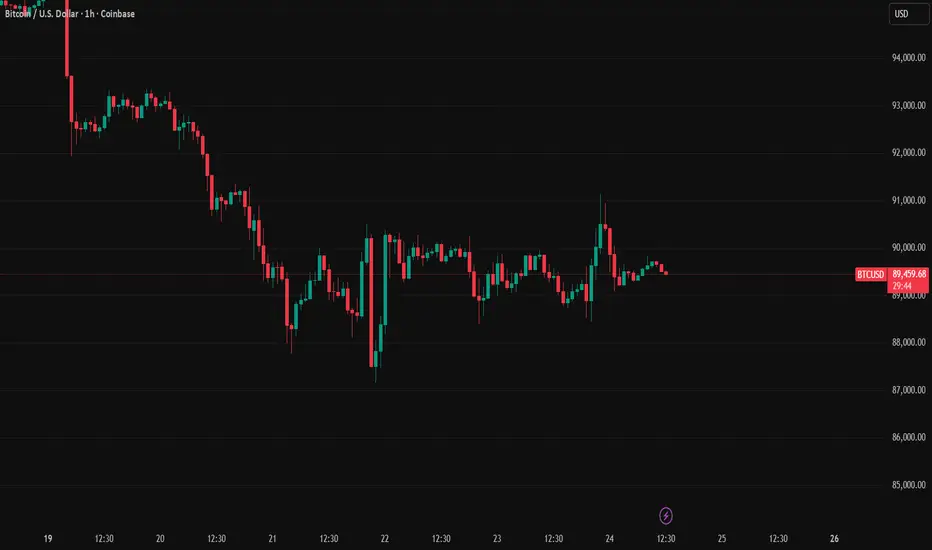
Why trying to catch tops & bottoms destroys accounts
Most accounts don’t blow up from “bad strategy.”
They blow up from one addictive behavior: forcing a reversal when the market has not granted reversal permission.
A reversal is not a candle pattern.
A reversal is a regime change — structure, participation, and liquidity behavior must all rotate together.
1) The trap: “It fell a lot, so it must bounce”
After a strong impulsive move, your brain starts doing dangerous math:
“It already dumped, downside is limited.”
“This is a discount.”
“I’ll catch the bottom with a tight SL.”
“Just one bounce and I’m back.”
That thinking is not analysis.
That is recovery psychology wearing a technical mask.
And the market punishes it because in a real downtrend, bounces are often just liquidation relief, not reversal.
2) What this chart is actually saying (not what you want it to say)
Look at the execution readouts on the BTCUSD 1H chart:

Context Board (right):
Direction: Bearish
H1 / H4 / Daily: Bearish
Momentum: BEAR
Liquidity Context: LOW
Long Score: 10 (No-Trade)
LTF Exec: WEAK
Qualification Gate (top):
SETUP: WAIT
LIQUIDITY: LOW
ENTRY PERMISSION: SKIP
EDC (bottom-right):
SETUP: WAIT
ENTRY PERMISSION: SKIP
LIQUIDITY: LOW
ACTION STATE: HOLD
This is not a “find the bottom” environment.
This is the system telling you: the market is not offering clean participation, and long attempts are structurally unsupported.
3) Why reversals fail here (the mechanics)
In bearish conditions with low liquidity:
Price bounces easily (because thin liquidity lets it lift)
Traders confuse bounce with reversal and enter early
The next sell wave hits (often a liquidity sweep / reloading)
Price drops back into the range
Your “tight SL” becomes a guaranteed stop-out machine
You re-enter to “get it right” → the real damage begins
The trap is not one loss.
The trap is repeat exposure inside a non-permission regime.
4) The hidden killer: “Bottom hunting” creates the worst R:R in reality
On paper, catching bottoms looks like high reward.
In practice, it produces:
Low hit-rate entries
Chop + wick environment
Stop clusters hunted repeatedly
Emotional re-entry loops
Over-leverage temptation (“If I nail this bottom, it’s huge”)
So even if you’re “right” once, the account is often already damaged by the attempts.
5) The professional rule: reversals are earned, not predicted
A valid reversal is when the market proves three things:
A) Structure shift
Break of the bearish sequence (lower highs / lower lows)
A reclaim that holds, not just taps
B) Liquidity behavior changes
Sweeps stop occurring “against you”
Liquidity stops being LOW; participation becomes consistent
C) Participation confirms
Momentum stops bleeding
Follow-through appears after the shift, not before it
Until these are aligned, a “reversal” is just a pullback inside continuation.
6) The Reversal Permission Checklist (use this before touching tops/bottoms)
A reversal attempt is only rational when most of these are true:
HTF context is neutralizing (bearish pressure reducing, not accelerating)
Liquidity is not LOW (no thin, stop-hunt conditions)
Momentum stops being BEAR-dominant (chop resolves into directional intent)
Long side stops showing “No-Trade” quality
Entry permission is not SKIP
LTF execution is not WEAK (execution conditions matter as much as direction)
If the dashboard says WAIT / SKIP / LOW, your job is not to be clever.
Your job is to protect capital and wait for permission.
7) The clean takeaway
Tops & bottoms are where ego trades.
Professionals don’t “guess” turning points — they trade after the market proves it has turned.
If you want longevity:
Stop trying to be first.
Start trying to be right with permission.
Catching a reversal is not a skill.
Avoiding the reversal trap is the skill.
#BTC #BTCUSD #Bitcoin #CryptoTrading #TradingPsychology #RiskManagement #Execution #NoTradeZone #MarketStructure #Liquidity #StopLossDiscipline #Overtrading #FOMO #ReversalTrap #TrendFollowing #CapitalPreservation #TradeManagement #PriceAction #Volatility #Discipline
Educational content only. Not financial advice. Markets involve risk; use your own risk management and decision process.
Most accounts don’t blow up from “bad strategy.”
They blow up from one addictive behavior: forcing a reversal when the market has not granted reversal permission.
A reversal is not a candle pattern.
A reversal is a regime change — structure, participation, and liquidity behavior must all rotate together.
1) The trap: “It fell a lot, so it must bounce”
After a strong impulsive move, your brain starts doing dangerous math:
“It already dumped, downside is limited.”
“This is a discount.”
“I’ll catch the bottom with a tight SL.”
“Just one bounce and I’m back.”
That thinking is not analysis.
That is recovery psychology wearing a technical mask.
And the market punishes it because in a real downtrend, bounces are often just liquidation relief, not reversal.
2) What this chart is actually saying (not what you want it to say)
Look at the execution readouts on the BTCUSD 1H chart:
Context Board (right):
Direction: Bearish
H1 / H4 / Daily: Bearish
Momentum: BEAR
Liquidity Context: LOW
Long Score: 10 (No-Trade)
LTF Exec: WEAK
Qualification Gate (top):
SETUP: WAIT
LIQUIDITY: LOW
ENTRY PERMISSION: SKIP
EDC (bottom-right):
SETUP: WAIT
ENTRY PERMISSION: SKIP
LIQUIDITY: LOW
ACTION STATE: HOLD
This is not a “find the bottom” environment.
This is the system telling you: the market is not offering clean participation, and long attempts are structurally unsupported.
3) Why reversals fail here (the mechanics)
In bearish conditions with low liquidity:
Price bounces easily (because thin liquidity lets it lift)
Traders confuse bounce with reversal and enter early
The next sell wave hits (often a liquidity sweep / reloading)
Price drops back into the range
Your “tight SL” becomes a guaranteed stop-out machine
You re-enter to “get it right” → the real damage begins
The trap is not one loss.
The trap is repeat exposure inside a non-permission regime.
4) The hidden killer: “Bottom hunting” creates the worst R:R in reality
On paper, catching bottoms looks like high reward.
In practice, it produces:
Low hit-rate entries
Chop + wick environment
Stop clusters hunted repeatedly
Emotional re-entry loops
Over-leverage temptation (“If I nail this bottom, it’s huge”)
So even if you’re “right” once, the account is often already damaged by the attempts.
5) The professional rule: reversals are earned, not predicted
A valid reversal is when the market proves three things:
A) Structure shift
Break of the bearish sequence (lower highs / lower lows)
A reclaim that holds, not just taps
B) Liquidity behavior changes
Sweeps stop occurring “against you”
Liquidity stops being LOW; participation becomes consistent
C) Participation confirms
Momentum stops bleeding
Follow-through appears after the shift, not before it
Until these are aligned, a “reversal” is just a pullback inside continuation.
6) The Reversal Permission Checklist (use this before touching tops/bottoms)
A reversal attempt is only rational when most of these are true:
HTF context is neutralizing (bearish pressure reducing, not accelerating)
Liquidity is not LOW (no thin, stop-hunt conditions)
Momentum stops being BEAR-dominant (chop resolves into directional intent)
Long side stops showing “No-Trade” quality
Entry permission is not SKIP
LTF execution is not WEAK (execution conditions matter as much as direction)
If the dashboard says WAIT / SKIP / LOW, your job is not to be clever.
Your job is to protect capital and wait for permission.
7) The clean takeaway
Tops & bottoms are where ego trades.
Professionals don’t “guess” turning points — they trade after the market proves it has turned.
If you want longevity:
Stop trying to be first.
Start trying to be right with permission.
Catching a reversal is not a skill.
Avoiding the reversal trap is the skill.
#BTC #BTCUSD #Bitcoin #CryptoTrading #TradingPsychology #RiskManagement #Execution #NoTradeZone #MarketStructure #Liquidity #StopLossDiscipline #Overtrading #FOMO #ReversalTrap #TrendFollowing #CapitalPreservation #TradeManagement #PriceAction #Volatility #Discipline
Educational content only. Not financial advice. Markets involve risk; use your own risk management and decision process.

MARAL Execution Workflow, Long & Short Permission , Dynamic risk mapper & Deep Candle Intelligence
Context → Liquidity Event → Displacement → Structure Shift → POI Confirmation → Risk Clearance (Discretionary | Educational)
Context → Liquidity Event → Displacement → Structure Shift → POI Confirmation → Risk Clearance (Discretionary | Educational)
Related publications
Disclaimer
The information and publications are not meant to be, and do not constitute, financial, investment, trading, or other types of advice or recommendations supplied or endorsed by TradingView. Read more in the Terms of Use.
MARAL Execution Workflow, Long & Short Permission , Dynamic risk mapper & Deep Candle Intelligence
Context → Liquidity Event → Displacement → Structure Shift → POI Confirmation → Risk Clearance (Discretionary | Educational)
Context → Liquidity Event → Displacement → Structure Shift → POI Confirmation → Risk Clearance (Discretionary | Educational)
Related publications
Disclaimer
The information and publications are not meant to be, and do not constitute, financial, investment, trading, or other types of advice or recommendations supplied or endorsed by TradingView. Read more in the Terms of Use.