
Difficulty: 🐳🐳🐳🐳🐋 (Advanced)
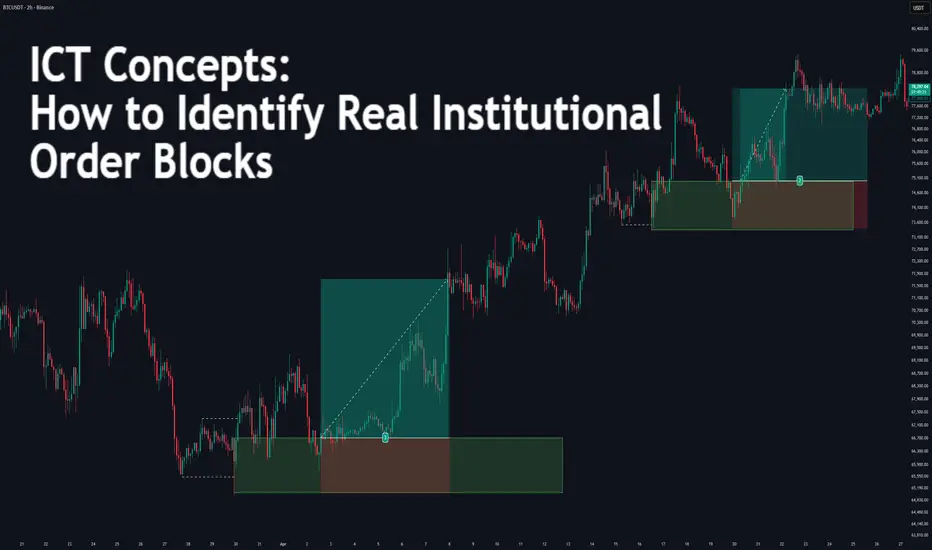
Most traders see a "red candle" and think sell. ICT traders see a "red candle" before a rally and see an Institutional Footprint. In this guide, you will learn to identify the Order Block—the zone where the "Big Fish" leave their orders behind.

🔵 WHAT IS AN ORDER BLOCK (OB)?
In the ICT (Inner Circle Trader) world, an Order Block is a specific candle where high-frequency institutional algorithms have neutralized liquidity and sponsored a new directional price swing.
It isn't just "supply or demand." It is a change in state of delivery. When institutions buy, they first need to clear out the "weak hands" (retail stops).
By reading Order Blocks, traders can:
Price is the movement, but the Order Block is the source.
🔵 THE ANATOMY OF A VALID BULLISH OB
For an Order Block to be high-probability, it must have Institutional Sponsorship. Don't just trade every opposite-colored candle. Look for these three pillars:

If there is no Displacement, there is no Institutional Sponsorship.
🔵 THE MEAN THRESHOLD (THE LINE IN THE SAND)
The most sensitive part of an Order Block isn't just the high or low; it is the Mean Threshold (50% level).

🔵 HOW TO TRADE THE ORDER BLOCK
We do not "market buy" when we see a big move. We wait for the Return to Order Block (RTO).
Step-by-Step Execution:


🔵 THE MITIGATION PROCESS
Think of price coming back to an Order Block like a ship returning to port to pick up the rest of its cargo. The institutions couldn't fill their entire position on the first move—they left "limit orders" waiting. When price returns, those orders are triggered, and the move continues.
🔵 QUICK CHECKLIST FOR HIGH-PROBABILITY OBs
🔵 CONCLUSION
Order Blocks are the footprints of the "Smart Money." By focusing on where the displacement starts, you stop guessing where support is and start seeing where the market is actually being forced to move.
If you need more clarity in your execution and want to make decisions easy, stop looking at every candle and start looking for the origin of the impulse.
Are you waiting for the "Return to Order Block" or do you find yourself chasing the green candles? Let's discuss your entry style below!
Most traders see a "red candle" and think sell. ICT traders see a "red candle" before a rally and see an Institutional Footprint. In this guide, you will learn to identify the Order Block—the zone where the "Big Fish" leave their orders behind.
🔵 WHAT IS AN ORDER BLOCK (OB)?
In the ICT (Inner Circle Trader) world, an Order Block is a specific candle where high-frequency institutional algorithms have neutralized liquidity and sponsored a new directional price swing.
It isn't just "supply or demand." It is a change in state of delivery. When institutions buy, they first need to clear out the "weak hands" (retail stops).
By reading Order Blocks, traders can:
- Enter trades at the "Wholesale" price
- Identify where banks are protecting their average entry
- Avoid chasing price after the move has already started
Price is the movement, but the Order Block is the source.
🔵 THE ANATOMY OF A VALID BULLISH OB
For an Order Block to be high-probability, it must have Institutional Sponsorship. Don't just trade every opposite-colored candle. Look for these three pillars:
- The Liquidity Purge: The candle must sweep the liquidity of an "Old Low" or "Equal Lows" first.
- Displacement: Price must leave the candle with speed and power, leaving behind Fair Value Gaps (FVG).
- Market Structure Shift (MSS): The impulsive move must break a previous short-term high.
If there is no Displacement, there is no Institutional Sponsorship.
🔵 THE MEAN THRESHOLD (THE LINE IN THE SAND)
The most sensitive part of an Order Block isn't just the high or low; it is the Mean Threshold (50% level).
- The Logic: Institutions will protect the midpoint of their buying/selling zone.
- The Rule: If a candle body closes below the 50% mark of a Bullish OB, the block is likely failing.
- The Reaction: We want to see price wick into the Mean Threshold and reject sharply.
🔵 HOW TO TRADE THE ORDER BLOCK
We do not "market buy" when we see a big move. We wait for the Return to Order Block (RTO).
Step-by-Step Execution:
- Wait for the Break: Price clears a high with displacement.
- Mark the Zone: Highlight the last down-close candle (the OB) before that move.
- Set the Limit: Place your entry at the High or the Mean Threshold of the OB.
- Stop Loss: Placed safely below the low of the Order Block candle.
🔵 THE MITIGATION PROCESS
Think of price coming back to an Order Block like a ship returning to port to pick up the rest of its cargo. The institutions couldn't fill their entire position on the first move—they left "limit orders" waiting. When price returns, those orders are triggered, and the move continues.
🔵 QUICK CHECKLIST FOR HIGH-PROBABILITY OBs
- Does the OB align with a Higher Timeframe (HTF) level?
- Did the move away from the OB create a Fair Value Gap?
- Is the OB "fresh" (unmitigated)?
🔵 CONCLUSION
Order Blocks are the footprints of the "Smart Money." By focusing on where the displacement starts, you stop guessing where support is and start seeing where the market is actually being forced to move.
If you need more clarity in your execution and want to make decisions easy, stop looking at every candle and start looking for the origin of the impulse.
Are you waiting for the "Return to Order Block" or do you find yourself chasing the green candles? Let's discuss your entry style below!

🔵Gain access to our powerful tools : bigbeluga.com/tv
🔵Join our free discord for updates : discord.com/invite/FuW63RKgdc
All scripts & content provided by BigBeluga are for informational & educational purposes only.
🔵Join our free discord for updates : discord.com/invite/FuW63RKgdc
All scripts & content provided by BigBeluga are for informational & educational purposes only.
Disclaimer
The information and publications are not meant to be, and do not constitute, financial, investment, trading, or other types of advice or recommendations supplied or endorsed by TradingView. Read more in the Terms of Use.
🔵Gain access to our powerful tools : bigbeluga.com/tv
🔵Join our free discord for updates : discord.com/invite/FuW63RKgdc
All scripts & content provided by BigBeluga are for informational & educational purposes only.
🔵Join our free discord for updates : discord.com/invite/FuW63RKgdc
All scripts & content provided by BigBeluga are for informational & educational purposes only.
Disclaimer
The information and publications are not meant to be, and do not constitute, financial, investment, trading, or other types of advice or recommendations supplied or endorsed by TradingView. Read more in the Terms of Use.