
Intro
1. Treasury income collapsed
2. Future ECL provisioning could affect capital
3. Loans are growing faster than deposits
4. Profit-booking after the results announcement
5. Technical weakness and mixed brokerage views
Brokerages are divided:
What should investors watch now?
Verdict
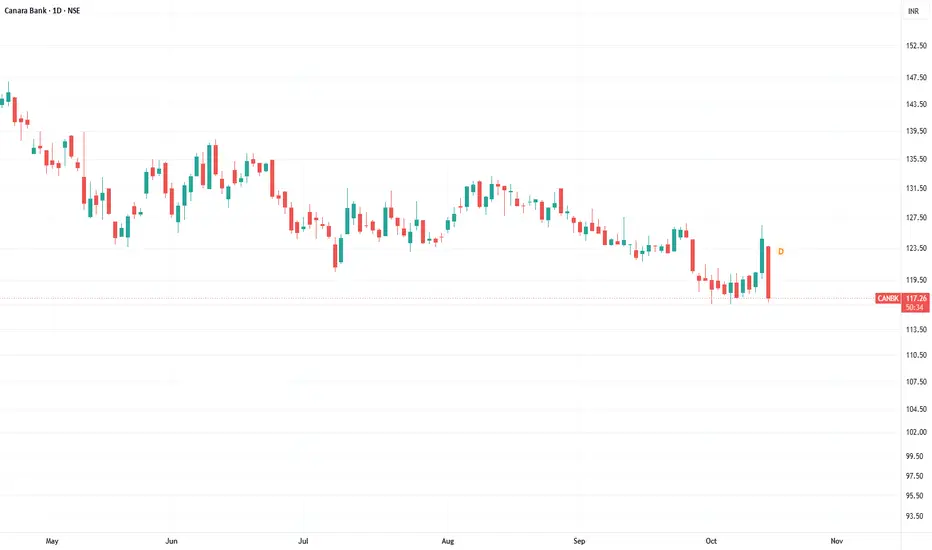
- Canara Bank fell sharply on 15 October 2026 despite reporting good Q2 FY27 results because investors were focused on the quality of earnings, future provisioning costs and deposit growth—not just net profit.
- The stock had fallen as much as 6.5–7% in morning trade. A timestamped quote at 12:58 p.m. showed it at ₹118.10, down 5.34%, after touching an intraday low of ₹116.71.
1. Treasury income collapsed
- Treasury income fell to ₹499 crore from ₹1,583 crore a year ago.
- Rising bond yields caused mark-to-market losses on investments.
- Overall non-interest income declined around 18% YoY, while operating profit increased by only about 2%.
- This is the most important explanation for why strong core interest income did not translate into faster overall profit growth.
2. Future ECL provisioning could affect capital
- Analysts have raised concerns about the estimated additional provisions required for the transition to the Expected Credit Loss (ECL) framework.
- Estimates cited by brokerages increased to ₹12,000–₹15,000 crore, from an earlier ₹10,000–₹12,000 crore range.
- The estimated impact on capital adequacy could be around 1.0–1.2 percentage points, depending on implementation and the final provisioning requirement.
- This is a future-transition risk, not a provision that should be assumed to have been charged in full this quarter.
3. Loans are growing faster than deposits
- Global advances grew approximately 19.5% YoY.
- Global deposits grew approximately 13.1% YoY.
- The gap raises questions about how efficiently the bank can attract deposits to fund continued lending growth.
- CASA deposit growth and the cost of acquiring deposits will be important to future margins.
4. Profit-booking after the results announcement
- Canara Bank shares rose approximately 3.9–4% on 14 October after the results, then reversed sharply the next day.
- Heavy selling and a rise in volume suggest that some traders booked profits after the initial positive reaction.
- This is consistent with a “sell the news” reaction, although it cannot explain every transaction or establish one single cause.
5. Technical weakness and mixed brokerage views
- The stock traded close to its recent 52-week low of approximately ₹116.55.
- The PSU Bank index was also weak during the morning, although the broader Nifty 50 was positive.
- This points to both stock-specific selling and sector pressure.
Brokerages are divided:
- Morgan Stanley maintained an Underweight rating with a ₹109 target
- While Motilal Oswal and JM Financial were positive, with targets of ₹160 and ₹150, respectively.
- These are analysts’ opinions, not assured price outcomes
What should investors watch now?
- ₹116.50–₹117: The immediate area to monitor because it is close to the reported intraday low and the recent 52-week low.
- A decisive breakdown could invite further technical selling.
- ₹123–₹125: The first recovery zone to watch, based on the opening and previous closing prices.
- A sustained recovery above this region would indicate improving near-term sentiment, but would not by itself confirm a trend reversal.
- Future results: Watch treasury income, net interest margin, deposit growth, ECL implementation and capital adequacy.
Verdict
- The fall does not automatically invalidate Canara Bank’s improving asset quality or strong NII growth.
- However, treasury-income volatility, the expected ECL transition impact and slower deposit growth explain why investors may be unwilling to reward the headline profit increase immediately.
- Existing investors should evaluate their original investment thesis, risk tolerance and the bank’s ability to sustain earnings.
- New investors should avoid assuming that a sharp fall makes the stock automatically cheap; confirmation from price action and clarity on future provisioning would provide a stronger basis for a decision.

Disclaimer
The information and publications are not meant to be, and do not constitute, financial, investment, trading, or other types of advice or recommendations supplied or endorsed by TradingView. Read more in the Terms of Use.
Disclaimer
The information and publications are not meant to be, and do not constitute, financial, investment, trading, or other types of advice or recommendations supplied or endorsed by TradingView. Read more in the Terms of Use.