
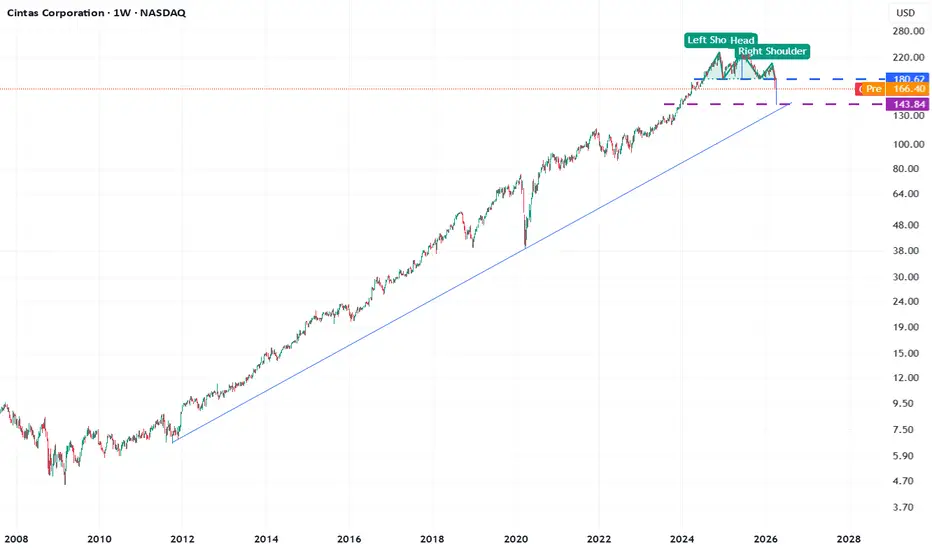
Bearish already breaking down
Looks like support is back at H&S target and long term up trendline
Reasons to be bearish
1. Premium valuation (biggest risk)
CTAS trades at ~34–42x earnings, well above market averages.
Metrics like:
Price-to-book ~13x
EV/Sales ~6x (vs ~2x sector)
➡️ This means:
The stock is priced for near-perfect execution
Any disappointment → sharp downside
2. Growth expectations already “priced in”
Analysts expect steady growth (~8–11% revenue/EPS).
➡️ Risk:
If growth slows even slightly → valuation compresses
Hard to outperform when expectations are already high
3. Earnings sensitivity (near-term catalyst risk)
Stock is currently under scrutiny due to recent earnings releases and guidance updates.
➡️ If:
margins slip
guidance weakens
→ stock likely reacts negatively
4. Cyclical exposure to business activity
Cintas provides uniforms, cleaning, and workplace services.
➡️ Highly linked to:
employment levels
business activity
hospitality / airlines / industrial demand
If the economy slows → demand drops.
5. Evidence of “lumpy” revenue segments
Uniform direct sales have already shown declines and unpredictability.
➡️ This segment:
can swing results unexpectedly
has previously triggered sharp stock drops (~10%)
6. Pricing power may weaken
Management has warned price increases are getting harder as inflation falls.
➡️ Risk:
Slower pricing growth → margin pressure
7. M&A execution risk (UniFirst deal)
Ongoing attempts to acquire UniFirst.
➡️ Risks:
Overpaying
integration issues
deal falling through → wasted time / costs
8. Slower organic growth vs valuation
Business is stable but not high-growth (~single-digit revenue growth).
➡️ Mismatch:
“steady business” vs “growth stock valuation”
9. Margin pressure from costs
Labour, logistics, and materials costs matter heavily in service businesses
➡️ If costs rise faster than pricing → margins shrink
10. Low dividend yield (less downside support)
Yield is ~0.9–1%
➡️ Investors aren’t paid much to hold during downturns
→ easier for money to rotate out
Bottom line (what matters most for CTAS)
The biggest downside drivers are:
Overvaluation vs moderate growth
Sensitivity to earnings / guidance
Exposure to economic slowdown
Weakening pricing power
Looks like support is back at H&S target and long term up trendline
Reasons to be bearish
1. Premium valuation (biggest risk)
CTAS trades at ~34–42x earnings, well above market averages.
Metrics like:
Price-to-book ~13x
EV/Sales ~6x (vs ~2x sector)
➡️ This means:
The stock is priced for near-perfect execution
Any disappointment → sharp downside
2. Growth expectations already “priced in”
Analysts expect steady growth (~8–11% revenue/EPS).
➡️ Risk:
If growth slows even slightly → valuation compresses
Hard to outperform when expectations are already high
3. Earnings sensitivity (near-term catalyst risk)
Stock is currently under scrutiny due to recent earnings releases and guidance updates.
➡️ If:
margins slip
guidance weakens
→ stock likely reacts negatively
4. Cyclical exposure to business activity
Cintas provides uniforms, cleaning, and workplace services.
➡️ Highly linked to:
employment levels
business activity
hospitality / airlines / industrial demand
If the economy slows → demand drops.
5. Evidence of “lumpy” revenue segments
Uniform direct sales have already shown declines and unpredictability.
➡️ This segment:
can swing results unexpectedly
has previously triggered sharp stock drops (~10%)
6. Pricing power may weaken
Management has warned price increases are getting harder as inflation falls.
➡️ Risk:
Slower pricing growth → margin pressure
7. M&A execution risk (UniFirst deal)
Ongoing attempts to acquire UniFirst.
➡️ Risks:
Overpaying
integration issues
deal falling through → wasted time / costs
8. Slower organic growth vs valuation
Business is stable but not high-growth (~single-digit revenue growth).
➡️ Mismatch:
“steady business” vs “growth stock valuation”
9. Margin pressure from costs
Labour, logistics, and materials costs matter heavily in service businesses
➡️ If costs rise faster than pricing → margins shrink
10. Low dividend yield (less downside support)
Yield is ~0.9–1%
➡️ Investors aren’t paid much to hold during downturns
→ easier for money to rotate out
Bottom line (what matters most for CTAS)
The biggest downside drivers are:
Overvaluation vs moderate growth
Sensitivity to earnings / guidance
Exposure to economic slowdown
Weakening pricing power

Disclaimer
The information and publications are not meant to be, and do not constitute, financial, investment, trading, or other types of advice or recommendations supplied or endorsed by TradingView. Read more in the Terms of Use.
Disclaimer
The information and publications are not meant to be, and do not constitute, financial, investment, trading, or other types of advice or recommendations supplied or endorsed by TradingView. Read more in the Terms of Use.