
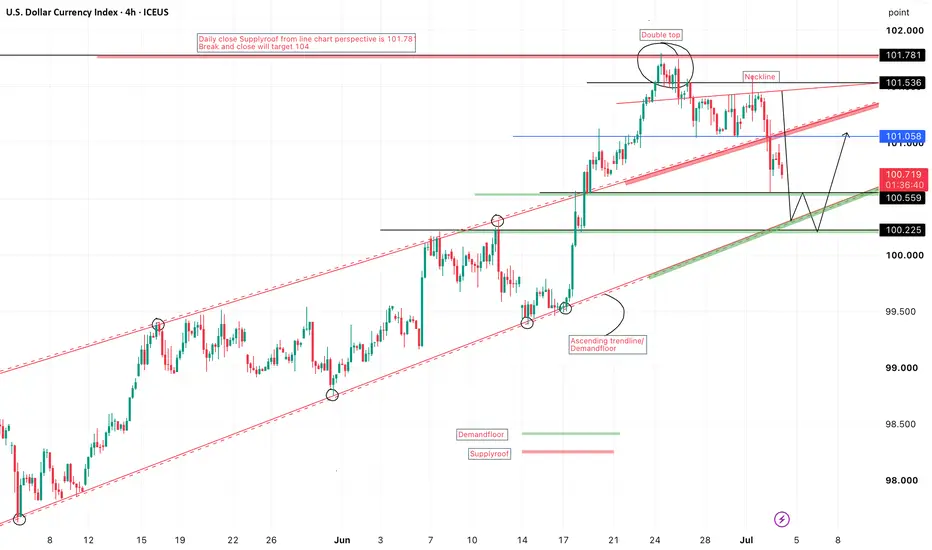
Dollar What is DXY?
The DXY (or USDX) measures the value of the US Dollar (USD) against a weighted basket of six major currencies:
• Euro (EUR) ~57.6%
• Japanese Yen (JPY) ~13.6%
• British Pound (GBP) ~11.9%
• Canadian Dollar (CAD) ~9.1%
• Swedish Krona (SEK) ~4.2%
• Swiss Franc (CHF) ~3.6%
A rising DXY = stronger USD. A falling DXY = weaker USD. Current levels are around 100.8–101 (as of early July 2026). 
How DXY Affects Gold (XAU/USD)
Gold and DXY have a strong negative (inverse) correlation — typically between -0.5 and -0.8 historically. 
• Stronger USD (↑ DXY) → Lower gold prices: Gold is priced in USD. A stronger dollar makes gold more expensive for buyers using other currencies, reducing demand and pressuring prices down.
• Weaker USD (↓ DXY) → Higher gold prices: Gold becomes cheaper for international buyers, boosting demand. Gold also acts as a hedge against dollar weakness.
Exceptions: During extreme crises (e.g., major geopolitical events or simultaneous safe-haven flows), both can sometimes rise together temporarily. 
How DXY Affects Other Currency Pairs (“Other Pairs”)
Since DXY tracks the USD’s strength, it has a direct impact on most USD-based forex pairs:
• Negative correlation pairs (DXY up → pair down):
• EUR/USD: Heavily weighted in DXY — strong inverse link.
• GBP/USD, AUD/USD, NZD/USD, etc. (commodity currencies often move with risk sentiment too).
• Positive correlation pairs (DXY up → pair up):
• USD/JPY, USD/CHF, USD/CAD (these strengthen when USD does).
Practical trading tip: If DXY is breaking higher, expect downward pressure on EUR/USD, GBP/USD, and gold.
#DXY

Disclaimer
The information and publications are not meant to be, and do not constitute, financial, investment, trading, or other types of advice or recommendations supplied or endorsed by TradingView. Read more in the Terms of Use.
Disclaimer
The information and publications are not meant to be, and do not constitute, financial, investment, trading, or other types of advice or recommendations supplied or endorsed by TradingView. Read more in the Terms of Use.