
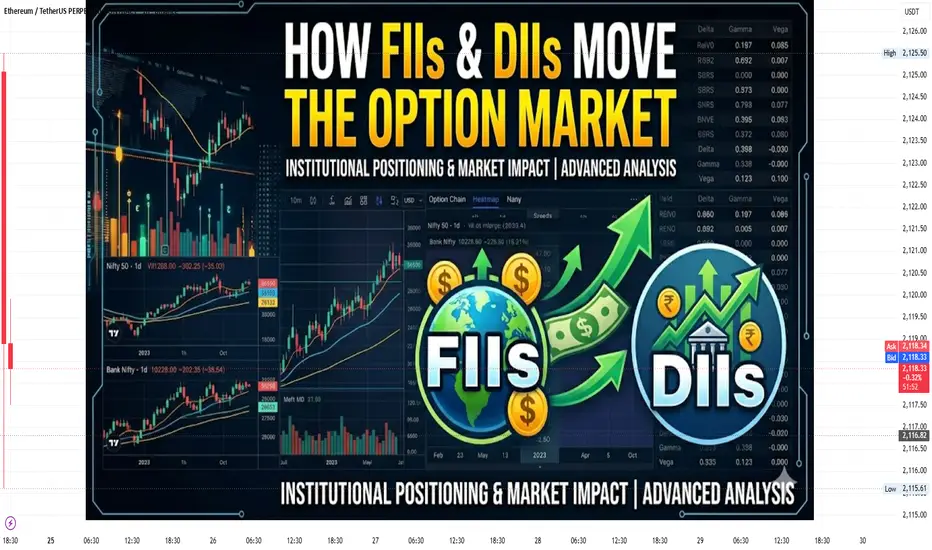
How FIIs & DIIs Move the Option Market
Institutional Positioning and Market Impact
Introduction
In the Indian stock market, institutional participants play a major role in deciding short-term momentum, volatility, and overall market direction. Among them, Foreign Institutional Investors (FIIs) and Domestic Institutional Investors (DIIs) are considered the biggest market-moving forces.
Their activity in the futures and options (F&O) segment directly impacts:
Index movement
Option premiums
Volatility expansion
Intraday trends
Market sentiment
Understanding how FIIs and DIIs position themselves in the option market can help traders identify smart money direction and improve trade quality.
Who Are FIIs and DIIs?
Foreign Institutional Investors (FIIs)
FIIs are foreign entities that invest money in Indian financial markets. These include:
Hedge funds
Global banks
Pension funds
Foreign asset management companies
FIIs usually trade with very large capital and dominate index derivatives like NIFTY and BANKNIFTY.
Key Characteristics:
High impact on index movement
Aggressive in futures trading
Major drivers of volatility
Influence short-term market direction
Domestic Institutional Investors (DIIs)
DIIs are Indian financial institutions investing within the domestic market.
These include:
Mutual funds
Insurance companies
Indian banks
Domestic asset managers
DIIs generally provide stability to the market and often counterbalance FII selling pressure.
Key Characteristics:
Long-term investment approach
Lower aggressive derivatives exposure
Strong cash market participation
Support during market corrections
Why Institutional Activity Matters in Options Trading
Retail traders mostly react to price movement, while institutions often create the movement.
FIIs and DIIs influence:
Option chain structure
Put and Call writing zones
Implied volatility (IV)
Market liquidity
Breakout and breakdown strength
When institutions build large positions, the market usually respects those levels.
How FIIs Move the Option Market
1. Heavy Index Futures Positioning
FIIs actively trade index futures to control directional movement.
Example:
Large long futures positions → bullish momentum
Large short futures positions → bearish pressure
The option market reacts immediately to these positions through:
Rising Call premiums
Falling Put premiums
Increase in IV
2. Aggressive Call Writing
FIIs often create strong resistance zones through Call writing.
Impact:
Market faces selling pressure near resistance
Upside momentum slows down
Option sellers gain advantage
Large Call writing at a strike usually indicates institutional expectation that price may stay below that level.
3. Put Writing Creates Support
When institutions write large quantities of Puts, it often signals confidence in support levels.
Impact:
Market stabilizes above support
Premium decay benefits sellers
Buyers become trapped near support reversals
Put writing is one of the strongest indicators of bullish institutional positioning.
Understanding Institutional Option Chain Positioning
Option chain data helps traders identify where institutions are active.
Key Observations:
Highest Call OI
Indicates major resistance zone.
Highest Put OI
Indicates strong support zone.
OI Shift
Shows changing market expectations.
Long Build-Up
Price up + OI up = bullish positioning.
Short Build-Up
Price down + OI up = bearish positioning.
These patterns are heavily influenced by institutional money flow.
How DIIs Influence the Market
DIIs mostly impact the cash market, but their actions indirectly affect options.
During Market Panic:
When FIIs sell aggressively, DIIs often buy quality stocks.
Result:
Market stabilizes
Panic selling reduces
Volatility cools down
This creates temporary support zones where option sellers regain control.
Institutional Traps in the Option Market
Smart money often creates emotional traps for retail traders.
1. Fake Breakouts
Institutions push price slightly above resistance to attract buyers, then reverse the market.
Objective:
Trigger retail buying
Capture liquidity
Reverse for profit
2. Premium Expansion Traps
Before major news events:
IV rises sharply
Option premiums become expensive
After the event:
IV crush happens
Buyers lose premium value quickly
Institutions usually benefit from these volatility shifts.
Important Data Traders Should Track
FII/DII Data
Daily institutional buying and selling data provides insight into market sentiment.
Open Interest (OI)
Tracks fresh positioning in futures and options.
PCR (Put Call Ratio)
Helps understand bullish or bearish positioning.
PCR=
Total Call Open Interest
Total Put Open Interest
Interpretation:
High PCR → bullish sentiment
Low PCR → bearish sentiment
How Retail Traders Can Use Institutional Activity
Follow Smart Money, Not Emotions
Instead of predicting the market, traders should observe where institutions are positioning themselves.
Focus on:
OI changes
Put writing zones
Call unwinding
Futures data
Volatility movement
Institutional footprints often appear before major moves happen.
Risk Management Is Still Important
Even institutional analysis is not perfect.
Markets can react unexpectedly due to:
Global news
Economic events
RBI policies
Geopolitical tensions
Always use:
Stop-loss
Proper position sizing
Risk-to-reward planning
Institutional Positioning and Market Impact
Introduction
In the Indian stock market, institutional participants play a major role in deciding short-term momentum, volatility, and overall market direction. Among them, Foreign Institutional Investors (FIIs) and Domestic Institutional Investors (DIIs) are considered the biggest market-moving forces.
Their activity in the futures and options (F&O) segment directly impacts:
Index movement
Option premiums
Volatility expansion
Intraday trends
Market sentiment
Understanding how FIIs and DIIs position themselves in the option market can help traders identify smart money direction and improve trade quality.
Who Are FIIs and DIIs?
Foreign Institutional Investors (FIIs)
FIIs are foreign entities that invest money in Indian financial markets. These include:
Hedge funds
Global banks
Pension funds
Foreign asset management companies
FIIs usually trade with very large capital and dominate index derivatives like NIFTY and BANKNIFTY.
Key Characteristics:
High impact on index movement
Aggressive in futures trading
Major drivers of volatility
Influence short-term market direction
Domestic Institutional Investors (DIIs)
DIIs are Indian financial institutions investing within the domestic market.
These include:
Mutual funds
Insurance companies
Indian banks
Domestic asset managers
DIIs generally provide stability to the market and often counterbalance FII selling pressure.
Key Characteristics:
Long-term investment approach
Lower aggressive derivatives exposure
Strong cash market participation
Support during market corrections
Why Institutional Activity Matters in Options Trading
Retail traders mostly react to price movement, while institutions often create the movement.
FIIs and DIIs influence:
Option chain structure
Put and Call writing zones
Implied volatility (IV)
Market liquidity
Breakout and breakdown strength
When institutions build large positions, the market usually respects those levels.
How FIIs Move the Option Market
1. Heavy Index Futures Positioning
FIIs actively trade index futures to control directional movement.
Example:
Large long futures positions → bullish momentum
Large short futures positions → bearish pressure
The option market reacts immediately to these positions through:
Rising Call premiums
Falling Put premiums
Increase in IV
2. Aggressive Call Writing
FIIs often create strong resistance zones through Call writing.
Impact:
Market faces selling pressure near resistance
Upside momentum slows down
Option sellers gain advantage
Large Call writing at a strike usually indicates institutional expectation that price may stay below that level.
3. Put Writing Creates Support
When institutions write large quantities of Puts, it often signals confidence in support levels.
Impact:
Market stabilizes above support
Premium decay benefits sellers
Buyers become trapped near support reversals
Put writing is one of the strongest indicators of bullish institutional positioning.
Understanding Institutional Option Chain Positioning
Option chain data helps traders identify where institutions are active.
Key Observations:
Highest Call OI
Indicates major resistance zone.
Highest Put OI
Indicates strong support zone.
OI Shift
Shows changing market expectations.
Long Build-Up
Price up + OI up = bullish positioning.
Short Build-Up
Price down + OI up = bearish positioning.
These patterns are heavily influenced by institutional money flow.
How DIIs Influence the Market
DIIs mostly impact the cash market, but their actions indirectly affect options.
During Market Panic:
When FIIs sell aggressively, DIIs often buy quality stocks.
Result:
Market stabilizes
Panic selling reduces
Volatility cools down
This creates temporary support zones where option sellers regain control.
Institutional Traps in the Option Market
Smart money often creates emotional traps for retail traders.
1. Fake Breakouts
Institutions push price slightly above resistance to attract buyers, then reverse the market.
Objective:
Trigger retail buying
Capture liquidity
Reverse for profit
2. Premium Expansion Traps
Before major news events:
IV rises sharply
Option premiums become expensive
After the event:
IV crush happens
Buyers lose premium value quickly
Institutions usually benefit from these volatility shifts.
Important Data Traders Should Track
FII/DII Data
Daily institutional buying and selling data provides insight into market sentiment.
Open Interest (OI)
Tracks fresh positioning in futures and options.
PCR (Put Call Ratio)
Helps understand bullish or bearish positioning.
PCR=
Total Call Open Interest
Total Put Open Interest
Interpretation:
High PCR → bullish sentiment
Low PCR → bearish sentiment
How Retail Traders Can Use Institutional Activity
Follow Smart Money, Not Emotions
Instead of predicting the market, traders should observe where institutions are positioning themselves.
Focus on:
OI changes
Put writing zones
Call unwinding
Futures data
Volatility movement
Institutional footprints often appear before major moves happen.
Risk Management Is Still Important
Even institutional analysis is not perfect.
Markets can react unexpectedly due to:
Global news
Economic events
RBI policies
Geopolitical tensions
Always use:
Stop-loss
Proper position sizing
Risk-to-reward planning

Hye Guys,Welcome to a professional trading journey built on precision, discipline, and smart money concepts.
📞 Phone: +91 93159 78955
💬 WhatsApp: wa.link/kdkejz
📩 Contact Mail: globalwolfstreet@gmail.com
📞 Phone: +91 93159 78955
💬 WhatsApp: wa.link/kdkejz
📩 Contact Mail: globalwolfstreet@gmail.com
Related publications
Disclaimer
The information and publications are not meant to be, and do not constitute, financial, investment, trading, or other types of advice or recommendations supplied or endorsed by TradingView. Read more in the Terms of Use.
Hye Guys,Welcome to a professional trading journey built on precision, discipline, and smart money concepts.
📞 Phone: +91 93159 78955
💬 WhatsApp: wa.link/kdkejz
📩 Contact Mail: globalwolfstreet@gmail.com
📞 Phone: +91 93159 78955
💬 WhatsApp: wa.link/kdkejz
📩 Contact Mail: globalwolfstreet@gmail.com
Related publications
Disclaimer
The information and publications are not meant to be, and do not constitute, financial, investment, trading, or other types of advice or recommendations supplied or endorsed by TradingView. Read more in the Terms of Use.