

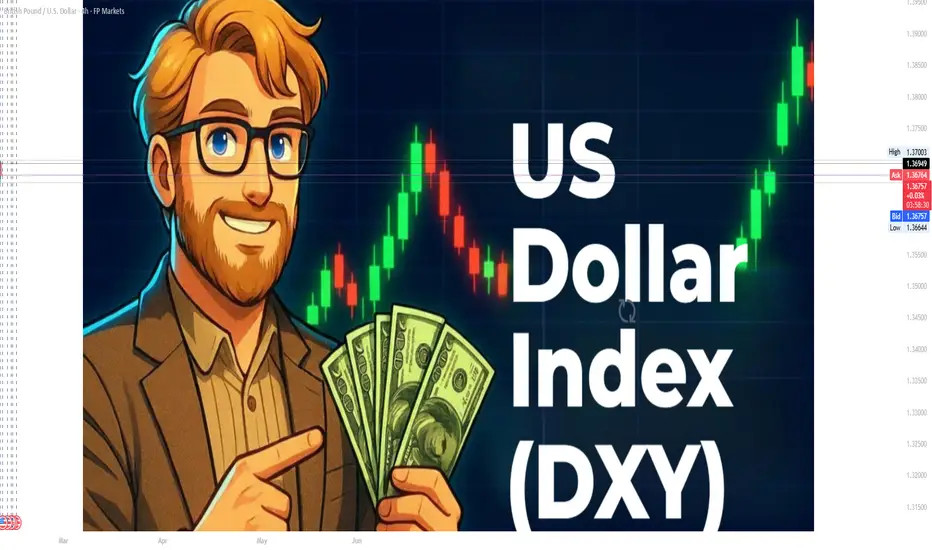
1. What is the US Dollar Index (DXY)?
The US Dollar Index (DXY) is a financial index that measures the strength or weakness of the US dollar (USD) relative to a basket of major global currencies.
It represents how the US dollar is performing in the international foreign exchange (forex) market.
The index helps traders, investors, policymakers, and economists track global confidence in the US dollar.
2. Origin and History of DXY
The US Dollar Index was introduced in 1973 by the Federal Reserve.
Its creation followed the collapse of the Bretton Woods system, when currencies moved from fixed exchange rates to floating rates.
Later, responsibility for the index shifted to ICE (Intercontinental Exchange), which now maintains and publishes it.
3. Base Value of the Index
The base value of DXY is 100.
A reading above 100 means the US dollar has strengthened compared to the base year.
A reading below 100 means the US dollar has weakened.
4. Currency Basket Composition
The DXY is calculated against six major currencies, each with a specific weight:
Euro (EUR) – ~57.6%
Japanese Yen (JPY) – ~13.6%
British Pound (GBP) – ~11.9%
Canadian Dollar (CAD) – ~9.1%
Swedish Krona (SEK) – ~4.2%
Swiss Franc (CHF) – ~3.6%
The Euro has the largest influence, meaning EUR/USD movements heavily impact DXY.
5. How DXY is Calculated
DXY is calculated using a geometric weighted average of the six currencies.
It uses exchange rates between the US dollar and each currency.
The formula gives more weight to currencies with larger trade relationships with the US.
6. What Does a Rising DXY Indicate?
A rising DXY indicates:
Strengthening US dollar
Increased global demand for USD
Capital flowing into US assets
Often reflects:
Higher US interest rates
Strong US economic data
Global risk aversion (safe-haven demand)
7. What Does a Falling DXY Indicate?
A falling DXY indicates:
Weakening US dollar
Reduced demand for USD
Capital moving out of US assets
Often reflects:
Lower interest rates
Expansive monetary policy
Improved global risk sentiment
8. Relationship Between DXY and Interest Rates
DXY is strongly influenced by US interest rates, especially Federal Reserve policy.
Higher interest rates:
Attract foreign investment
Strengthen USD
Push DXY upward
Lower interest rates:
Reduce yield advantage
Weaken USD
Push DXY downward
9. Role of the Federal Reserve
The Federal Reserve (Fed) plays a critical role in DXY movement.
Key Fed tools affecting DXY:
Interest rate decisions
Quantitative easing (QE)
Quantitative tightening (QT)
Forward guidance
Hawkish Fed → Stronger DXY
Dovish Fed → Weaker DXY
10. DXY as a Global Risk Indicator
DXY often behaves as a safe-haven indicator.
During global crises:
Investors rush to USD
DXY rises sharply
During risk-on environments:
Investors seek higher returns elsewhere
DXY weakens
11. Impact of DXY on Commodities
Most global commodities are priced in USD.
Relationship:
Strong DXY → Commodities become expensive → Prices fall
Weak DXY → Commodities cheaper → Prices rise
Strong inverse correlation with:
Gold
Silver
Crude oil
12. Relationship Between DXY and Gold
Gold and DXY usually move in opposite directions.
When DXY rises:
Gold becomes expensive in other currencies
Demand falls
When DXY falls:
Gold demand rises as hedge against USD weakness
13. Impact of DXY on Equity Markets
Strong DXY:
Hurts US exporters
Can pressure emerging market equities
Weak DXY:
Benefits multinational companies
Supports global equity markets
14. DXY and Emerging Markets
Emerging markets often have USD-denominated debt.
Strong DXY:
Debt servicing becomes expensive
Capital outflows from EMs
Weak DXY:
Eases financial pressure
Encourages capital inflows
15. DXY and Indian Markets
DXY has a major influence on:
INR exchange rate
FII flows
Crude oil prices
Rising DXY:
Rupee depreciation
FII selling pressure
Falling DXY:
Rupee appreciation
Improved liquidity for Indian equities
16. DXY in Forex Trading
DXY is widely used by forex traders as a directional bias tool.
If DXY is bullish:
USD pairs like USD/JPY, USD/INR tend to rise
If DXY is bearish:
Pairs like EUR/USD, GBP/USD tend to rise
17. DXY Technical Analysis
Traders analyze DXY using:
Support and resistance levels
Trendlines
Moving averages
RSI and MACD
Breakouts in DXY often lead to strong trends across global markets.
18. DXY Futures and Trading Instruments
DXY can be traded via:
Futures contracts (ICE Exchange)
ETFs like UUP
CFDs
Used for:
Hedging currency exposure
Speculative trading
19. Limitations of the DXY
Currency basket is Euro-heavy
Does not include:
Chinese Yuan
Indian Rupee
May not fully reflect modern global trade dynamics
20. DXY vs Broad Dollar Index
Broad Dollar Index includes currencies of:
China
Mexico
South Korea
DXY is narrower but more widely followed in markets
21. Long-Term Trends in DXY
DXY tends to move in long cycles:
Multi-year bull and bear phases
Driven by:
Interest rate cycles
Economic leadership
Global capital flows
22. Why DXY is Important for Traders and Investors
Acts as a global macro compass
Helps anticipate:
Commodity trends
Equity market movements
Currency volatility
Essential for:
Forex traders
Commodity traders
Equity investors
23. Summary
DXY is a powerful indicator of US dollar strength
Influences almost every global asset class
Reflects macroeconomic, monetary, and geopolitical trends
Understanding DXY helps investors make better cross-market decisions

Related publications
Disclaimer
The information and publications are not meant to be, and do not constitute, financial, investment, trading, or other types of advice or recommendations supplied or endorsed by TradingView. Read more in the Terms of Use.
Related publications
Disclaimer
The information and publications are not meant to be, and do not constitute, financial, investment, trading, or other types of advice or recommendations supplied or endorsed by TradingView. Read more in the Terms of Use.