
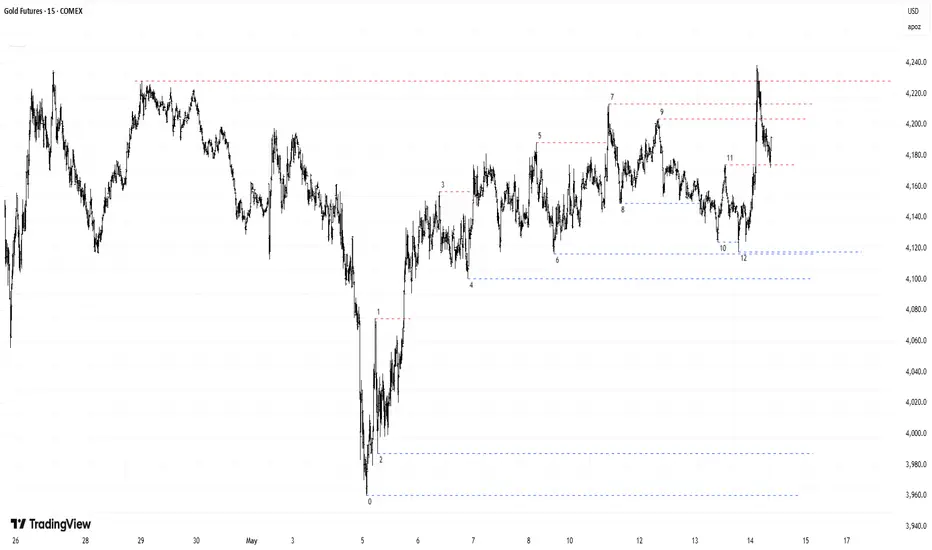
Ask them to remember much, and they won't.
This is not just intuition. Empirical research on market microstructure, specifically studies on price impact decay by Bouchaud and Potters at Capital Fund Management, shows that the price impact of any event follows a power-law decay function. The market processes each event and progressively resets toward equilibrium. Old levels do not command the market. They are simply forgotten.
A lot of traders treat the market like an elite historian with a flawless memory. They focus on what happened days, weeks, and months ago, drawing straight lines from old pivots, expecting the market to strictly obey them.
If they do this, it is not because they are delusional, it works, but there is a much more powerful way to structure markets.
Markets operate like a drunk person. If you ask a drunk person what they did three weeks ago, you will get a blank stare. But if you ask them what just happened five minutes ago, or what is hitting them in the face right now, they will react. Markets do the exact same thing.
Its memory is highly volatile, dynamic, and heavily weighted toward the present. Order flow follows live events and unfolding structure, instead of sitting static. The most powerful responses, the best opportunities, and the best trades will be tied to what is happening right now.
If you have 750 candles on your chart, you are likely using old information. Discard that. Focus on the present context. A simple approach to trading does not need multiple timeframes or levels coming from the age they invented Coca-Cola. If you look closely, your setup will most likely appear using way less information, but a much more powerful one.
The market does not remember much. Focus on the present structure.
This is not just intuition. Empirical research on market microstructure, specifically studies on price impact decay by Bouchaud and Potters at Capital Fund Management, shows that the price impact of any event follows a power-law decay function. The market processes each event and progressively resets toward equilibrium. Old levels do not command the market. They are simply forgotten.
A lot of traders treat the market like an elite historian with a flawless memory. They focus on what happened days, weeks, and months ago, drawing straight lines from old pivots, expecting the market to strictly obey them.
If they do this, it is not because they are delusional, it works, but there is a much more powerful way to structure markets.
Markets operate like a drunk person. If you ask a drunk person what they did three weeks ago, you will get a blank stare. But if you ask them what just happened five minutes ago, or what is hitting them in the face right now, they will react. Markets do the exact same thing.
Its memory is highly volatile, dynamic, and heavily weighted toward the present. Order flow follows live events and unfolding structure, instead of sitting static. The most powerful responses, the best opportunities, and the best trades will be tied to what is happening right now.
If you have 750 candles on your chart, you are likely using old information. Discard that. Focus on the present context. A simple approach to trading does not need multiple timeframes or levels coming from the age they invented Coca-Cola. If you look closely, your setup will most likely appear using way less information, but a much more powerful one.
The market does not remember much. Focus on the present structure.

Disclaimer
The information and publications are not meant to be, and do not constitute, financial, investment, trading, or other types of advice or recommendations supplied or endorsed by TradingView. Read more in the Terms of Use.
Disclaimer
The information and publications are not meant to be, and do not constitute, financial, investment, trading, or other types of advice or recommendations supplied or endorsed by TradingView. Read more in the Terms of Use.