
For more than two decades, the “yen carry trade” has been a discreet yet powerful pillar of global finance. This mechanism relies on borrowing at low cost in yen—thanks to the ultra-low rates set by the Bank of Japan (BoJ)—and investing those funds in higher-yielding foreign assets (equities, bonds, emerging markets, etc.). The logic was appealing: low financing costs + high returns = profit.
But estimating the size of this phenomenon is challenging. The transactions span loans, bonds, derivatives, and diverse institutions, and the data is fragmented. Depending on the source, the active global carry trade could represent a few hundred billion dollars (200–300 billion in a conservative estimate), while broader calculations including debt, funding structures, and derivative exposures point to volumes reaching 500–800 billion dollars, or even more in some assessments.
What makes it worrying is that this cheap-liquidity flow has functioned as a global engine for risk-asset investment, supporting equity markets, debt markets, and emerging economies that depended on capital “imported” through the yen.
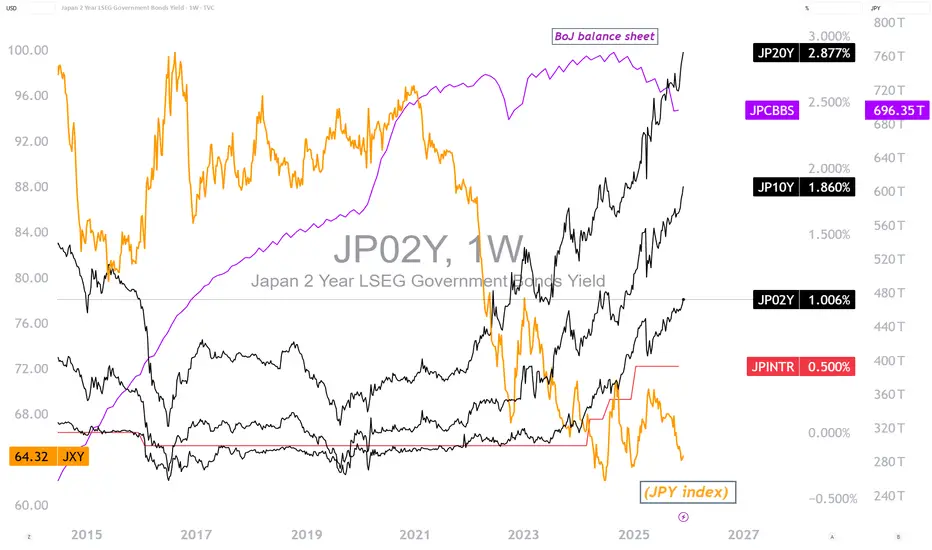
But this engine is fading. The BoJ has begun raising rates, and the yen has strengthened, increasing the cost of yen borrowing and reducing carry-trade margins. In this environment, many investors have already started unwinding their positions, as Japan’s bond yields have been rising sharply since 2024, as shown in the chart below.

A halt or significant slowdown of the carry trade can have several consequences: reduced flows toward risk assets, forced selling, volatility, tightening global liquidity, and higher financing costs for regions or actors dependent on foreign capital. If 300 to 500 billion dollars were to exit, it would represent a substantial withdrawal relative to typical investment flows, potentially triggering notable corrections in risk assets.
However, this scenario does not necessarily imply a “crash.” It is more of a global adjustment: normalization of funding conditions, redefinition of valuations, and possible market stabilization after the purge of the most fragile positions. Moreover, even though Japanese interest rates are rising, they remain significantly lower than U.S. or European rates.
In short: the yen carry trade has acted as a buffer—and even a stimulant—for global markets. Its unwinding signals a transition. It is a structural shift, not a systemic risk, because the amounts remain relatively contained. In any case, the future monetary policy of the Bank of Japan, especially the policy decision expected on Friday, December 19, will influence stock-market risk assets.
DISCLAIMER:
This content is intended for individuals who are familiar with financial markets and instruments and is for information purposes only. The presented idea (including market commentary, market data and observations) is not a work product of any research department of Swissquote or its affiliates. This material is intended to highlight market action and does not constitute investment, legal or tax advice. If you are a retail investor or lack experience in trading complex financial products, it is advisable to seek professional advice from licensed advisor before making any financial decisions.
This content is not intended to manipulate the market or encourage any specific financial behavior.
Swissquote makes no representation or warranty as to the quality, completeness, accuracy, comprehensiveness or non-infringement of such content. The views expressed are those of the consultant and are provided for educational purposes only. Any information provided relating to a product or market should not be construed as recommending an investment strategy or transaction. Past performance is not a guarantee of future results.
Swissquote and its employees and representatives shall in no event be held liable for any damages or losses arising directly or indirectly from decisions made on the basis of this content.
The use of any third-party brands or trademarks is for information only and does not imply endorsement by Swissquote, or that the trademark owner has authorised Swissquote to promote its products or services.
Swissquote is the marketing brand for the activities of Swissquote Bank Ltd (Switzerland) regulated by FINMA, Swissquote Capital Markets Limited regulated by CySEC (Cyprus), Swissquote Bank Europe SA (Luxembourg) regulated by the CSSF, Swissquote Ltd (UK) regulated by the FCA, Swissquote Financial Services (Malta) Ltd regulated by the Malta Financial Services Authority, Swissquote MEA Ltd. (UAE) regulated by the Dubai Financial Services Authority, Swissquote Pte Ltd (Singapore) regulated by the Monetary Authority of Singapore, Swissquote Asia Limited (Hong Kong) licensed by the Hong Kong Securities and Futures Commission (SFC) and Swissquote South Africa (Pty) Ltd supervised by the FSCA.
Products and services of Swissquote are only intended for those permitted to receive them under local law.
All investments carry a degree of risk. The risk of loss in trading or holding financial instruments can be substantial. The value of financial instruments, including but not limited to stocks, bonds, cryptocurrencies, and other assets, can fluctuate both upwards and downwards. There is a significant risk of financial loss when buying, selling, holding, staking, or investing in these instruments. SQBE makes no recommendations regarding any specific investment, transaction, or the use of any particular investment strategy.
CFDs are complex instruments and come with a high risk of losing money rapidly due to leverage. The vast majority of retail client accounts suffer capital losses when trading in CFDs. You should consider whether you understand how CFDs work and whether you can afford to take the high risk of losing your money.
Digital Assets are unregulated in most countries and consumer protection rules may not apply. As highly volatile speculative investments, Digital Assets are not suitable for investors without a high-risk tolerance. Make sure you understand each Digital Asset before you trade.
Cryptocurrencies are not considered legal tender in some jurisdictions and are subject to regulatory uncertainties.
The use of Internet-based systems can involve high risks, including, but not limited to, fraud, cyber-attacks, network and communication failures, as well as identity theft and phishing attacks related to crypto-assets.
But estimating the size of this phenomenon is challenging. The transactions span loans, bonds, derivatives, and diverse institutions, and the data is fragmented. Depending on the source, the active global carry trade could represent a few hundred billion dollars (200–300 billion in a conservative estimate), while broader calculations including debt, funding structures, and derivative exposures point to volumes reaching 500–800 billion dollars, or even more in some assessments.
What makes it worrying is that this cheap-liquidity flow has functioned as a global engine for risk-asset investment, supporting equity markets, debt markets, and emerging economies that depended on capital “imported” through the yen.
But this engine is fading. The BoJ has begun raising rates, and the yen has strengthened, increasing the cost of yen borrowing and reducing carry-trade margins. In this environment, many investors have already started unwinding their positions, as Japan’s bond yields have been rising sharply since 2024, as shown in the chart below.
A halt or significant slowdown of the carry trade can have several consequences: reduced flows toward risk assets, forced selling, volatility, tightening global liquidity, and higher financing costs for regions or actors dependent on foreign capital. If 300 to 500 billion dollars were to exit, it would represent a substantial withdrawal relative to typical investment flows, potentially triggering notable corrections in risk assets.
However, this scenario does not necessarily imply a “crash.” It is more of a global adjustment: normalization of funding conditions, redefinition of valuations, and possible market stabilization after the purge of the most fragile positions. Moreover, even though Japanese interest rates are rising, they remain significantly lower than U.S. or European rates.
In short: the yen carry trade has acted as a buffer—and even a stimulant—for global markets. Its unwinding signals a transition. It is a structural shift, not a systemic risk, because the amounts remain relatively contained. In any case, the future monetary policy of the Bank of Japan, especially the policy decision expected on Friday, December 19, will influence stock-market risk assets.
DISCLAIMER:
This content is intended for individuals who are familiar with financial markets and instruments and is for information purposes only. The presented idea (including market commentary, market data and observations) is not a work product of any research department of Swissquote or its affiliates. This material is intended to highlight market action and does not constitute investment, legal or tax advice. If you are a retail investor or lack experience in trading complex financial products, it is advisable to seek professional advice from licensed advisor before making any financial decisions.
This content is not intended to manipulate the market or encourage any specific financial behavior.
Swissquote makes no representation or warranty as to the quality, completeness, accuracy, comprehensiveness or non-infringement of such content. The views expressed are those of the consultant and are provided for educational purposes only. Any information provided relating to a product or market should not be construed as recommending an investment strategy or transaction. Past performance is not a guarantee of future results.
Swissquote and its employees and representatives shall in no event be held liable for any damages or losses arising directly or indirectly from decisions made on the basis of this content.
The use of any third-party brands or trademarks is for information only and does not imply endorsement by Swissquote, or that the trademark owner has authorised Swissquote to promote its products or services.
Swissquote is the marketing brand for the activities of Swissquote Bank Ltd (Switzerland) regulated by FINMA, Swissquote Capital Markets Limited regulated by CySEC (Cyprus), Swissquote Bank Europe SA (Luxembourg) regulated by the CSSF, Swissquote Ltd (UK) regulated by the FCA, Swissquote Financial Services (Malta) Ltd regulated by the Malta Financial Services Authority, Swissquote MEA Ltd. (UAE) regulated by the Dubai Financial Services Authority, Swissquote Pte Ltd (Singapore) regulated by the Monetary Authority of Singapore, Swissquote Asia Limited (Hong Kong) licensed by the Hong Kong Securities and Futures Commission (SFC) and Swissquote South Africa (Pty) Ltd supervised by the FSCA.
Products and services of Swissquote are only intended for those permitted to receive them under local law.
All investments carry a degree of risk. The risk of loss in trading or holding financial instruments can be substantial. The value of financial instruments, including but not limited to stocks, bonds, cryptocurrencies, and other assets, can fluctuate both upwards and downwards. There is a significant risk of financial loss when buying, selling, holding, staking, or investing in these instruments. SQBE makes no recommendations regarding any specific investment, transaction, or the use of any particular investment strategy.
CFDs are complex instruments and come with a high risk of losing money rapidly due to leverage. The vast majority of retail client accounts suffer capital losses when trading in CFDs. You should consider whether you understand how CFDs work and whether you can afford to take the high risk of losing your money.
Digital Assets are unregulated in most countries and consumer protection rules may not apply. As highly volatile speculative investments, Digital Assets are not suitable for investors without a high-risk tolerance. Make sure you understand each Digital Asset before you trade.
Cryptocurrencies are not considered legal tender in some jurisdictions and are subject to regulatory uncertainties.
The use of Internet-based systems can involve high risks, including, but not limited to, fraud, cyber-attacks, network and communication failures, as well as identity theft and phishing attacks related to crypto-assets.

This content is written by Vincent Ganne for Swissquote.
This content is intended for individuals who are familiar with financial markets and instruments and is for information purposes only and does not constitute investment, legal or tax advice.
This content is intended for individuals who are familiar with financial markets and instruments and is for information purposes only and does not constitute investment, legal or tax advice.
Disclaimer
The information and publications are not meant to be, and do not constitute, financial, investment, trading, or other types of advice or recommendations supplied or endorsed by TradingView. Read more in the Terms of Use.
This content is written by Vincent Ganne for Swissquote.
This content is intended for individuals who are familiar with financial markets and instruments and is for information purposes only and does not constitute investment, legal or tax advice.
This content is intended for individuals who are familiar with financial markets and instruments and is for information purposes only and does not constitute investment, legal or tax advice.
Disclaimer
The information and publications are not meant to be, and do not constitute, financial, investment, trading, or other types of advice or recommendations supplied or endorsed by TradingView. Read more in the Terms of Use.